Stickermule

Custom Stickers, Die Cut Stickers, Bumper Stickers - Sticker Mule

A Public Service Announcement! ;)

A Public Service Announcement! ;)

Wednesday, July 27, 2011

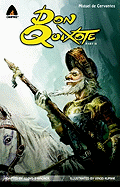
Ashley Swarthout Reviews Campfire's *Don Quixote, Part II*

Title: Don Quixote: Part II
Author: Miguel de Cervantes
Wordsmith: Lloyd S. Wagner
Illustrator: Vinod Kumar
Colorist: Vinod S. Pillai
Publisher: Kalyani Navyug Media Pvt. Ltd.
Publication Date: August 9, 2011

Don Quixote: Part II begins after Don Quixote has returned home from his many adventures. He spends his days in solitude and remembrance until he is convinced by his friend and squire, Sancho Panza, and the bachelor, Samson Carrasco, to embark on a new adventure. His journey with Sancho Panza begins in high spirits but is crushed when he finds his love, Lady Dulcinea, has been enchanted and turned into a peasant woman who no longer recognizes him.


The journey continues with many high points for the Don Quixote and his squire, most of which occur during a long stay with a duke and duchess. The Duke and Duchess create elaborate pranks for Don Quixote to work through, all without his knowledge. When Don Quixote and Sancho Panza continue on their adventures they are confronted by a knight who challenges Don Quixote by declaring his lady is more beautiful than Lady Dulcinea. Once Don Quixote loses the joust he returns home with instructions from the victor to stay there for a full year. However, after returning home Don Quixote becomes ill and passes away in his bed surrounded by his friends and caretakers.

The humor was entertaining, and the illustrations were captivating. Even if the reader has never heard of the classic novel written by Miguel de Cervantes, this graphic novel gives relevant information on the classic novel and is constructed artistically so as to potentially peek enough interest on the character of Don Quixote for readers to want to read the longer text. However, being that the protagonist is an older knight, and the journey seems to be doomed to fail from the start, young adults reading this text may have difficulty relating to Don Quixote and his mission.

There are a couple of the characteristics present in the best examples of young adult literature in Don Quixote: Part II. The reading of the graphic novel is fast paced. It quickly takes the reader on the journey alongside Don Quixote and Sancho Panza. The language is mostly simple but does include an occasional higher level word. For example, the word “vanquished” is used several times throughout the text, and the word “bravado” is used on page 28 to describe Don Quixote’s behavior with a lion he wishes to fight. The graphic novel is fast-paced in that it moves from action to action with little to no lull time between.

In addition to being fast-paced, Don Quixote: Part II‘s character, Don Quixote, is overly optimistic most of the time. There are very few instances where he is not optimistic. In the very beginning of the novel when he decides to leave for more adventures, he is not concerned about his age or about the rumors that he is mad. He says, “Within four days, my dear friend Sancho, we shall be on the road again, doing good and combating evil” (10). There are times when Sancho is not as optimistic as Don Quixote, and Don Quixote is quick to point out his friend’s fear. “It seems to me, Sancho, that you want to be perched on that tree to watch the bull fight without danger” (22).

Don Quixote: Part II is missing many of the characteristics that define the best young adult literature examples. The most obvious missing characteristic is that it is not written from the point of view of a young adult; furthermore, the protagonist is a much older, past-his-glory-days, mad knight, making it difficult for young adult readers to identify with him. While Don Quixote is quick to take credit for his perceived accomplishments, a characteristic of the best of best in young adult literature, his accomplishments are not really his. Every time he believes he has accomplished a grand victory or deed, it is actually out of folly or prank.

For instance, on page 62 Don Quixote believes that he has defeated Malambruno, thus removing the beards from the duennas when, in actuality it was a grand prank produced by the Duke and Duchess. The text does not have various genres and subjects. The text contains only a few basic ideas and they do not change during the course of reading. The graphic novel also fails to include a diversity of ethnicities and cultures in both text and illustrations. Another major missing characteristic is that it does not deal with emotions that are important to young people. There are many emotions included and experienced: Don Quixote’s desire to accomplish more great deeds, he becomes depressed when his “so-called” loved one does not recognize him, he is boastful when he believes he has been victorious, and remorseful when he is defeated.

Though Don Quixote moves through all these relatable emotions, it is all done so out of folly and humor, distancing the feeling of relation between the reader and the character. A reader may relate to the feeling of depression when rejected by a lover, but Don Quixote’s rejection was because the peasant was not his real lover. That mistake made by a mad man makes the feeling of depression no longer relatable.

I would recommend this book as an introductory text to the classic novel originally written in 1605 by Miguel de Cervantes. Though the character of Don Quixote is not relatable, he is entertaining and amusing. Being that the graphic novel adapted by Lloyd S. Wagner was also enjoyable and comical, it would be a great introduction to the waggish qualities of Don Quixote and humorous adventures that Don Quixote and Sancho Panza experience. For teachers this would be a recommendable addition to a classroom library for middle and high school aged readers in both English and History classrooms.

Travis Beck Reviews Campfire's *In Defense of the Realm*

Title: In Defense of the Realm
Author: Sanjay Deshpande
Artists: Lalit Kumar Sharma, Illustrator; Jagdish Kumar, Inker
Publisher: Kalyani Navyug Media Pvt. Ltd.
Publication Date: Copyright © 2011


The graphic novel In Defense of the Realm by Sanjay Deshpande is a cautionary tale of the dangers of waging war without the use of strategy. It demonstrates how a leader should exercise his or her power when making decisions that can either enhance his subjects’ lives or destroy their lives to the extreme outcome of death.


I would briefly like to talk about the setting of the story, which serves as its foundation. The setting is both physical and chronological. It takes place in what is called the Indus Valley Civilization around 2310 B.C. Once lost to the ravages of time, Dholavira is a 5000-year old city of what we call the Harappan Civilization. It is located on the island of Khadir, India. Lost and shrouded in mystery, the city began to reveal its secrets when it was excavated in the 1990s. Interpretation of life in Dholayira fell to our author, Sanjay Deshpande, an archeologist and heritage consultant who worked on sight from 1992 till 1998. He characterized the Harappian Civilization as having exceptional and intricate architectural advancements for its time. An example of this was a fully functional sewage system.


Though evidence doesn’t suggest that the Harappans were militant in nature, archeological evidence suggests that they were well-prepared for defense against enemies. The Harappans also developed intricate internal and external trade routes, water collection and storage systems and a solid economic infrastructure. Overall, the evidence points to a very prosperous society and civilization. However, Sanjay and his colleagues have not been able to shed much light on their system of government. Where the Harappan rulers authoritarian? How much power and control did they have and to what existent did they exercise it? So far experts don’t have the answers to these questions. “No great monuments, palaces, temples, or graveyards full of gold have been found.” (pg.4).


Most of the Harappan written records have been destroyed by the ravages of time; what little was found is on personal artifacts that have yet to be deciphered. The fictional tale of In Defense of the Realm is loosely grounded in these incomplete facts. However, it is important to be aware of these facts in order to understand the complexity of the world in which the characters live or the reader will be lost.


I found that the story centers around two main characters, Prince Meluha and Princess Kundalini. Both characters are on a journey from adolescence into adulthood. They are characterized as model teenagers (or the perception of what an adult would consider a model teenager). Struggling to cope with events that are happening around them, both characters are innocent, honest, naive, confused, and, above all, scared in the face of uncertain futures. They are on the verge of either ruling their perspective kingdoms or of utter failure. They seem to take very different journeys to their destinies.


Prince Meluha’s journey is more physical in contrast to Princess Kundalini’s’ which is more emotional. The similarity is that they both have to rely heavily on cognitive processes, constantly asking themselves “What is the smart thing to do?” In the beginning, Master Torana, a philosopher and teacher, is telling their story to three students. He is telling it in a third person dramatic narrative which seems to get lost in the middle of the story. The basic plot of the story is the conflict between the peaceful kingdom of Dholavira ruled by Prince Muluhu’s father, Raja Sanjaya and the invading army of the Akkadians ruled by King Sargon.


Sargon’s army invades and puts the city of Dholayira under siege. On a hunting trip at the time, Prince Muluhu is cut off from his kingdom. Prince Muluhu must then embark on a journey in order to rally support from two other kingdoms that are part of a five kingdom realm. The Prince must put aside childish notions in order to become an effectively ambassador and save his family and kingdom. The invasion results in the assassination of Princess Kundalini’s father, Raja Mahavindasa.


The assassination is orchestrated and perpetrated by the main antagonist in the story, a spy named Takshaka. Takshaka is later killed by one of his allies, a fitting end for the conniving character! The assassination plunges the kingdom of Harappa into chaos. Princess Kundalini relying on what her father had taught her rises from the ashes of this catastrophe and takes her place as Queen of Harappa. The Princess later devises a strategy to end the war with minimal casualties. The plan is successful and peace and prosperity is returned to the five kingdoms in the realm. There is a coronation and Prince Maluhu is declared ruler of Dholavira. The two rulers fulfill their arranged promise of marriage and end up ruling Harappan as a whole.


These two characters are free to take credit for their own accomplishments, though the amount of poise and humbleness they display seems unrealistic for their age. There is a diversity of ethnicities and culture displayed in the book.


The best example of this is that there are five kingdoms within the realm, all of which have distinct cultures. Within these kingdoms are cities with their own unique cultures; the fact that they all have to get along in order to coexist and eventually survive gives testament to the success of cultural diversity. The story is an optimistic one in that adolescents have the capacity to demonstrate maturity in the face of adversity. It shows the emotional struggles of coping that a young adult might have such as confusion, uncertainty and worrying about the future. It shows that change is often a good thing through the use of Junex vs. Senex with the young replacing the old in a natural cycle.


In contrast, as far as meeting the best of the best criteria for graphic novels, it seems to fall short. I didn’t get the feeling that the story was written from the point of view of an adolescent. As I stated earlier, it was written from an adult perspective of how we think an adolescent should be, not actually how they are.


This makes the characterization come off as false and unrealistic. I didn’t think that the pace was fast enough and the subject matter in the middle of the novel might bore young readers to the point of losing interest. I don’t think that the story had a variety of genres and subjects, at least not any of great interest to the average reader. What might be of interest to some readers are the historical references within the text but this is only geared toward a select secondary group of readers.


In conclusion, the narrator comes in from time to time, giving the reader historical facts about life in the Indus Civilization. This is an attempt to educate the reader, one of Deshpande’s main objects. However, I don’t think that it was consistent enough to be effective. I just didn’t get the feeling that the story was written from the point of view of an adolescent. With that said I would definitely recommend this to students interested in ancient civilization especially to those who are interested in India’s history.


I think this would be a good book for readers who are transitioning from the concrete thought processes into abstract thought processes. It is also a great tool for introducing moral values and believes, as the characters are always striving to do the right thing and the violence is never glorified.

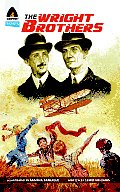
George A. Arreola Reviews Campfire's * The Wright Brothers*


Title: Title: The Wright Brothers
Artist: Sankha Banerjee
Publisher: Campfire Graphic
Publication Date: June 28, 2011

From an early age, Orville and Wilbur Wright were encouraged by their parents to learn as much as possible in the classroom as well as to seek knowledge outside the classroom. Their father wanted them not to be content with just the knowledge from school; he figured there was a lot to be learned outside the classroom too. The boys got their mechanical interest from their mother who had made a few appliances that she used at home. The boys also inherited their curiosity from their father, who used to travel throughout the country and brought back gifts from far away places which, encouraged their adventurous spirit. Their father introduced them to a small printing press in which Orville took interest.


However, within a short time, he outgrew the printing press and invested in another press involving his brother Wilbur, who he trusted and knew he could count on. Both brothers went on to venture into other interests that were successful. Their main goal was to build a plane and be able to fly. While there were many brilliant scientists working to build a plane, the Wright brothers, with less than a high school education, were successful because of their determination and ability to cooperate with each other.


The story follows the two main characters of Orville and Wilbur Wright and shares what these two brothers were like growing up. The graphic novel covers the main points of their lives, allowing the reader to see that not everything was perfect; they had their struggles along the way but were able to succeed. They found obstacles and people that did not believe they could accomplish such a task as flying. The Wright Brothers graphic novel provide interesting facts and the graphics making it easy to follow. Young adults could follow along without any problem because the text is easy to read and the graphics help to follow along.


The Wright Brothers graphic novel covers most of the characteristics of a graphic novel. It might not be part of the “best of the best,” but it does have the elements of a good graphic novel. Most of the book is good, but the story of the Wright brothers in this book is more of a summary of the Wright brother’s lives. There is minimal dialog in the book. The author summarized the story in 68 pages. The Wright Brothers book is an interesting one, but the author could have made into one of the best of the best if he would have put more effort into it. Young adults are intrigued with real life stories of people succeeding. Unfortunately the author cuts the readers short.


After reading this graphic novel, there were a few things that I learned about the Wright brothers. The book does meet the criteria as young adult literature book. I felt this graphic novel kept my interest, and it would be a good book for young adults around the ages of 8-12 to read. Prior to reading this book the only thing I knew about the Wright brothers was that they had been the first ones to fly a plane, but there is more to it. What young adults can learn from this book goes beyond inventing a plane. What it teaches is what was mentioned on the first day of class: “A hard worker would outwork a smart person.” This is precisely what the Wright brothers were able to do while there were many distinguished scientist were trying to be the first ones to fly.


While it was no easy task, and they did have many setbacks but that did not prevent them from accomplishing their goal. Every time something failed they were more determined to succeed. This is a good lesson for any young adult who has a dream.


I would recommend this graphic novel to students from grades 4th through 8th. The Wright Brothers is a positive story. It is very encouraging for young adults who aspire to be successful. The Wright brothers might not have finished high school and might not have been the brightest students, but they had the desire, determination, and work ethic to make their goals come true. The road to success was not a smooth one; they encountered many difficulties on their way to accomplishing their goals. If students are able to grasp the concept of hard work than this book is a success.

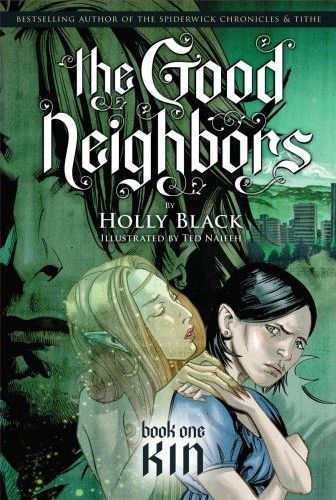
Karina Pena Reviews *The Good Neighbors Book One: Kin*


Title: The Good Neighbors: Book One: Kin

Author: Holly Black

Artist/s: Ted Neifeh

Publisher: Graphix

Publication Date: 2008

The Graphic Novel The Good Neighbors Book One: Kin is an introduction to the story of Rue Silver, which brings two different realms together. The realm of faeries is starting to slowly take over the human realm and Rue Silver may be the only one who can stop it. Furthermore, Rue’s father is accused of murdering a college student named Sarasa Narayan.


Luckily, Rue finds out that the real killer is the brother of Sarasa. After Rue’s mother goes missing she begins to get glimpses of the faerie realm. Rue knows she must find her mother, who was sent back to the faerie realm because of a promise her father broke. Rue finds out that she is a faerie and that her grandfather is the faerie king that she probably shouldn’t trust. In this book her journey has just begun.


She has to find a way to deal with her family, her boyfriend, and the two different realms. It is a well written graphic novel that people can read and enjoy. The illustration themselves do a great job on showing the depth of Rue’s emotions in her struggles.

The graphic novel has some characteristics of the best young adult literature but it doesn’t mean it is one of the best. It is written in Rue’s point of view, which makes it more relatable and understanding to young adults. One of her accomplishments in the book is that she finds out that Sarasa’s brother is the one who killed her and not her father. She can take credit for her accomplishments because she almost seems to be on her own. In the end of the book it does leave the reader hanging and makes the reader wonder what is going to happen next. Even so, it does leave the reader with an optimistic ending that Rue will find her mom and defeat whichever of the evil fairies is trying to take over the human realm.


The graphic novel slightly answers the question for Rue, “who am I and what am I going to do about it?” At the end she does find out that she is a faerie, and she knows she has to look for her mom and help the human realm. It has some emotions that are important and relatable to young adults like isolation and sadness.


The graphic novel is missing some character development on Rue and her friends; the novel doesn’t give any insight on her. Her emotions are seen in the illustrations but there is no way to relate to her in this book because of the lack of knowledge of her relationship with her parents or friends. Since it is the first graphic novel of the series and it has less emotional and character development, it may be that after reading the series the reader may be able to relate to Rue.
This book is great for young adults that are interested in mysteries and fantasy. It would keep young adult entertained and wanting to finish the series to see what happens and how it will end for Rue.


The reader will probably try to find a way to relate to Rue and what she is going through. The book does meet the criteria to be considered a young adults literature. Since it is the first graphic novel of the series the readers just get a slight introduction to what the story is about. I wouldn’t recommend anyone to use the book for education purposes. There isn’t much you can teach with this book.

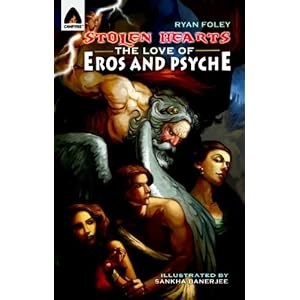
Myriam Martinez Reviews *Eros and Psyche*


Title: Stolen Hearts: The Love of Eros and Psyche
Author: Ryan Foley
Artists: Sankha Banerjee, Prince Varghese
Publisher: Kalyani Navyug Media Pvt. Ltd.
Publication Date: 2010

This graphic novel depicts the Greek myth of Eros and Psyche as told to a young woman to teach her the lesson of how a conflict between a mother and daughter-in-law unfolds. The novel describes the clash between Eros’s mother and Psyche, which develops as a result of Aphrodite’s jealousy of Psyche’s beauty. Aphrodite sends Eros to set a trap for Psyche; however, love develops between the two. In response, Aphrodite condemns Psyche to forever be miserable, which in turn causes Eros to deprive the world of love. A compromise is made in which Psyche is isolated from the world in a castle, where a man visits her at night. Unknown to her, that man is Eros; however, she is not allowed to see his face as part of the compromise to avoid her knowing who he is.


Psyche is induced to break her promise by her sisters, who encourage her to see his face. As a result, Eros leaves her. Psyche begs for help from Aphrodite, who places four conditions on her assistance. Psyche manages to meet three of the conditions despite their apparent impossibility. She fails on the fourth condition, but Eros realizes her efforts, saves her, and asks the gods to immortalize her. His wish is granted and they are allowed to live happily ever after. Overall, the novel does a good job of introducing the storyline and setting up the reader for what follows, but fails in that a reader without prior knowledge of the Greek myth would have a hard time filling the gaps in the story.


This graphic novel posses various elements of young adult literature. Among the ones present are that the young person is free to take credit for her accomplishments. Psyche is responsible for resolving her mistakes and is given credit for doing so. The novel is also fast-paced. The novel is also basically optimistic in that Psyche learns and matures as the story progresses, and it has a happy result. The novel also deals with emotions that are important to young people such as love, learning from mistakes, and believing in yourself to succeed.


The graphic novel is missing several characteristics of young adult literature. The novel is narrated by an adult and therefore is not written from the point of view of a young adult. The novel does not include a variety of genres and subjects because it is constrained to Greek mythology. Also lacking is a diversity of ethnicities and cultures. Perhaps because of the timeframe of the original story, the story is removed from reality in that other cultures are not present in the story. Also, while it touches on emotions that might be of interest to young adults, it may be difficult for them to relate to gods and other unfamiliar situations.


I believe the text could be of interest to young adults, especially those with an interest in Greek mythology. The colored dialogue boxes are very useful in helping the reader follow the story and identify who is speaking. The novel also gives a face to the characters of Greek mythology, which are normally described in text only. While it does not fit perfectly into the definition of a young adult piece, it has enough of its elements to qualify as one. For those that are not familiar with the original Greek story, it may be a way to introduce them to a new medium. However, for those that dislike Greek mythology, this may not be a book of interest to them.


I would recommend this book to young adults for the reasons mentioned above. The novel has enough of the elements for a good young adult piece to draw their interest and provide for a good read. For those already very familiar with the original Greek story, I would caution them to remember that it is a slightly different version that does not remain completely true to the original. I would recommend it to young adults especially for its lessons of love and of determination.

Pamela Antwine Reviews *The Swiss Family Robinson*

The Swiss Family Robinson is a great graphic novel. The story is about a family
traveling on a ship from England to Port Jackson, located in New South Wales. Their journey
on the ship becomes disastrous when they encounter a catastrophic storm.

I thought this graphic novel was great and effective for several reasons, including:
the easy flow of the dialogue, the sequence of events was timely, and the illustrations
were very effective. These were demonstrated on (pgs.44, 73).


In the graphic novel the character Fritz is the oldest of four sons, and appears to be a young man of sixteen. Fritz is able to take credit for his accomplishments on
several occasions. Most notable was when he felt his fate lay in the mouth of a shark. Young
Fritz had only been on the island for one day, and unaccustomed to shark attacks. The shark wasswimming towards Fritz when he was transporting the animals from the ship. As terrified as
Fritz was, he was able to shoot and wound the shark on his father’s command (p.29). Another
accomplishment was when Fritz captured and tamed an wild eagle (p.45).


The Swiss Family Robinson graphic novel is fast-paced because the events happen
quickly. In the beginning of the story, the family is on a ship. By the middle of the
story the family is on a deserted island, and at the end of the story, the family has
survived all their trials and tribulations. The fast pace of a graphic novel is important
because it keeps the readers attention. It also keeps the reader wondering and guessing
what will happen next.


The story is optimistic, because through it all, the family survives. They
overcame a lot of obstacles when the ship was caught in the storm by remaining calm and
patient. Their demonstration of optimism came through when the family prayed, “ Our heads
were soothed by the comfort of childlike prayer, and the horrors of our situation seemed less
terrible.” Their faith and family unity helped strengthen their ability to remain optimistic.
Time and change were demonstrated when the boys first arrived at the island:
They were young boys, and vulnerable to their surroundings. They then changed into
men after being on the island for ten years (p.53). They spoke with optimism just after
their father had completed making each of them a pair of boots (p.41). “ Yes, we’ve had a
pretty eventful time since we landed here all those months ago” (p.42).


The family’s fate of leaving the island once seemed hopeless. But now the family
has a choice to leave or remain on the island. Each person chooses to seek their own
happiness and fulfillment. This is witnessed at the end of the graphic novel,
when the boys are deciding what the future holds for them. Fritz, now a man of twenty-six,
has decided to marry Montrose and move to England. Ernest the second oldest, who appeared
to be thirteen in the first part of the story, now probably a young man of twenty-three,
has chosen to remain with his parents on the island, and continue to study science. Jack the
third oldest son, who appeared to be ten in the beginning of the story, also chooses to remain on
the island as a rider, and shooter.


Frank, the youngest son, who appeared to be eight in the beginning of the story, decides to go to school in London (p.81). The young men made their life choices with such maturity and optimism. This was noted as they made a toast to “ New Switzerland,” then Jack who said, “ Long life and happiness to those who make New Switzerland their home!” the second toast came from Fritz“ three cheers for England and Colonel Montrose! Success and happiness to those of us who return to Europe!” (p.80). Although what the future holds is unknown, these young men seem mature enough to handle all that comes their way.


The Swiss Family Robinson graphic novel deals with the emotions that are important to
young people. The novel demonstrates fearful situations and being able to overcome them. Most young adults at some point in their lives experience fear. In the novel there were incidents of the boys experiencing fear on the ship when the storm first came (p.5). They overcame their fear by going to the lower level of the ship where it was quiet, warm, and dry. Jack experienced fear
when he opened the closed captain’s door on the ship, and the attack dogs rushed towards him
and knocked him to the floor. Jack’s response was to hide his fear and remain calm and
everything worked out fine (p.10). Another important feeling young adults experience is
acceptance.

This was demonstrated when Ernest at age 13, was seeking approval from his father and
older brother Fritz. Ernest wanted to go hunting with them, but was not allowed because they felt he was too young. So one day they allowed Ernest to go hunting with them. Although the hunt was unsuccessful in capturing an animal, Ernest could not have been happier. He proved he was quite the hunter with his sharp instincts, and keen eye for spotting the wild animals. From then on Ernest, was always included in the hunt for wild animals. Young adults need to be able to read a graphic novel that deals with similar emotions they can identify with to maintain their interest and to be used as a teaching lesson.


The element missing of the young adult literature is the point of view of the of the young adults for the writing because the graphic novel was written from the point of view of the father. Another element missing is the absence of diversity of ethnicities and cultures because the family lived alone on the island for ten years. This graphic novel does meet the criteria for being considered young adult literature because it offers simplified words throughout the story. The quality of characters and setting are realistic and it reflects on the age of innocence embarking on a unfamiliar journey. The illustrations command your attention as does the story itself.

I would recommend this graphic novel because it demonstrates adventure,
family unity and a coming of age story. The novel makes good use of dialogue. The
sequence of events follows suit. The illustrations are very graphic and detail oriented.
This would be a great book for children ages eight through fourteen.

Lorenzo Licerio Reviews Campfire's *Call of the Wild*

Title: The Call of the Wild
Author: Jack London
Adapted by: Lloyd S. Wagner
Artist: Sachin Nagar
Publisher: Campfire
Publication Date: 2010

This novel gives the reader a great sense of the harsh life that both men and beast confronted in the great Alaskan wilderness at the turn of the century. It tells the story of a dog that, unwillingly, is taken into a great journey. Through this journey, he discovers the kindness and evil that is within some men and animals. It also helped him find his most basic animal instincts. This would serve him in surviving and discovering his true nature and calling in life.

I thought the story in this novel had a good flow to it. It kept me interested in the characters and plot. I think the liberal use of color in the artwork really kept the story alive. I enjoyed the novel overall and would recommend it.

The main character in this novel is the dog Buck. The story is told by Buck’s character and there are no children in it. I think the story was fast paced. It didn’t dwell too long on any particular subject, and that kept the story flowing. It dealt with the subject of dogs, which I think is always a favorite of young adults. I think the negative treatment of them will surprise and challenge the emotions of some children. The graphics did help in visualizing the story and helped in understanding it.

I don’t think there were many elements of the “best of the best” in this novel. There was no young person in the story for young adults to relate to. That takes out of the list most of the” best of the best” elements in young adult literature. That been said, I still think it has some good qualities.

Although it doesn’t have some of the criteria that identify most young adult literature, I still like some of the other elements within it. The struggle to survive is a theme that does resonate in the life of a teenager (not always to the extent of life and death, but surviving teenage life, with all its complexities.) There was some optimism in the dog surviving, form harsh weather, the fights for sled leader, to the mistreatment from the men. The dog also started to get the feeling that his true call was to roam free in a pack. He would get visions of that and would eventually join and lead a pack of his own. The graphics in this novel I think is another element that would attract the youth into reading it.


I think the colors were used adequately and in the right amount. There were times when the artist would use only white and dark lines, which would give the effect of the cold and snowy terrain of the area. Some times he would use bright colors in the portrayal of the mountains, forests and rivers. I especially liked the dark red color he used in the background of the Buck’s dream of the Indian warrior dancing around the fire.

Even though the novel had no young protagonist as the main character, I would still recommend this novel. I don’t think this would be a novel for anybody below middle school age. Some of the violence depicted against the dogs would be a little too graphic for younger children; especially the way the men treat dogs. I especially think high school students would enjoy the nature of life in those times.

Audrey Gleason Reviews *Amulet Book 2*


Amulet 2: The Stonekeeper’s Curse
Kazu Kibuishi
Drawn by Kazu Kibuishi
Colors and Backgrounds by Kazu Kibuishi, Amy Kim Kibuishi, Anthony Go Wu, and Jason Caffoe
Publisher: Graphix, an imprint of Scholastic, Inc.
Published: September 2009

A continuation from the first book of Amulet: The Stonekeeper, the second in the series, The Stonekeeper’s Curse, places the reader in the dangerous world of Alledia, ruled by malicious elves, where hope can only be found in a twelve-year-old girl, Emily. The graphic novel offers a nice mix of a well-developed storyline and artfully drawn characters.


The Stonekeeper’s Curse is comprised of the viewpoints of the young heroine Emily the Stonekeeper, as well as that of her younger brother, Navin. While both siblings have guidance along their separate, but intertwined journeys, the two adolescents take matters into their own hands and accomplish a great deal individually with help from newly-introduced friends and old allies from the previous book.


Emily and Navin run into elves, cursed townspeople that turn into animals, and wise, old, talking trees. Each of these characters has their distinctive culture, bring a uniquely fictionalized diversity to the story. When Emily and Navin have to part ways, the reader may see how each manages the difficulties of a particular situation the siblings are thrown into and watch the heroes grow. All the while, Emily and Navin struggle with internal conflict of confidence, acceptance of self, and uncertainty of where they may end up.


The intertwined journeys lead Emily and Navin to answers they are looking for, and answers they never knew the question to. The storyline is complex enough to keep the reader’s attention and moves with a cohesive fluidity, making this a possible consideration of being one of the “best of the best” in young adult literature.


As the second book in the Amulet series, it lacks a bit in the variety of subjects and genres. This could be due to how much guidance is seen given to Emily and Navin. Even the evil Trellis has a type of guide, Luger, in his journey to destroy Emily and gain the power of the amulet for himself. All the guidance that is given to the characters has one wondering if the heroes and villain can take credit for all their work.


Unfortunately, if the reader has yet to read the book’s predecessor, The Stonekeeper, they might find themselves lost for a while. The Stonekeeper’s Curse does not introduce main and assisting characters that were previously in the first book. The audience is expected to already be familiar with their backgrounds, and what roles they exactly play. Though, the graphic novel does hint to what happened in the previous story, the reader is left to put all the puzzle pieces together by themselves; which makes the reading of it that much more frustrating.


Overall The Stonekeeper’s Curse has a good entertainment value that young adult readers can appreciate. Emily’s gripping adventure will engage readers who will not only have their fill of a well-written work that captivates real human emotion, all the while entertaining with detailed pictures that is beautifully done through brilliant colors, and an eye for capturing the essence of each character’s feeling.


Any young adult that likes fantasy and adventure will have an enjoyable time reading The Stonekeeper’s Curse. As a warning though, the reader should read the Amulet series in sequential order, so that the story comes across entirely.

Patricia Hoban Reviews *Amulet Book 3*

Title: Amulet: Book Three The Cloud Searchers
Author: Kazu Kibuishi
Artist/s: Kazu Kibuishi
Publisher: Scholastic, Graphix
Publication Date: 2010

This graphic novel is the third book in a series of four. It may seem at first like a long read, but once one starts reading one really cannot put it down. The story is a continuation of the adventures of Emily and her friends, however, in this book the Elf King’s son, Trellis, and his companion, Luger, have joined Emily and company on their search for Cielis, the lost city. Many believe that Cielis was destroyed when the Elf nation attacked the Guardian Council, however, others believe that the Guardian Council moved the city in order to protect it. As the reader reads one learns why Trellis has asked for Emily’s help to defeat his father, and to one’s surprise it is because of the stones. The stones play a large role in the story as well. At first one may think that it is only a source of power for the stone keepers, but the story of the stones runs much deeper. As the journey continues, there are many elements who wish to stop the travelers, the Elf King and his “hunter”, Gabilan, who was sent to finish the job of killing the stone keeper Emily, as well as Trellis for “treason” in not completing his task of killing Emily.

The journey takes the travelers into the Golbez Cycle, a terrible storm, in which they encounter not only bad weather but horrible flying creatures called Wyverns. Once through the threat of the Wyverns and past other terrible natural weather elements, the travelers reach the beacon that will help them find the lost city. One last encounter with Gabilan tests the strength of Emily. Then it is off to the lost city of Cielis, where the Guardian Council is choosing their successors before they all die off.

Although the story is not told in the point of view of the protagonist, Emily, it does have the essence of a third person, omniscient voice. The readers are not given just one point of view but the point of view from different characters and even their thought process is clear, even through the illustrations you can gain an idea of what is happening in their mind, almost as if one were taking a walk through their thoughts. This story does fall under certain aspects of the “Best of the Best” because although Emily has not completely harnessed the power of being a stone keeper, when needed she acts to battle an enemy or protect a loved one using the training she has gained and is able to take credit for her accomplishments. Although it does take training to help her control her powers, in the end it is only her that can manipulate those powers with her feelings and thoughts.

Another aspect that the story falls under with is it is very fast-paced. The story has the feeling of moving very quickly to get to the climax, the climax being the finding of the lost city and the battle with Gabilan at the beacon. There is definitely different cultures and ethnicities in this story. Although it is a futuristic tale and deals with magic, one does meet all the different characters who are humans, animals, elves and even robots. Even though they are all different they all come together. This story is definitely filled with optimism. Emily has doubts in herself but knows that it is up to her in the end. Not only is it a journey to find the lost city but it is also a journey for Emily to find herself in a way, to find who she is as a stone keeper. Even as a graphic novel this story does deal with emotions that young adults deal with on a daily basis. Emily is in a constant struggle within of what should she do, who should she be, and definitely what she is going to do about it. She knows she has to do what is right, but she struggles with the fact that she must also protect her family.

I do not feel that this story lacks much as far as being categorized in the “Best of the Best” when it comes to YA literature. The story may have been a little easier to follow if was told from Emily’s point of view so that the readers could gain a better idea of what was going on in her mind and what was happening through her eyes. However, it would have been a completely different story at that point, maybe a different series. There is never really a point within this story per se where Emily begins to answer the question of “What am I going to do about it?” This could be because it is part of a series of books and that change may come within the fourth book. Other than that it does carry all the elements to be considered the “Best of the Best.”

I honestly feel that this story, no the series, meets and fits the criteria for young adult literature. Considering that the story is fast paced, optimistic, contains characters that have the different characteristics of YA literature and so many other aspects, I feel that this would be a good book for young adults to read. There are many instances in life where young adults deal with answering the epic questions, “Who am I and what am I going to do about it?” and this book also addresses at least one of those questions. I’m sure the fourth book addresses the other. Not only does it deal with things that fall into the “best of the best” but it is not a difficult read at all and the illustrations help to guide the reader and draw them in.

I have to agree with one of the reviews of this book from Jeff Smith, “Five-no three pages into Amulet and you’ll be hooked,” (Back cover). Now granted this may have been about the first book, but after reading this book I know I definitely want to get the others and read them.
I would definitely recommend this book too anyone who loves futuristic anime type stories and books.

The story is a tale of adventure, friendship and so much more. Honestly, I would recommend this story to anyone. It is kind of like watching a movie that ends only to carry on into a second one (kind of like the last Harry Potter movie). Once the reader reaches the end one wants to know what happens next. The hook is definitely there and it draws the reader in. It is a book that one can’t put down once they’ve started.

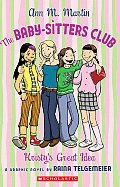
Fabiola Velasquez Reviews *Babysitters Club: Kristy's Great Idea*

Review of The Babysitters Club: Kristy’s Great Idea

Title: Babysitters Club: Kristy’s Great Idea
Author: Raina Telgemeier
Artist/s: Raina Telgemeier
Publisher: Graphix
Publication Date: 2006

The Babysitters Club: Kristy’s Great Idea is a graphic novel based on a book by the same name published in 1988. It deals with four friends, Kristy, Mary Anne, Claudia and Stacey, who are seventh graders that create a baby-sitters club. They come upon various issues related to growing up while they establish the club. It is an excellent graphic novel for young girls and is filled with topics to which they can relate.


The Babysitters Club possesses a variety of elements of young adult literature. It is told in the point of view of Kristy, who has the idea for the club. Her ambition about the club demonstrates her early maturity and responsibility. The idea of a club of this sort can affect young readers positively by inspiring them to create a similar small business. The value of hard work is an important theme in the novel. Kristy and her friends are great role models for young girls. The Babysitters Club is simple in its plot as well as its drawings. The author makes it easy for readers to follow along and her drawings allow for us to feel what the characters are experiencing. The pictures make the book an enjoyable read.

The graphic novel deals with subjects that young girls can easily relate to. Several of them include Kristy’s divorced parents and her absent father, as well as her mother dating. She cannot get used to her mom’s boyfriend, Watson, but as the novel progresses she gives him a chance and finally accepts him. Her family’s situation is a realistic one. Although her father is not in her life, the book portrays her mother as being very involved. Another common theme that readers can relate to is that of peers growing up at different paces, which is shown in the novel with Claudia. Of the four friends, she is already wearing makeup and seems more concerned about her appearance. Girls like Claudia, who are in a rush to grow up, are so commonly seen in schools.


Further in the book, Claudia shares with her friends that her parents did not give her permission to wear makeup although she is still wearing a pair of skull earrings she is not supposed to. This incident in The Babysitters Club portrays that young girls should be in no rush to grow up. One of the more serious topics of the book is Stacey’s diabetes. It is difficult for children at this age to deal with friends who are sick. Stacey is hesitant to share with her friends about her disease because she is afraid of her friend’s reaction. Fortunately, her friends are supportive and do not tease her like the friends from her old school. The novel is overall optimistic and gives an encouraging message to young readers.

One of the elements of young adult literature that I noticed missing from The Babysitters Club was a diversity of ethnicities. The colorless pictures make the girls races undistinguishable, which made me assume they are of the same ethnicity. I feel that the lack of different cultures is made up for by the different personalities of the characters. They are all unique in their own ways and contribute their abilities to the club.


The novel deals with emotions that are important to young people, especially young girls. It made me think back to my middle school days and the way I felt when I was dealing with similar issues. I find it difficult for the same issues, though, to be relevant to boys. I cannot imagine the novel being read in a classroom and being enjoyed by both genders. The book being an adaptation from another novel makes it complicated for it to include issues that are happening nowadays to young adults.

The Babysitters Club meets the criteria for being considered young adult literature. Its themes are simple but are those that are important to teenagers and its sequels offer the idea of taking the journey of growing up with the four girls with deeper themes. I would definitely recommend The Babysitters Club to young girls and to those who read the original series. I, myself, read the originals and found this adaptation very enjoyable. The Babysitters Club offers young readers the understanding of a few topics in real life while still making it a fun read.

C.C. Almodovar Reviews *Amulet Book 1*


Review of Amulet: Book One The Stonekeeper
Title: Amulet: Book One The Stonekeeper
Author: Kazu Kibuishi
Artist: Kazu Kibuishi
Publisher:GRAPHIX
Publication Date: 2008


“Szrak, Hweeee, Squawk, Krnch, and Szzt,” are just a few of the exciting words that are in this thrilling and adventurous first installment of Kazu Kibuishi’s book Amulet. Amulet is a graphic novel centered around a young girl named Emily and her little brother Navin. This story is very action packed. In the prologue, Emily’s family is driving to pick up Navin, Emily’s younger brother, when her father swerves to miss a broken down car and drives off the road. The car flips over and nearly falls off of a cliff. Emily and her mother, Karen, are the only ones to get out before the car slides off of the cliff with Emily’s father still inside, killing him when the car crashes at the bottom of the cliff.


The story begins with the family moving in to a new town and moving into an old family house to try to ease their financial needs. The first night in their new house, they hear a strange noise in the basement. Karen goes down to check it out and is abducted by a creature to a different land. Emily and Navin follow right behind her and start their journey to get her back. Emily finds a special amulet which has secret powers. She must learn how to use it and control it in order to help their journey. They make new friends along the way which help them on their journey to rescue their mother. Amulet is an exciting story. The fluid illustrations in addition to the text make it very easy to read. The illustration panels read almost like an action film using different angles to show movement rather than just being static. The quality of this book is superb and the story just draws the reader in and makes them want to continue reading the later volumes to find out what happens to Emily and Navin.


Amulet possesses some characteristics of young adult literature and also contains some of the “Best of the best” ideas. This story is centered on two pre-teens, Emily and Navin. It follows them on their journey into a new land in order to search for their mother. Many readers could identify with the story’s main character, Emily. She is an adventurous girl whom loves her family deeply. She has already lost one parent and will do whatever she can to protect her mother and brother. A “Best of the best” quality represented in the book is that Emily takes responsibility and gets credit for her actions. When she learns about the amulet and its powers, she has to accept them. She is given the responsibility of taking care of the amulet and controlling its power.


Another “Best of the best” quality is that the story is quickly paced, but it is not simple. The story has a good amount of action which makes it a fast-paced story and Amulet deals with a few serious topics. It deals with a death of a parent and also the kidnapping of the other. Emily and Navin are left alone in an unfamiliar land to rescue their mother. The language in the story is also very easy to understand and the dialogue is not very lengthy, which contributes to the fast paced story.


Another “Best” quality is that the story is optimistic. Emily and Navin’s father is dead and their mother has been kidnapped. Instead of crying at home they are taking action and try to rescue her. Whatever Emily is feeling she does not let it get to her. She wants to get her mother back and will do whatever it takes. Emily and Navin come close to rescuing her a few times but their attempts get foiled at the last minute. They, however, do not give up and try to come up with a different way of approaching the rescue. Amulet has a silver lining and even though this is the first book in the series, the readers can see that Emily is beginning to change from a little girl to a young responsible woman. These elements of young adult literature are use to help create an original story that can be both relatable and entertaining to you adult readers.


Amulet contains many elements of young adult literature; however, it does not contain them all. The story does not include different ethnicities and cultures, which is a “Best if the best” quality. Emily and Navin go into a new mysterious land that is somehow in their basement. They do not know where they are or what kind of different creatures they see. The story shares a little information about the new world but is very limited. The story also is focused on the main characters and their journey. This book is used to set up the story and it does not show or mention different ethnicities or cultures of our world. For readers who are not into fantasy, this book may be difficult for them to get into because it is not relatable in that way. Another “Best of the best” characteristic which is limited is the variety of genres and subjects that are relatable. The story deals with death of a parent and with the kidnapping of the other and how Emily is coping with them. These topics are family oriented and show readers that it is important to care for family. This story does not touch on other important topics to young adult readers such as drinking, dealing with the opposite sex, school, and puberty. This may limit the relatable content to its readers and have less of a connection to them.


This graphic novel is very interesting and entertaining, and I would recommend young adult people to read this book. It is very entertaining and is action-packed, which makes the reading flow easily and quickly. Since this is a series book, it will interest the readers to continue with the story and find out what happens to Emily, Navin, and their mother Karen. Like some quest-type stories, this book is optimistic and has a silver lining. You can see that Emily is slowly changing from a little girl to a young adult. She is becoming more responsible and taking credit for her actions. Even though this book does not have other topics that are in young adult books such as dating and puberty, this is still a very entertaining book. The title Amulet does not provide a lot of information to go off of but the prologue gives an abundance of information and illustrates the situation the family is in at the beginning of the story.


I would recommend this book to young adults both in middle school and high school. This book is easy to read without being boring. The story sucks the reader in within the first couple of pages and leaves you wanting more. I believe the easy flow will also help young adults read cover to cover. This is a quest or journey story, and I believe it can appeal to many people.


I believe even adults would enjoy this book and the Amulet series. It may not change the lives of people but it is very entertaining and can be a great escape from the real world.

Con Fatigue!

I has it!

Monday, July 18, 2011

San Diego Here I Come!

It's been slow around the interwebs lately, as many of my steady news outlets have personnel doing the same as I: Getting ready for San Diego Comic Con! This will be my second-ever SDCC. I went back in 2002(?) as editor-in-chief of the online comics and commentary site Outcast Studios.

This year I'll be going as a panelist, joining Katie Monnin and others in an academic session on comics and writing. I'll be wearing some comics-related clothing, but I will not be in full costume this year. Maybe next year, though!

Tuesday, July 12, 2011

Is Sookie Stackhouse Coming to a GN Near You?

Maybe. Maybe not. But, True Blood writer Charlaine Harris says she has a trinity of graphic novels featuring vampirishy characters up her sleep as her next big project. Click here for more info.

Sunday, July 10, 2011

Saturday, July 09, 2011

George O'Connor Introduces the Greek Myths in Only 10 Panels

First Second graphic novelist and pretty cool dude Gorge O'Connor loves his mythology and does a great job interpreting its characters and adapting its stories. He's published several Greek God-centric graphic novels, and here he gives an overview that could be used in tons of classrooms.

Wednesday, July 06, 2011

Monnin Talks to InsideHigherEd.com about Comics and Literacy

Click the link embedded in this post's title to hear my friend and colleague Katie Monnin, a professor at the University of North Florida, speak on comics and education. InsideHigherEd is a website that explores issues of working and teaching in academe and also hosts job positions announcements, so you can bet it gets some good traffic. So, Katie's words should reach a large audience of hopefully receptive ears and may be the first words some visitors will have heard regarding the connections between comics and learning.

Tuesday, July 05, 2011

2011 Harvey Noms are Public!


Josh Elder and the Reading With Pictures anthology are up for several awards. Great to see a comics-and-literacy text get some props!

39 Graphic Novels for Kids!

Folks at School Library Journal remind that tykes like comics just as much as Spiegelman scholars with this list.

Wednesday, June 29, 2011

Center for Cartoon Studies Granted $225,000

The school will use the finds to develop a center named after its founder, Inky Solomon. The Inky Solomon Center will help former students develop their projects.

That's a lot of scratch and should serve notice to anyone interested in grants that comics-related projects can garner significant dough, especially when a local community understand their importance and impact.

Tuesday, June 28, 2011

Darryl Cunningham's Evolution Web Comic Making the Rounds

I had no idea Darryl Cunningham has created a host of science-based comics. See his latest, "Evolution" here. Heidi at The Beat reports that he has also done a comic on autism, and you may alreasy know about his Psychiatric Tales comic.

DC to Stop "Writing for Trade"

That's the term given to the practice of writing long story arcs so they can be repackaged and sold as graphic novels, more specifically the trade paperback kind of GN. ICV2 reports that DC blames the phenomenon for slowing sales of pamphlet comics.

OK, but if you're gaining sales in GN formatted comics, what's the problem?

Read what DC bigwigs think by clicking the link embedded in this post's title.

I wonder if this move will affect graphic novels sales in a significant way. My initial thought is "probably not," since we all know pamphlet comics are not exactly a growth market, and GN's were chugging right along for a while there, though they've slowed too, and we do live in a "What have you done for me lately?" world.

Monday, June 27, 2011

Shreveport, LA, Librarian Wins Great Graphic Novel Giveaway at ALA 2011!

LeVette Fuller of Shreve Memorial Library won over $25,000 worth of graphic novels for her community! Gotta love these promotionals, sponsored by Bodart, Diamond, and GraphicNovelReporter.

Friday, June 24, 2011


For me, one of the most exciting features of J. Michael Straczynski’s (JMS) run on the Amazing Spider-Man (2001-2007) was his decision to give Peter Parker a stable job. The choice of occupation was a perfect fit, in my opinion, and illustrated JMS’s understanding of the best of the character. At his core and his best, Peter Parker is defined by the drive to do good, to set things right, to see responsibility and maturity triumph in an insane world that rewards the maniacal and offers riches and multiple escape routes to the careless and thoughtless who only think about “Number 1.”


Peter’s life, after the death of Uncle Ben, has been about troping blind grandstanding and braggadocio while always trying to make a positive impact on his world (Spidey is the quipy confident; Peter the worrywart) whether as penance or simply the only way he can live with himself and his social realities. Peter’s “life world” has always made him an excellent fit for the teaching profession, so JMS made him a substitute science teacher. Brilliant!

Shortly after JMS left Spidey in 2007, I stopped reading. The events and happenings since Staczynski’s efforts to re-establish the essence and ethos of the character seem shallow and false, what with the shirking of responsibility, odd choices, and the deal with Mephisto, Marvel’s top yet-still-third tier Satan analogue who hasn’t done much since toying with the Thing and the Beyonder in Marvel Secret Wars II.

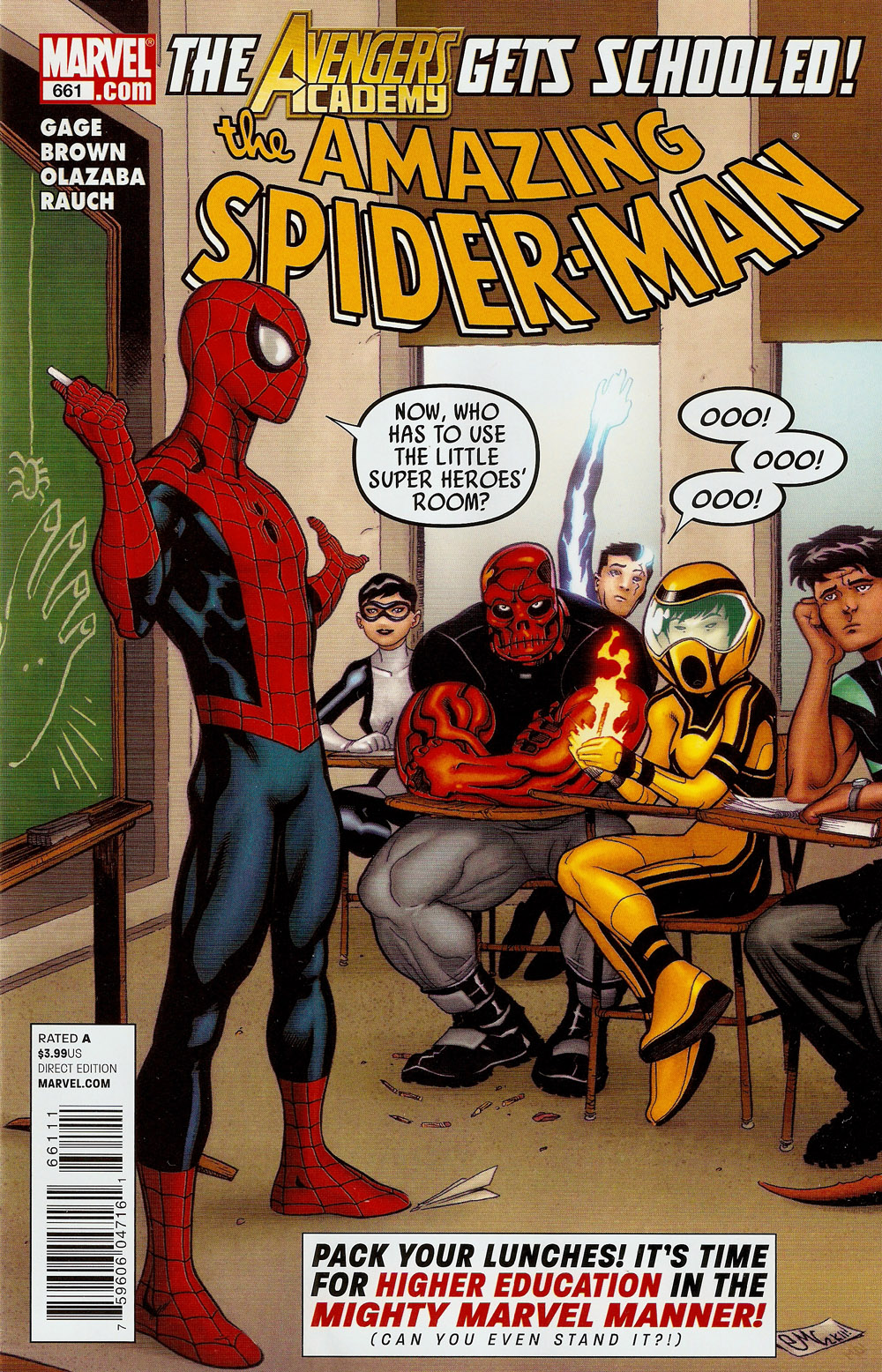
So, imagine my joy when I saw Avengers Academy guest-starring in the Amazing Spider-Man #661, complete with a cover image of Spider-Man at the chalkboard in front of the group of teen heroes (OK, the posture doesn’t represent the best of a constructivist classroom, but we can’t expect a cover artist to me 100% savvy in the was of contemporary pedagogy, can we?).

The issue finds Spidey’s new team, the Freedom Foundation, very busy with an overgrown ape and getting an assist from Hank Pym (Giant Man), the headmaster of Avengers Academy, who informs the heroes that his “core faculty” is busy tomorrow, so he needs a substitute. Peter is quick to volunteer, though Giant Man had the Thing in mind.

“Now hold on just one flippin’ second!” Peter retorts. “…I have a teacher’s license! I taught kids for a living!” he says with pride. So, he convinces Pym to let him substitute for a day.

While it is a joy for me to see Peter back in the classroom for reasons mentioned above, and it is nice to see writer Christos Gage acknowledging JMS’s contributions to the Spider-Man mythos, it is particularly interesting to see how the creative team handle the phenomenon of teaching. How intriguing is it? Enough so that I just used “particularly” as an adjective describing “interesting” even though I had to split the verb phrase to do it.

Media representations of teachers and teaching have been noticed by teacher educators. Catherine Carter, the English methods professor at my undergraduate alma mater, Western Carolina University, recently published an article on the topic in English Education in which she pointed out how misleading, if not dangerous, media messages about teaching can be for those young people considering the profession as well as for those already in the profession, who must not only gauge themselves against the impossible in reality, but also in what ad campaigns and Hollywood have construed as effective teaching. One of my doctoral mentors from the University of Virginia, Margo Figgins, has co-created a multimedia piece of scholarship exploring representations of teaching in film and warned of similar worries.

So, what does AMS #661 suggest about teaching, and is it healthy for the profession? What utility might this issue have for practicing teachers, teacher educators, pre-service teacher candidates and teacher-student relationships in general? Let us consider what the comic offers.

I have mentioned the cover, which might as well be a still from Welcome Back, Kotter or Head of the Class. The teacher is at the front of the room, holding chalk and referencing his scribble, while the class is scrunched together in a set of uncomfortable wooden desks in a sparse room. We have representations of the eager beaver, the silent but attentive, the bored jock, the bored every guy, and the jokester among the students. The eager beaver character is most eager to go to the restroom, though, as Spidey makes a silly mistake in asking the entire class who needs to use the “little super heroes room.” Where’s the hall pass? The toilet seat? I know you’re a sub, Peter, but shouldn’t you have a system in place? ;)

The cover image represents a rather media-saturated image of the student-teacher dynamic, complete with stereotypical modes of discourse, seating arrangements, students, environment, and rookie mistakes.

Inside the comic, Peter’s interaction with Hank Pym seems more about proving his worth than about a love of teaching, more about wanting to be acknowledged as an important member of his social groups than about making a difference. He is proud to have been a teacher and to have earned a license! So, when Pym says that “changes everything,” Spidey is happy, only to learn that Giant Man thinks he’ll be a good sub not only because of his credentials, but because of the mistakes he made as a teen hero too. Ever the Charlie Brown in spandex, the Spider-Man. He can’t win for losing.

His penchant for earning backhanded praise spins directly and immediately into a surely correlated aspect of his neuroses: self-doubt. A cut-away reveals Peter walking with friend Carlie. Hat is he most worried about?:

Peter: I mess up a lot, Carlie [….] It’s not a big deal…You learn from your
mistakes.

Peter: But these are at-risk kids. I could ruin their whole lives.

Carlie: Or save them.

The teacher as savior myth is clearly at work, or at least the possibility of it. Peter Parker as great white savior of kids on the fringe might bring to mind any number of films where it seems a naive white teacher gets students to learn math or literature after earning their trust and delivering a corny rap. The idea comes from Carlie, not the experienced Peter, so who is to know how Peter reacts to her attempt to comfort him? The writer gives us none of his reaction, instead cutting to the beginning of class the next day.

It should also be noted that this myth of the savior, especially the “great white savior” is complicated a bit since it is Spider-Man, not Peter Parker, who teaches the class. No one knows Spidey’s alter-ego, so he could be of any race or origin, though his students do seem to know his (Spider-Man’s, not Peter’s) history as a costumed presence in New York City.

While the “teacher as savior” utterance might offer means of exploring other instances of the concept in media and/or help pre-service teachers question their motivations and the realities of transformational pedagogy, so too can Peter’s worry inform our understanding of teaching, specifically who is worthy or qualified to teach.

Peter is worried that his mistakes make him a liability, that his proclivity for messing up means he has nothing to offer students, or, at worst, suggests he could ruin them. Teacher as “saint” is reflected in his reservations. There seems to be in popular thought the idea that a teacher needs to hide his or her past and be the perfect human being. I remember the gall my first principal felt I had for admitting to my students that “I had made mistakes before” when they asked me if I had ever smoked marijuana. We all know of instances of schools implementing policy restricting teachers from making their presidential preferences known to students, and a recent bill in Tennessee will ban homosexual teachers or those who want to explore social issues related to homosexuality from using the word “gay” in school grounds, the assumption from the bill’s sponsors most-likely being that “gay” somehow equates to “immoral” or ‘unchristian.”

I believe Peter’s brief interaction with Carlie offers much to debate and discuss for teachers and students and especially for teacher educators and their pre-service students. Who is best to teach?: The sinner or the saint? The one with troubled life experiences or the one with an easy life to date Are these binaries even possible? Why do we decide to become teachers in the first place? What drives us? How deep do the rivers of our motivations run? Do they go deeper than what the films like Dangerous Minds or Freedom Writers tell us about teaching? If not, where to go from there?

What’s more, what about our lives can damage kids? This is the other major myth to evolve from the exchange: tainted as one who can only taint. The “sinner” as negative destructive influence, as the one who can never be washed clean and can only pass along his natural depravity. The same questions as mentioned above still seem relevant. But, how often in the media is our teacher construct considered tainted, except by convention? Others taint the media-constructed teacher, not his or her life experiences. The teacher is the “rebel in the right” whereas the “establishment” only sees the troublesome rebel who must be removed. Apparently, principals ad parents prefer that someone more like the saint put all those pages back in the Anthology of American Literature. Robin Williams should keep on walking.
Despite the traditional desk layout and teacher-student proximics apparent at the beginning of Spidey’s class, the subject is on the more abstract side of the Bloom and Marzano scales. Spidey uses Socratic techniques to get the students to consider super-hero ethics.

SM: So let’s say you’e in school in your civilian identity. Some jock gives you a
wedgy in front of a bunch of hot girls and calls you “egghead”…What do
you do?

SM: You’re on a date. A bad guy robs a bank nearby…

As the students answer, another popular myth from film and television emerges: the child as genius; or, more aptly put, the “everychild” as smarter than the “everyadult.” They offer answers that seem beyond Spidey’s paradigmatic understanding of the super-hero dynamic, then they tell him how the hip new young people do it. Duh! The in-class portion of the lesson ends when Spidey is unable to adequately answer a question from a student who inquires as to what is the best use of one’s super-powers, fighting villains or helping fight disease through capitalizing on one’s abilities.

Meet the Amazing, Out-Of-Touch Spider-Man: Spectacular fogie.

As I have said before in an essay exploring concepts of education, multiculturalism, and acculturation in the X-Men comics, especially in the dynamic of Xavier’s School for Gifted Youngsters, any representation of schooling and teaching, whether it be from a Norman Rockwell painting, a film, or an advertising campaign, can help us inform our own notions of pedagogy and explore what messages are being marketed to us about teaching, teachers, and students – if we acknowledge the fact and directly, overtly, critically examine the images put before us.

What is especially interesting in comics – super-hero comics, anyway – is that overt pedagogical instances often morph into vocational education. Comics aren’t the only form of media playing with vocational education these days. Hogwarts is a school for wizards, after all. The students in the film Hero High mimic the X-Men in that they are in school to learn how to use their powers for good. But, comics offer multiple instances of not only vocational education, but on-the-job training. Pedagogy of place and pedagogy of experience often supersede the classroom dynamic. Dewey might very well love how young people learn in comics, if their field trips didn’t put them in danger of dying.

Spidey takes Avengers Academy on patrol, and soon enough the teens stop a robbery. Spidey evaluates their performance and offers critique. Students offer counter-evidence of said critique. A dialogic is created, and why shouldn’t it be? It’s an authentic instance and an authentic learning environment. And in such situations, experience matters. Spidey is able to save the children from the doubts and fears the “surprise villain” Psycho Man has instilled in them. Spider-Man fights those feelings too, along with more doubt, but overcomes them because he knows they come from external stimuli, not really from within. The issue ends on a cliffhanger, with Psycho Man turning the teens against the teacher using not fear or doubt, but by mind-controlling them through hate. It appears the teacher is about to become the student, the boys and girls will be the mothers and fathers of the man, who will die an old fogie death and make room for the new breed and culture.

One shouldn’t fault a comic book for having a comic book ending, of course. But it is interesting to examine the reasons behind why the in-class portion of the lesson was a struggle while the kids seemed to thrive in a situation that was real-life, in real-time, and concretely situated. Does this suggest a limit to the benefits of abstract, high-level thinking? A sort of proof of what Milton regaled as the benefits of active virtue? If students can’t test their philosophical opinions, what good are they? Mustn’t education have to come out from the desk, but also out from the classroom? Is a more vocational education experience better than one that is strictly academic? How does a constructivist approach fit into either or both dynamics, and how, if possible, can we blend pedagogies of experience with school building-centric curricula?

Or are we simply reading too much into yet another media construction of the student-teacher dynamic? Are we being influenced by more false truths about teaching in the final scene of the Amazing Spider-Man #661?


So, what does AMS #661 suggest about teaching, and is it healthy for the profession? What utility might this issue have for practicing teachers, teacher educators, pre-service teacher candidates and teacher-student relationships in general? It offers a unique, multimodal way “in” to discussing matters of the profession and perceptions of it. The issue is situated in the media but also strangely detached from dominant media discourses in the way that millions might see a film version of a comic, but only tens of thousands might read the source material. The comic book therefore is a media construct and may be subject to all that entails, but it might also benefit (or suffer) from the distancing effect of distribution and readership/ viewership, the insider on the outside. Teachers and students at the k-12 level and teacher educators and their pre-service teachers can mine that dynamic to get at the others regarding the phenomenon of contemporary teaching.

Thursday, June 23, 2011

Featured Speaker Gig Set for Albany, October 2011!

Not sure if I've announced this, but I'll be a featured speaker at the 2011 New York State English Council event this Autumn. The focus will be on character education. Here's a link to my bio as reported by NYSEC. I'm looking forward to it!

Warren, NJ, Librarian Talks about Comics and Critical Thinking

IDW's *Code Word:Geronimo* is Death of bin Laden Story in Gn Format

Anyone not see this coming?

What's more surprising to me is that this is, apparently, the first time I've mentioned the name Osama bin Laden on this blog, which has been running since 2006.

Wednesday, June 22, 2011

Diamond Bookshelf Offers Summer Reading Suggestions

Holy Crap, That's a Lot of Graphic Novel Programming

The American Library Association is showing mad respect! I gotta get in on some o' dat next year!

Image Comics to Run w/ DC's Rating System

If you're interested in that sort of thing, then this is big news for you. Since the CCA is a ghost now, the bigwigs in comics companies have come up with their own ratings systems. Warner Bros Comics' system is similar to gaming rankings, I guess. I'm not much of a gamer beyond Super Mario Bros.

MOCCA Exhibit Focuses on Eisner's NY, Runs through August 14

Ugh! Too bad my "Jewish American Literature through the Graphic Novel" class won't start until a few weeks after this....

ICV2 Looks at the Current State of Kids' Comics

UTEP/Office Tour 4 Reference

Sex Ed Comics Available @ Not Your Mother's Meatloaf

That's the name of the blog you can visit by clicking the link embedded in this post's title. A couple of ladies have spear-headed an effort to produce comics on various topics related to the health and sexual well-being of young people. You can see their recent call for shorts and get PDF's of the comics they've already published online too.

Sunday, June 19, 2011

You could win 20 Grand worth of Graphic Novels at ALA 2011!

The first giveaway was at the Texas Library Association. Now, Graphic Novel Reporter, Brodart, and Diamond are targeting the national American Library Association even being held in NOLA (that's :New Orleans, Louisiana" to the unhip) June 23-28. I know a lot of very cool people who are going to be there, and I just wish they could have taken me with them.

Sometimes I feel like I might be a member of all the wrong professional groups. Or maybe just not all the right ones. Anyway, here's to all those sexy librarians who will be rockin' it in the Big Easy, graphic novel style!

GNR posts "Hottest GN's" for Summer 2011

For those of you caught up on your review piles....

Meet the Graphic Novel Gurus

Mary Klucznik works in New York state's Chttenango High School and builds her graphic novel library with the help of student experts. Great idea!

Wednesday, June 15, 2011

Kids Using Comics in New Delhi, India, to Talk About Corruption, Social Issues...

....through something called the World Comics India Organization, a sort of Indian Comic Book Project. How quickly the U.S. can get left behind these days, eh?

Friday, June 03, 2011

Saturday, May 28, 2011

NYU Library *Marvels and Monsters* Exhibit focuses on Asians in Comics

From the link:

"Marvels and Monsters:
Unmasking Asian Images in U.S. Comics, 1942-1986
May 26 - August 19, 2011

Over four decades that included some of the most turbulent times in our nation's history, science fiction author and cultural studies scholar William F. Wu painstakingly gathered an archive of comics distinguished not only by its size and reach, but by its scope: It is perhaps the world's only, and certainly the largest, collection of comic books featuring images of Asians and Asian Americans...."

Friday, May 27, 2011

Evensen Interviewed @ *Norse Mythology blog*

Part one of an interview with my friend and collaborator Erik A. Evensen has been posted at Dr. Karl E. H. Seigfried's blog on all things Norse mythology. Erik hosts questions about his book Gods of Asgard, which debuted in 2007 and is a graphic novel adaptation of the Norse myths, recently brought to the fore by Summer blockbuster Thor movie. "Brought to the thoor," you might say. :)

Anyway, check out the interview! When the next installment/s post, I'll help you to it/them as well.

Wednesday, May 25, 2011

Sneak Peak at Second Volume of Twilight, the GN

Me, I've replaced vampire-themed texts with Life Sucks and Fat Vampire in my YA Lit course. Students had mixed feelings about the quality of the first GN adaptation, and I remember having a hard time finding nice things to say about it when I was looking for reviews for the rationales project. For those interested, the book will hit the shelves in October of 2011.

Thursday, May 19, 2011

Proof I Ain't Just Spoutin' Off @ the Mouth!

Super-Powered Word Study is a finalist for the 2011 Next Generation Indie book Awards. I'm going to blog about this more once I know what I can and can't say (and when). In the meantime, feast your eyes on this nice certificate for verification that I ain't no liar!


Sarah Lightman's Mini Documentary: Women in Comics

Some of this stuff is so "like, whoah!" Click the link embedded in this post's title to view the documentary.

Super Heroes As Characters in Famous Paintings

"Low" (art) and behold (high art). ;)

"Graphic Novels Big Draw at Mountain View Public Library"

Or so says the title to an article posted on Mountainviewpatch.com. The Mountain View of focus is in California. Thanks to facebook friends Comic Book Literacy for the link.

GEEKDAD.com Profiles Yang's Latest GN: _Level Up_

Gene Yang has another kids/adolescent-friendly graphic novel debuting in a few months. Level Up tells the story of a kid who want to live a life full of video game playing while his dad has made it clear an M.D. should be in the boy's future. Yang says it's also another example of "Pop Art," or comics' proclivity for exploring father/son relationships. Well, he doesn't use the term "pop art" exactly. I think Art Spiegelman coined that partifcular usage of the phrase....

Wednesday, May 18, 2011

Telegraph Article on Boys and "Long Books"

"Teachers are giving up trying to make boys read long books because they cannot get past 100 pages, new research as found."

That's the lead sentence to this article from the British newspaper, anyway. Apparently some research suggests that boys are turned off by long books -- defined in the article as 200+ pages -- simply because they are long.

It's more of the "boys can't sit still" stuff, but there are some good points about motivation and interest that come from the article as well.

The whole things reminds me of that body of "comics as a conduit" research that suggests that comics readers go on to read more and more varied literature than non-readers. The article does mention comics as a means of helping boys develop a love a reading.

Every Elfquest Comics Ever Available Online

Thursday, May 05, 2011

NKU To Dabble in Awesome

According to Rich Shivener, Northern Kentucky University has chosen David Mack's Kabuki: The Alchemy for its 2011 Book Connection Program. This means that every member of the incoming freshman class will be reading and responding to a graphic novel.


Sweet!


I know LSU was considering doing this with Persepolis a few years ago, but I don't think they went through with it. I'm not sure if NKU's effort marks the first time a graphic novel has been the central text of a freshman entrance experience, but the "common text" idea is one that has become pretty popular over the last decade or so, so maybe it won't be the last.

Houston 4th-Graders Create Comic Book Depicting Harm to Classmates

An unfortunate story that the Houston Fox outlet is exploiting, but what is heartening is that so many players in the situation are being mature about things. Even the newscasters seem sincerely concerned about the story and what it might suggest about youth culture. Click the link embedded in this post's title, watch the video, and tell me if you don't feel the same.

A New Poster for my Office Door

Click the image to make it larger and legible. I try Prezis, posters, and leading by example to help my students see that teacher education shouldn't be a breeze, because the challenges of k-12 education are vast and need intelligent, motivated, progressive young educators who have been challenged to think and excell, not given hand-outs or spoon-fed their degrees and grades.


Stupid Politician Attacks Neil Gaiman

Gaiman, who is apparently a "pencil-necked little weasel" in the eyes of Minnesota Republican Matt Dean, is under fire from Dean for a $45,000 speaking fee he charged Stillwater Library last year. Gaiman says he gave the fee to charity. That's not good enough for Dean, who must be eyebrows-deep in an election campaign for douche-iest state representative.

I think he'll win. But he is a Republican in the 21st century, so the competition will be fierce.

Tuesday, May 03, 2011

Mike Cotton Leaves Wizard

After 11 years, Wizard writer Mike Cotton is leaving the company for other opportunities. The Beat writes, "it was commonly said that when Cotton left the Wizard ship it would be nothing but an empty hulk drifting the seas." I am one who certainly agrees with that statement, but I have to admit that it has been at least 5years since I've opened a copy of Wizard.

Here's my Mike Cotton story, and I think it says a lot about the man, who really is a fine writer. I don't know if he remembers this, but I do:

The only time I've been to SDCC was back in around 2001 or 2002. I happened by a row of tables near the Wizard booth. I remember a spinning wheel that featured give-aways, and I'm pretty sure Lou Ferrigno was nearby too. I happened to see a gentleman wearing a name tag. "Wow, that's Mike Cotton!" I mouthed silently, only to see the fellow reading my lips and display a little bit of blushing pride and humility at my awe.

Colin Upton Does Comics on Diabetes

Anyone who has or knows someone with diabetes will appreciate these autobiographical comics from Colin Upton. Heck, so will anyone seeking a sympathetic voice regarding food and weight issues in general. The Beat has a preview of "Diabetes Funnies" here.

Monday, May 02, 2011

Adam Hines Wins Another for _Duncan the Wonder Dog_

This time the graphic novel takes home the LA Times Book Prize for best GN.

Wednesday, April 27, 2011

Scheduled to Skype with a ELA Methods Class at NCSU


I'm hyped about my scheduled Skype with a class of middle grades pre-service educators tomorrow. That the audience will be college students from North Carolina State University makes it a little more exciting, as I am a native Old Hickory Stater. All my k-12 teaching experience took place in North Carolina as well. We'll be talking graphic novels and literacy/education, of course.

"Hamburgers for One," 2011 Eisner Nom for Best Short Story, Now Online for Free

Click the title to this post to access the 24-page sequential art narrative short story by Frank Stockton. I'm especially interested in this one because it also falls under the YA Lit category.


Heidi MacDonald calls it "the almost painful story of an awkward teen boy and his attempts to interact with his world."

ALA hosts Artist's Alley

For the first time ever, the American Library Association has hosted an artist's alley -- a place where comics creators can sit and sell their stuff while also chatting up fans -- at its national convention. New Orleans was the premiere of the happening, which surely suggests the interest in comics and literacy is still going strong among those who have been among the earliest and staunchest advocates of the sequential art form.

Kudos to my librarian friends for keeping up the great work!

Monday, April 25, 2011

"Lois Lane, Reporter" Comic

A feminist revisionist take on the mythos of Lois Lane? Just more realistic? Entertaining, for sure.

2011 Hugo Awards Noms Released!

There's the graphic novel category, of course, but several other comics are featured too.

Audrey Niffenegger's *The Night Bookmobile* Selected as "One Book, One Conference" Selection for Recent TLA

Learn more here.

Maureen Bakis Talks Comics in the Classroom

Maureen is a high school teacher at Masconomet Regional High School in Topsfield, Massachusetts, and is doing some writing for Graphic Novel Reporter.

Thursday, April 21, 2011

Dorkly.com's 5 Advertisements from Watchmen...

Watchmen, that troper of tropes, proves that a troper of tropes is pretty easy to trope. I'm tropin' out on this! Trope, trope, trope....


Texas Librarian Wins $20G Worth of GN's!

At the recent Texas Library Association's state conference, Eduardo Zepeda won the "Great Graphic Novel Giveaway" prize, which contained more than 700 graphic novels. Zepeda is the librarian for Weslaco Public Library. Click here to learn more.

Another Eisner Nom 2011 Puts Work Online for Free

This time it's AdHouse's Afrodisiac that one can read gratis, following in the footsteps of Dave Kellett, who recently posted his book Literature: Unsuccessfully Competing with TV Since 1953 for free-of-charge online viewing as well.

Both titles are Eisner nominees for best humor production.

Meltzer, Gaiman Speak Out for Libraries

The American Library Association has released an image of authors advocating for libraries, and among them are Brad Meltzer and Neil Gaiman, who join Alan Moore as outspoken proponents por las bibliotecas. Click this post's title to see the poster.

Tuesday, April 19, 2011

Vanessa Davis' Passover Webcomic

Material for my Jewish American Literature: The Graphic Novel course just keeps popping up! :)

"Graphic Novels for Kids with Autism"


This article from Autmont.com, the website for an organization serving the Montgomery County, MD, community, lists some great graphic novels that parents recommend for kids with autism. PARENTS, I said!

Monday, April 18, 2011

George R.R. Martin Talk Comics and Reading Circa 1981

Another story of an accomplished adult who learned to read through comics! Hotcha!!

Thursday, April 14, 2011

2011 Kids' Comic Convention Programming Now Up!

See what Alex Simmons and friends have brewing for the April 16 event!

Wednesday, April 13, 2011

Columbia, Harvard Show Love for Graphic Novels


On April 14, 2011, Columbia University will host "An Evening With Neil Gaiman" that will also feature Paul Levitz, who is a lecturer at the Ivy. Details here.

Sixteen days later, Harvard will host a series of speakers at the "Comics and Muslim Identity" event, sponsored by the institution's Center for Middle Eastern Studies.

Sequential Tart Writers Have High Praise for *Kill Shakespeare* Series

Monday, April 11, 2011

John Weaver Offers Advice for Comics in the Classroom

GNR asks high school teacher John Weaver about teaching graphic novels in the classroom. Weaver has taught Watchmen and V for Vendetta, and he is currently exploring one of my other faves, Incognegro. See the interview here.

Elementary Kids Offer Praise of Classics

Read "From the Mouth of Babes: A Word About Classics in the Comics Format" over at The Graphic Classroom blog. Video included!

Kellett's 2011 Eisner-Nominated _Literature!_ Free Online

Dave Kellett has made his recent Eisner-nominated comic Literature!...Unsuccessfully Competing Against TV Since 1953 available online. The book is a collection of strips and is nominated for "Best Humor Publication." Read it here!

Ian Gordon Puts _Comics Strips and Consumer Culture: 1890-1945_ Online For Free!


The book of comics scholarship can be yours to read and share by clicking here. It was first published in 1998 by the Smithsonian Institute. Thanks to the good doctor for allowing open access to a fine work.

Thursday, April 07, 2011

2011 Eisner Award Noms Released


Martha Cornog on "Why comics Make Reading Fun"

This article from the most-recent Graphic Novel Reporter update features tons of advice for parents and those interested in kids' literacy and also offers an overview of topics of import on the comics-and-literacy discussion. Highly-recommended reading.

Wednesday, April 06, 2011

Kelly Gallagher Talks Reading, Kids

Here's a great interview with a teacher who really gets it when it comes to reading and kids. He basically makes a pro-comics argument with every word he says.

_Tin Tin_ Racism Case *CAN* Be Heard in Belgium

Thanks to Sturge for the update on the case that Mbuto Mondondo has brought against Tin Tin in the Congo. Apparently if an image offends, it can be deemed illegal and harmful in Belgium. While I may not support the racist images in the book, I do not support the book being banned in any way. But, I'm an old-fashioned American who likes freedom of speech, not one of those hyper-lefty liberals like Lindsey Graham.

Monday, April 04, 2011

Harvard Workshops Focus on Muslim Identity in Comics

Did you know the Harvard University Center for Middle East Studies has been giving workshops on Muslim identity and comics? Me neither, but there's one coming up in late April, and it is free and open to the public!

Editors of *Icons of the American Comic Book* Seek Submissions

See the PR below: Dear Comics Scholar: Randy Duncan and I would like to invite your contribution to a new anthology we are editing for ABC-CLIO called Icons of the American Comic Book. The project will include 100 entries spanning the breadth of comics culture, including the characters, creators, titles, and other facets that have achieved iconic status with the American consciousness. For your contribution, we can offer you an honorarium: · $90 for each of the entries designated to run approximately 5,000 words · $50 for each of the entries designated to run approximately 2,750 words We are looking at an initial deadline of August 1, 2011. Our aim with Icons of the American Comic Book will be to provide fresh insights into the significance of some of the most widely known and fascinating popular culture icons of the 20th and 21st centuries. Each entry will discuss the iconic significance of its subject and should be both more detailed and more entertaining than the conventional encyclopedia entry. More than simply character or creator biographies, the entries will provide in-depth explorations of the icons as products of and an influence upon American culture, informed by scholarly research. Below is our list of entries (a strike through indicates an entry that is already assigned).
[Please contact the editors at the given e-mail address for a list of open entries]
If you are interested in contributing, please let us know what your primary as well as any secondary preferences would be, but do keep in mind that we will need your initial draft(s) by Aug. 1. Along with each entry you request include a brief statement of your qualifications to write on the subject. Please respond to msmith@wittenberg.edu Our publishers have stipulated that we should consider our primary audience to be students doing research. To that end, each entry must include a bibliography and one (or more) sidebars of 50-300 words each. (These considerations must be included within the word counts.) We’re also planning to invite some guest contributors to 1) read and comment on the draft entries, 2) contribute a sidebar, or 3) even collaborate on the entry itself on several key entries. For example, comic book writer and editor Mark Waid (Superman: Birthright) might be enticed to act as a consultant on the Superman entry. Each guest’s role will depend on your comfort and willingness to work in such an arrangement. Thank you and we look forward to hearing from you soon, Matthew J. Smith and Randy Duncan

Gene Yang joins Hamline University's MFA Program, as a Professor!


Hamline's MFAC (Master of Fine Arts in Writing for Children and Young Adults) program is expanding to include graphic novels and comics.


Very, very cool.


For more info on Hamline University, a graduate school of liberal studies based in St. Paul, MN, click here.

Saturday, April 02, 2011

Decatur, TX, Librarian Talks GN's, Rural America

Denice Herrera talks access, comics, and teen readers from the perspective of a rural librarian.