Stickermule

Custom Stickers, Die Cut Stickers, Bumper Stickers - Sticker Mule

A Public Service Announcement! ;)

A Public Service Announcement! ;)
Showing posts with label mythology. Show all posts

Wednesday, July 27, 2011

Myriam Martinez Reviews *Eros and Psyche*


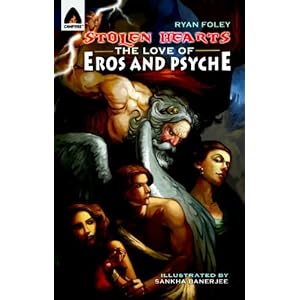
Title: Stolen Hearts: The Love of Eros and Psyche
Author: Ryan Foley
Artists: Sankha Banerjee, Prince Varghese
Publisher: Kalyani Navyug Media Pvt. Ltd.
Publication Date: 2010

This graphic novel depicts the Greek myth of Eros and Psyche as told to a young woman to teach her the lesson of how a conflict between a mother and daughter-in-law unfolds. The novel describes the clash between Eros’s mother and Psyche, which develops as a result of Aphrodite’s jealousy of Psyche’s beauty. Aphrodite sends Eros to set a trap for Psyche; however, love develops between the two. In response, Aphrodite condemns Psyche to forever be miserable, which in turn causes Eros to deprive the world of love. A compromise is made in which Psyche is isolated from the world in a castle, where a man visits her at night. Unknown to her, that man is Eros; however, she is not allowed to see his face as part of the compromise to avoid her knowing who he is.


Psyche is induced to break her promise by her sisters, who encourage her to see his face. As a result, Eros leaves her. Psyche begs for help from Aphrodite, who places four conditions on her assistance. Psyche manages to meet three of the conditions despite their apparent impossibility. She fails on the fourth condition, but Eros realizes her efforts, saves her, and asks the gods to immortalize her. His wish is granted and they are allowed to live happily ever after. Overall, the novel does a good job of introducing the storyline and setting up the reader for what follows, but fails in that a reader without prior knowledge of the Greek myth would have a hard time filling the gaps in the story.


This graphic novel posses various elements of young adult literature. Among the ones present are that the young person is free to take credit for her accomplishments. Psyche is responsible for resolving her mistakes and is given credit for doing so. The novel is also fast-paced. The novel is also basically optimistic in that Psyche learns and matures as the story progresses, and it has a happy result. The novel also deals with emotions that are important to young people such as love, learning from mistakes, and believing in yourself to succeed.


The graphic novel is missing several characteristics of young adult literature. The novel is narrated by an adult and therefore is not written from the point of view of a young adult. The novel does not include a variety of genres and subjects because it is constrained to Greek mythology. Also lacking is a diversity of ethnicities and cultures. Perhaps because of the timeframe of the original story, the story is removed from reality in that other cultures are not present in the story. Also, while it touches on emotions that might be of interest to young adults, it may be difficult for them to relate to gods and other unfamiliar situations.


I believe the text could be of interest to young adults, especially those with an interest in Greek mythology. The colored dialogue boxes are very useful in helping the reader follow the story and identify who is speaking. The novel also gives a face to the characters of Greek mythology, which are normally described in text only. While it does not fit perfectly into the definition of a young adult piece, it has enough of its elements to qualify as one. For those that are not familiar with the original Greek story, it may be a way to introduce them to a new medium. However, for those that dislike Greek mythology, this may not be a book of interest to them.


I would recommend this book to young adults for the reasons mentioned above. The novel has enough of the elements for a good young adult piece to draw their interest and provide for a good read. For those already very familiar with the original Greek story, I would caution them to remember that it is a slightly different version that does not remain completely true to the original. I would recommend it to young adults especially for its lessons of love and of determination.

Saturday, July 09, 2011

George O'Connor Introduces the Greek Myths in Only 10 Panels

First Second graphic novelist and pretty cool dude Gorge O'Connor loves his mythology and does a great job interpreting its characters and adapting its stories. He's published several Greek God-centric graphic novels, and here he gives an overview that could be used in tons of classrooms.

Friday, June 03, 2011

Friday, May 27, 2011

Evensen Interviewed @ *Norse Mythology blog*

Part one of an interview with my friend and collaborator Erik A. Evensen has been posted at Dr. Karl E. H. Seigfried's blog on all things Norse mythology. Erik hosts questions about his book Gods of Asgard, which debuted in 2007 and is a graphic novel adaptation of the Norse myths, recently brought to the fore by Summer blockbuster Thor movie. "Brought to the thoor," you might say. :)

Anyway, check out the interview! When the next installment/s post, I'll help you to it/them as well.

Thursday, February 10, 2011


Joseph Bruchac and Will Davis's graphic novel Dawn Land (:01, 2010) is an adaptation from Bruchac's 1993 novel of the same name. The prose must be amazing if the sequential art narrative is any reflection of it.

In Dawn Land, Bruchac pulls from his own Native American heritage and mythos and the mythoi of other indigenous North Americans to craft an epic on par with any other age's classics: The Odyssey, The Iliad, Lord of the Rings, Star Wars (Sky Walker is a character in Bruchac's text and helps us see where Lucas' inspiration for the name may have originated), Bone -- you name it.

After the giant Stone People kill Young Hunter and Weasel Tail's parents, they embark of different paths. The older Weasel Tail, once his brother's protector and marked by one of the giants, becomes their herald and their hunter, leading them to villages where they can murder and eat the inhabitants. Young Hunter, always smaller than his peers, on the other hand, grows to embrace the noble warrior role, the champion of humanity (which includes all elements of nature in the lore of this text).

Weasel Tail, lusty, murderous, and mentally ill, and his brother meet again shortly after a cave painting has shown Young Hunter the climax of his current journey. Weasel Tail, now named Holds of the Stone, redeems himself in the final battle with the giants, sacrificing himself to save his brother, who through new technology (a bow), innovation (which he tips with stone arrow heads), and the support of his ancestors, defeats the last of the imposing man-eaters.

As such, Dawn Land appears to be a tale set in an in-between, a liminal space. Young Hunter is told as such by his mentors. It is easy to read the tale as an allegory about progress and technology and even to see the giants as imposing Europeans set on changing the customs and cultures of the land, but it should be made clear that the giants are as much a part of the landscape as every other natural element in the text. They're not the white marauders from a foreign land; they're ancient beings whose time has passed, like the other ancient ones -- giant bears and sabretoothed cats -- that Young Hunter and his trusty dog companions -- Agwedjiman, Pabetciman, and Danowa -- must vanquish to their place in history.

There are some prose pages after the comics narrative that work to inform readers about Bruchac's culture, his process as a writer, and how they intersect. There are also several resources mentioned where one can learn more about the Wabanaiak people of Ndakinna/New England.

This graphic novel is rich in heritage and mythology, and, simply-put, is a must-read and one of First Second's best graphic novels to date.

Monday, July 19, 2010

A Campfire Classic vs. A Campfire Mythology

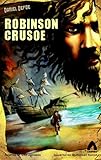
Campfire has sent me a slew of review copies, and I keep being generally impressed. Tonight, I'm going to compare and contrast a book from their Campfire Classic line, Robinson Crusoe (adapted by Dan Johnson, illustrated by Naresh Kumar, colors by Anil C.K.) with a book from their Campfire Mythology line, Ryan Foley's Legend: The Labors of Heracles (illustrated by Sankha Banerjee, colors by Ajo Kurian).


It's not an unnatural pairing considering the religious overtones in both. Crusoe is sort of a 18th century Jesus, and in the early days of Christianity, it wasn't rare for Greeks and Romans to confuse Jesus with the gods in their pantheon. There's more than a little Christ in Hercules.


Regarding the Robinson Crusoe adaptation, Christianity rules the day. Those looking for the critique of government and economy will have to squint a bit, but those who like to read the text as a Christian allegory or Christian coming of age story will be most pleased. Indeed, I can see the text having much utility in Christan schools or Sunday school classrooms.


The coloring in both texts continues the Campfire tradition of offering an intriguing palette. At their best, the images seem to be painted and vibrantly give the pages a warm, active glow. This is especially true for the Heracles book. In contrast, the colors in Robinson Crusoe sometimes live up to Campfire's standards but other times look more like an overdone oil pastel, muddy and ragged. To the artists' credit though, a haggard, rough, jagged line is appropriate when illustrating the trials and tribulations of a mere mortal. Heracles, a man-god, is better suited for beauty.


While the adaptation of Robinson Crusoe sheds a lot of nuance from the original text, Ryan Foley more skillfully parses elements of Hercules' mythos. While I wonder about the historical accuracy of having a young Greek boy paired with a female mentor, Foley frames the narrative such as lovely Lady Demiarties tells the story to young Prenditus, who asks questions at times that Lady D simply says must be answered another day.


Foley also does an excellent job of making sure the more... adulterated elements of Hercules' labors are depicted in a family-friendly manner while also inserting a bit of humor into the text. Perhaps its the extra centuries of lore, or the inherent nebulous nature of myths vs a rather finite core from a source text like a novel, but Foley just seems capable of squeezing more out of his text that Johnson does with his.


For example, in a wonderful example of superimposing, an ovoid panel featuring the face of Eurystheus is placed in a horizontal, rectangular panel in which Heracles shovels poop from his stables. The oval fits neatly "in" the pile of poop, a perfect place for the shithead king.
Then there's the undeniable bit of tastiness that is Heracles petting Cerberus: "Who's a good dog? Huh? Who's a good dog? You are. Cerberus is a good dog."


Both books offer extra information at the end. Johnson offers history of other famous shipwrecks rather than explore the nixed sub-themes of Defoe's masterpiece, and Foley offers the history of several other key Greco-Roman deities to help readers keep the hulking half-god heroes of antiquity distinct.
I enjoyed reading both. I love Daniel Defoe's Robinson Crusoe, so much that I actually explored the theme of middle spaces in my application for doctoral programs, but not necessarily for the same reasons that Johnson's adaptation will bring to the fore. Still, it's an impressive book that will absolutely serve its best purpose as a text exploring Christian themes. Folley's Legend: The Labors of Heracles is an absolute blast, however, a ten out of ten to Robinson Crusoe's worthy 8.

Again, to sum it: It's not that Campfire's Robinson Crusoe isn't strong, it's just not as strong as Hercules.