A Public Service Announcement! ;)

A Public Service Announcement! ;)
Showing posts with label Campfire. Show all posts

Wednesday, July 27, 2011

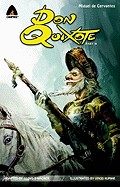
Ashley Swarthout Reviews Campfire's *Don Quixote, Part II*

Title: Don Quixote: Part II
Author: Miguel de Cervantes
Wordsmith: Lloyd S. Wagner
Illustrator: Vinod Kumar
Colorist: Vinod S. Pillai
Publisher: Kalyani Navyug Media Pvt. Ltd.
Publication Date: August 9, 2011

Don Quixote: Part II begins after Don Quixote has returned home from his many adventures. He spends his days in solitude and remembrance until he is convinced by his friend and squire, Sancho Panza, and the bachelor, Samson Carrasco, to embark on a new adventure. His journey with Sancho Panza begins in high spirits but is crushed when he finds his love, Lady Dulcinea, has been enchanted and turned into a peasant woman who no longer recognizes him.


The journey continues with many high points for the Don Quixote and his squire, most of which occur during a long stay with a duke and duchess. The Duke and Duchess create elaborate pranks for Don Quixote to work through, all without his knowledge. When Don Quixote and Sancho Panza continue on their adventures they are confronted by a knight who challenges Don Quixote by declaring his lady is more beautiful than Lady Dulcinea. Once Don Quixote loses the joust he returns home with instructions from the victor to stay there for a full year. However, after returning home Don Quixote becomes ill and passes away in his bed surrounded by his friends and caretakers.

The humor was entertaining, and the illustrations were captivating. Even if the reader has never heard of the classic novel written by Miguel de Cervantes, this graphic novel gives relevant information on the classic novel and is constructed artistically so as to potentially peek enough interest on the character of Don Quixote for readers to want to read the longer text. However, being that the protagonist is an older knight, and the journey seems to be doomed to fail from the start, young adults reading this text may have difficulty relating to Don Quixote and his mission.

There are a couple of the characteristics present in the best examples of young adult literature in Don Quixote: Part II. The reading of the graphic novel is fast paced. It quickly takes the reader on the journey alongside Don Quixote and Sancho Panza. The language is mostly simple but does include an occasional higher level word. For example, the word “vanquished” is used several times throughout the text, and the word “bravado” is used on page 28 to describe Don Quixote’s behavior with a lion he wishes to fight. The graphic novel is fast-paced in that it moves from action to action with little to no lull time between.

In addition to being fast-paced, Don Quixote: Part II‘s character, Don Quixote, is overly optimistic most of the time. There are very few instances where he is not optimistic. In the very beginning of the novel when he decides to leave for more adventures, he is not concerned about his age or about the rumors that he is mad. He says, “Within four days, my dear friend Sancho, we shall be on the road again, doing good and combating evil” (10). There are times when Sancho is not as optimistic as Don Quixote, and Don Quixote is quick to point out his friend’s fear. “It seems to me, Sancho, that you want to be perched on that tree to watch the bull fight without danger” (22).

Don Quixote: Part II is missing many of the characteristics that define the best young adult literature examples. The most obvious missing characteristic is that it is not written from the point of view of a young adult; furthermore, the protagonist is a much older, past-his-glory-days, mad knight, making it difficult for young adult readers to identify with him. While Don Quixote is quick to take credit for his perceived accomplishments, a characteristic of the best of best in young adult literature, his accomplishments are not really his. Every time he believes he has accomplished a grand victory or deed, it is actually out of folly or prank.

For instance, on page 62 Don Quixote believes that he has defeated Malambruno, thus removing the beards from the duennas when, in actuality it was a grand prank produced by the Duke and Duchess. The text does not have various genres and subjects. The text contains only a few basic ideas and they do not change during the course of reading. The graphic novel also fails to include a diversity of ethnicities and cultures in both text and illustrations. Another major missing characteristic is that it does not deal with emotions that are important to young people. There are many emotions included and experienced: Don Quixote’s desire to accomplish more great deeds, he becomes depressed when his “so-called” loved one does not recognize him, he is boastful when he believes he has been victorious, and remorseful when he is defeated.

Though Don Quixote moves through all these relatable emotions, it is all done so out of folly and humor, distancing the feeling of relation between the reader and the character. A reader may relate to the feeling of depression when rejected by a lover, but Don Quixote’s rejection was because the peasant was not his real lover. That mistake made by a mad man makes the feeling of depression no longer relatable.

I would recommend this book as an introductory text to the classic novel originally written in 1605 by Miguel de Cervantes. Though the character of Don Quixote is not relatable, he is entertaining and amusing. Being that the graphic novel adapted by Lloyd S. Wagner was also enjoyable and comical, it would be a great introduction to the waggish qualities of Don Quixote and humorous adventures that Don Quixote and Sancho Panza experience. For teachers this would be a recommendable addition to a classroom library for middle and high school aged readers in both English and History classrooms.

Travis Beck Reviews Campfire's *In Defense of the Realm*

Title: In Defense of the Realm
Author: Sanjay Deshpande
Artists: Lalit Kumar Sharma, Illustrator; Jagdish Kumar, Inker
Publisher: Kalyani Navyug Media Pvt. Ltd.
Publication Date: Copyright © 2011


The graphic novel In Defense of the Realm by Sanjay Deshpande is a cautionary tale of the dangers of waging war without the use of strategy. It demonstrates how a leader should exercise his or her power when making decisions that can either enhance his subjects’ lives or destroy their lives to the extreme outcome of death.


I would briefly like to talk about the setting of the story, which serves as its foundation. The setting is both physical and chronological. It takes place in what is called the Indus Valley Civilization around 2310 B.C. Once lost to the ravages of time, Dholavira is a 5000-year old city of what we call the Harappan Civilization. It is located on the island of Khadir, India. Lost and shrouded in mystery, the city began to reveal its secrets when it was excavated in the 1990s. Interpretation of life in Dholayira fell to our author, Sanjay Deshpande, an archeologist and heritage consultant who worked on sight from 1992 till 1998. He characterized the Harappian Civilization as having exceptional and intricate architectural advancements for its time. An example of this was a fully functional sewage system.


Though evidence doesn’t suggest that the Harappans were militant in nature, archeological evidence suggests that they were well-prepared for defense against enemies. The Harappans also developed intricate internal and external trade routes, water collection and storage systems and a solid economic infrastructure. Overall, the evidence points to a very prosperous society and civilization. However, Sanjay and his colleagues have not been able to shed much light on their system of government. Where the Harappan rulers authoritarian? How much power and control did they have and to what existent did they exercise it? So far experts don’t have the answers to these questions. “No great monuments, palaces, temples, or graveyards full of gold have been found.” (pg.4).


Most of the Harappan written records have been destroyed by the ravages of time; what little was found is on personal artifacts that have yet to be deciphered. The fictional tale of In Defense of the Realm is loosely grounded in these incomplete facts. However, it is important to be aware of these facts in order to understand the complexity of the world in which the characters live or the reader will be lost.


I found that the story centers around two main characters, Prince Meluha and Princess Kundalini. Both characters are on a journey from adolescence into adulthood. They are characterized as model teenagers (or the perception of what an adult would consider a model teenager). Struggling to cope with events that are happening around them, both characters are innocent, honest, naive, confused, and, above all, scared in the face of uncertain futures. They are on the verge of either ruling their perspective kingdoms or of utter failure. They seem to take very different journeys to their destinies.


Prince Meluha’s journey is more physical in contrast to Princess Kundalini’s’ which is more emotional. The similarity is that they both have to rely heavily on cognitive processes, constantly asking themselves “What is the smart thing to do?” In the beginning, Master Torana, a philosopher and teacher, is telling their story to three students. He is telling it in a third person dramatic narrative which seems to get lost in the middle of the story. The basic plot of the story is the conflict between the peaceful kingdom of Dholavira ruled by Prince Muluhu’s father, Raja Sanjaya and the invading army of the Akkadians ruled by King Sargon.


Sargon’s army invades and puts the city of Dholayira under siege. On a hunting trip at the time, Prince Muluhu is cut off from his kingdom. Prince Muluhu must then embark on a journey in order to rally support from two other kingdoms that are part of a five kingdom realm. The Prince must put aside childish notions in order to become an effectively ambassador and save his family and kingdom. The invasion results in the assassination of Princess Kundalini’s father, Raja Mahavindasa.


The assassination is orchestrated and perpetrated by the main antagonist in the story, a spy named Takshaka. Takshaka is later killed by one of his allies, a fitting end for the conniving character! The assassination plunges the kingdom of Harappa into chaos. Princess Kundalini relying on what her father had taught her rises from the ashes of this catastrophe and takes her place as Queen of Harappa. The Princess later devises a strategy to end the war with minimal casualties. The plan is successful and peace and prosperity is returned to the five kingdoms in the realm. There is a coronation and Prince Maluhu is declared ruler of Dholavira. The two rulers fulfill their arranged promise of marriage and end up ruling Harappan as a whole.


These two characters are free to take credit for their own accomplishments, though the amount of poise and humbleness they display seems unrealistic for their age. There is a diversity of ethnicities and culture displayed in the book.


The best example of this is that there are five kingdoms within the realm, all of which have distinct cultures. Within these kingdoms are cities with their own unique cultures; the fact that they all have to get along in order to coexist and eventually survive gives testament to the success of cultural diversity. The story is an optimistic one in that adolescents have the capacity to demonstrate maturity in the face of adversity. It shows the emotional struggles of coping that a young adult might have such as confusion, uncertainty and worrying about the future. It shows that change is often a good thing through the use of Junex vs. Senex with the young replacing the old in a natural cycle.


In contrast, as far as meeting the best of the best criteria for graphic novels, it seems to fall short. I didn’t get the feeling that the story was written from the point of view of an adolescent. As I stated earlier, it was written from an adult perspective of how we think an adolescent should be, not actually how they are.


This makes the characterization come off as false and unrealistic. I didn’t think that the pace was fast enough and the subject matter in the middle of the novel might bore young readers to the point of losing interest. I don’t think that the story had a variety of genres and subjects, at least not any of great interest to the average reader. What might be of interest to some readers are the historical references within the text but this is only geared toward a select secondary group of readers.


In conclusion, the narrator comes in from time to time, giving the reader historical facts about life in the Indus Civilization. This is an attempt to educate the reader, one of Deshpande’s main objects. However, I don’t think that it was consistent enough to be effective. I just didn’t get the feeling that the story was written from the point of view of an adolescent. With that said I would definitely recommend this to students interested in ancient civilization especially to those who are interested in India’s history.


I think this would be a good book for readers who are transitioning from the concrete thought processes into abstract thought processes. It is also a great tool for introducing moral values and believes, as the characters are always striving to do the right thing and the violence is never glorified.

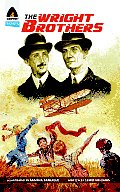
George A. Arreola Reviews Campfire's * The Wright Brothers*


Title: Title: The Wright Brothers
Artist: Sankha Banerjee
Publisher: Campfire Graphic
Publication Date: June 28, 2011

From an early age, Orville and Wilbur Wright were encouraged by their parents to learn as much as possible in the classroom as well as to seek knowledge outside the classroom. Their father wanted them not to be content with just the knowledge from school; he figured there was a lot to be learned outside the classroom too. The boys got their mechanical interest from their mother who had made a few appliances that she used at home. The boys also inherited their curiosity from their father, who used to travel throughout the country and brought back gifts from far away places which, encouraged their adventurous spirit. Their father introduced them to a small printing press in which Orville took interest.


However, within a short time, he outgrew the printing press and invested in another press involving his brother Wilbur, who he trusted and knew he could count on. Both brothers went on to venture into other interests that were successful. Their main goal was to build a plane and be able to fly. While there were many brilliant scientists working to build a plane, the Wright brothers, with less than a high school education, were successful because of their determination and ability to cooperate with each other.


The story follows the two main characters of Orville and Wilbur Wright and shares what these two brothers were like growing up. The graphic novel covers the main points of their lives, allowing the reader to see that not everything was perfect; they had their struggles along the way but were able to succeed. They found obstacles and people that did not believe they could accomplish such a task as flying. The Wright Brothers graphic novel provide interesting facts and the graphics making it easy to follow. Young adults could follow along without any problem because the text is easy to read and the graphics help to follow along.


The Wright Brothers graphic novel covers most of the characteristics of a graphic novel. It might not be part of the “best of the best,” but it does have the elements of a good graphic novel. Most of the book is good, but the story of the Wright brothers in this book is more of a summary of the Wright brother’s lives. There is minimal dialog in the book. The author summarized the story in 68 pages. The Wright Brothers book is an interesting one, but the author could have made into one of the best of the best if he would have put more effort into it. Young adults are intrigued with real life stories of people succeeding. Unfortunately the author cuts the readers short.


After reading this graphic novel, there were a few things that I learned about the Wright brothers. The book does meet the criteria as young adult literature book. I felt this graphic novel kept my interest, and it would be a good book for young adults around the ages of 8-12 to read. Prior to reading this book the only thing I knew about the Wright brothers was that they had been the first ones to fly a plane, but there is more to it. What young adults can learn from this book goes beyond inventing a plane. What it teaches is what was mentioned on the first day of class: “A hard worker would outwork a smart person.” This is precisely what the Wright brothers were able to do while there were many distinguished scientist were trying to be the first ones to fly.


While it was no easy task, and they did have many setbacks but that did not prevent them from accomplishing their goal. Every time something failed they were more determined to succeed. This is a good lesson for any young adult who has a dream.


I would recommend this graphic novel to students from grades 4th through 8th. The Wright Brothers is a positive story. It is very encouraging for young adults who aspire to be successful. The Wright brothers might not have finished high school and might not have been the brightest students, but they had the desire, determination, and work ethic to make their goals come true. The road to success was not a smooth one; they encountered many difficulties on their way to accomplishing their goals. If students are able to grasp the concept of hard work than this book is a success.

Myriam Martinez Reviews *Eros and Psyche*


Title: Stolen Hearts: The Love of Eros and Psyche
Author: Ryan Foley
Artists: Sankha Banerjee, Prince Varghese
Publisher: Kalyani Navyug Media Pvt. Ltd.
Publication Date: 2010

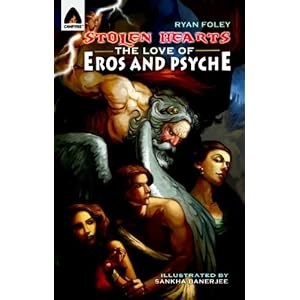
This graphic novel depicts the Greek myth of Eros and Psyche as told to a young woman to teach her the lesson of how a conflict between a mother and daughter-in-law unfolds. The novel describes the clash between Eros’s mother and Psyche, which develops as a result of Aphrodite’s jealousy of Psyche’s beauty. Aphrodite sends Eros to set a trap for Psyche; however, love develops between the two. In response, Aphrodite condemns Psyche to forever be miserable, which in turn causes Eros to deprive the world of love. A compromise is made in which Psyche is isolated from the world in a castle, where a man visits her at night. Unknown to her, that man is Eros; however, she is not allowed to see his face as part of the compromise to avoid her knowing who he is.


Psyche is induced to break her promise by her sisters, who encourage her to see his face. As a result, Eros leaves her. Psyche begs for help from Aphrodite, who places four conditions on her assistance. Psyche manages to meet three of the conditions despite their apparent impossibility. She fails on the fourth condition, but Eros realizes her efforts, saves her, and asks the gods to immortalize her. His wish is granted and they are allowed to live happily ever after. Overall, the novel does a good job of introducing the storyline and setting up the reader for what follows, but fails in that a reader without prior knowledge of the Greek myth would have a hard time filling the gaps in the story.


This graphic novel posses various elements of young adult literature. Among the ones present are that the young person is free to take credit for her accomplishments. Psyche is responsible for resolving her mistakes and is given credit for doing so. The novel is also fast-paced. The novel is also basically optimistic in that Psyche learns and matures as the story progresses, and it has a happy result. The novel also deals with emotions that are important to young people such as love, learning from mistakes, and believing in yourself to succeed.


The graphic novel is missing several characteristics of young adult literature. The novel is narrated by an adult and therefore is not written from the point of view of a young adult. The novel does not include a variety of genres and subjects because it is constrained to Greek mythology. Also lacking is a diversity of ethnicities and cultures. Perhaps because of the timeframe of the original story, the story is removed from reality in that other cultures are not present in the story. Also, while it touches on emotions that might be of interest to young adults, it may be difficult for them to relate to gods and other unfamiliar situations.


I believe the text could be of interest to young adults, especially those with an interest in Greek mythology. The colored dialogue boxes are very useful in helping the reader follow the story and identify who is speaking. The novel also gives a face to the characters of Greek mythology, which are normally described in text only. While it does not fit perfectly into the definition of a young adult piece, it has enough of its elements to qualify as one. For those that are not familiar with the original Greek story, it may be a way to introduce them to a new medium. However, for those that dislike Greek mythology, this may not be a book of interest to them.


I would recommend this book to young adults for the reasons mentioned above. The novel has enough of the elements for a good young adult piece to draw their interest and provide for a good read. For those already very familiar with the original Greek story, I would caution them to remember that it is a slightly different version that does not remain completely true to the original. I would recommend it to young adults especially for its lessons of love and of determination.

Pamela Antwine Reviews *The Swiss Family Robinson*

The Swiss Family Robinson is a great graphic novel. The story is about a family
traveling on a ship from England to Port Jackson, located in New South Wales. Their journey
on the ship becomes disastrous when they encounter a catastrophic storm.

I thought this graphic novel was great and effective for several reasons, including:
the easy flow of the dialogue, the sequence of events was timely, and the illustrations
were very effective. These were demonstrated on (pgs.44, 73).


In the graphic novel the character Fritz is the oldest of four sons, and appears to be a young man of sixteen. Fritz is able to take credit for his accomplishments on
several occasions. Most notable was when he felt his fate lay in the mouth of a shark. Young
Fritz had only been on the island for one day, and unaccustomed to shark attacks. The shark wasswimming towards Fritz when he was transporting the animals from the ship. As terrified as
Fritz was, he was able to shoot and wound the shark on his father’s command (p.29). Another
accomplishment was when Fritz captured and tamed an wild eagle (p.45).


The Swiss Family Robinson graphic novel is fast-paced because the events happen
quickly. In the beginning of the story, the family is on a ship. By the middle of the
story the family is on a deserted island, and at the end of the story, the family has
survived all their trials and tribulations. The fast pace of a graphic novel is important
because it keeps the readers attention. It also keeps the reader wondering and guessing
what will happen next.


The story is optimistic, because through it all, the family survives. They
overcame a lot of obstacles when the ship was caught in the storm by remaining calm and
patient. Their demonstration of optimism came through when the family prayed, “ Our heads
were soothed by the comfort of childlike prayer, and the horrors of our situation seemed less
terrible.” Their faith and family unity helped strengthen their ability to remain optimistic.
Time and change were demonstrated when the boys first arrived at the island:
They were young boys, and vulnerable to their surroundings. They then changed into
men after being on the island for ten years (p.53). They spoke with optimism just after
their father had completed making each of them a pair of boots (p.41). “ Yes, we’ve had a
pretty eventful time since we landed here all those months ago” (p.42).


The family’s fate of leaving the island once seemed hopeless. But now the family
has a choice to leave or remain on the island. Each person chooses to seek their own
happiness and fulfillment. This is witnessed at the end of the graphic novel,
when the boys are deciding what the future holds for them. Fritz, now a man of twenty-six,
has decided to marry Montrose and move to England. Ernest the second oldest, who appeared
to be thirteen in the first part of the story, now probably a young man of twenty-three,
has chosen to remain with his parents on the island, and continue to study science. Jack the
third oldest son, who appeared to be ten in the beginning of the story, also chooses to remain on
the island as a rider, and shooter.


Frank, the youngest son, who appeared to be eight in the beginning of the story, decides to go to school in London (p.81). The young men made their life choices with such maturity and optimism. This was noted as they made a toast to “ New Switzerland,” then Jack who said, “ Long life and happiness to those who make New Switzerland their home!” the second toast came from Fritz“ three cheers for England and Colonel Montrose! Success and happiness to those of us who return to Europe!” (p.80). Although what the future holds is unknown, these young men seem mature enough to handle all that comes their way.


The Swiss Family Robinson graphic novel deals with the emotions that are important to
young people. The novel demonstrates fearful situations and being able to overcome them. Most young adults at some point in their lives experience fear. In the novel there were incidents of the boys experiencing fear on the ship when the storm first came (p.5). They overcame their fear by going to the lower level of the ship where it was quiet, warm, and dry. Jack experienced fear
when he opened the closed captain’s door on the ship, and the attack dogs rushed towards him
and knocked him to the floor. Jack’s response was to hide his fear and remain calm and
everything worked out fine (p.10). Another important feeling young adults experience is
acceptance.

This was demonstrated when Ernest at age 13, was seeking approval from his father and
older brother Fritz. Ernest wanted to go hunting with them, but was not allowed because they felt he was too young. So one day they allowed Ernest to go hunting with them. Although the hunt was unsuccessful in capturing an animal, Ernest could not have been happier. He proved he was quite the hunter with his sharp instincts, and keen eye for spotting the wild animals. From then on Ernest, was always included in the hunt for wild animals. Young adults need to be able to read a graphic novel that deals with similar emotions they can identify with to maintain their interest and to be used as a teaching lesson.


The element missing of the young adult literature is the point of view of the of the young adults for the writing because the graphic novel was written from the point of view of the father. Another element missing is the absence of diversity of ethnicities and cultures because the family lived alone on the island for ten years. This graphic novel does meet the criteria for being considered young adult literature because it offers simplified words throughout the story. The quality of characters and setting are realistic and it reflects on the age of innocence embarking on a unfamiliar journey. The illustrations command your attention as does the story itself.

I would recommend this graphic novel because it demonstrates adventure,
family unity and a coming of age story. The novel makes good use of dialogue. The
sequence of events follows suit. The illustrations are very graphic and detail oriented.
This would be a great book for children ages eight through fourteen.

Lorenzo Licerio Reviews Campfire's *Call of the Wild*

Title: The Call of the Wild
Author: Jack London
Adapted by: Lloyd S. Wagner
Artist: Sachin Nagar
Publisher: Campfire
Publication Date: 2010

This novel gives the reader a great sense of the harsh life that both men and beast confronted in the great Alaskan wilderness at the turn of the century. It tells the story of a dog that, unwillingly, is taken into a great journey. Through this journey, he discovers the kindness and evil that is within some men and animals. It also helped him find his most basic animal instincts. This would serve him in surviving and discovering his true nature and calling in life.

I thought the story in this novel had a good flow to it. It kept me interested in the characters and plot. I think the liberal use of color in the artwork really kept the story alive. I enjoyed the novel overall and would recommend it.

The main character in this novel is the dog Buck. The story is told by Buck’s character and there are no children in it. I think the story was fast paced. It didn’t dwell too long on any particular subject, and that kept the story flowing. It dealt with the subject of dogs, which I think is always a favorite of young adults. I think the negative treatment of them will surprise and challenge the emotions of some children. The graphics did help in visualizing the story and helped in understanding it.

I don’t think there were many elements of the “best of the best” in this novel. There was no young person in the story for young adults to relate to. That takes out of the list most of the” best of the best” elements in young adult literature. That been said, I still think it has some good qualities.

Although it doesn’t have some of the criteria that identify most young adult literature, I still like some of the other elements within it. The struggle to survive is a theme that does resonate in the life of a teenager (not always to the extent of life and death, but surviving teenage life, with all its complexities.) There was some optimism in the dog surviving, form harsh weather, the fights for sled leader, to the mistreatment from the men. The dog also started to get the feeling that his true call was to roam free in a pack. He would get visions of that and would eventually join and lead a pack of his own. The graphics in this novel I think is another element that would attract the youth into reading it.


I think the colors were used adequately and in the right amount. There were times when the artist would use only white and dark lines, which would give the effect of the cold and snowy terrain of the area. Some times he would use bright colors in the portrayal of the mountains, forests and rivers. I especially liked the dark red color he used in the background of the Buck’s dream of the Indian warrior dancing around the fire.

Even though the novel had no young protagonist as the main character, I would still recommend this novel. I don’t think this would be a novel for anybody below middle school age. Some of the violence depicted against the dogs would be a little too graphic for younger children; especially the way the men treat dogs. I especially think high school students would enjoy the nature of life in those times.

Monday, April 11, 2011

Elementary Kids Offer Praise of Classics

Read "From the Mouth of Babes: A Word About Classics in the Comics Format" over at The Graphic Classroom blog. Video included!

Thursday, February 10, 2011

GNR Profiles Andrew Dodd/Campfire

Campfire is a relatively new imprint making a mark with quality adaptations of classics and exciting original works. They've sent me a ton of review material over the least couple of years, and I still have a stack to get to, but, overall, I've been very impressed with the talent they've assembled.

The look of their books is distinctive, and they have some amazing colorists helping form that look. They also have a knack for finding writers who truly know how to handle the original material when it comes to the adaptations.

I'm glad to see Graphic Novel Reporter giving them some love, and they certainly have some from me as well.

Tuesday, August 10, 2010

Campfire's _Moby Dick_

Another admirable and entertaining effort from Campfire, Moby Dick features the elements most adaptations focus upon: the action, the whaling, the obsession. Some of the nuance and innuendo makes it into this adaptation, but mostly we get the "nautical action film" version.

That being said, it's a good read. I hate that it ends so abruptly. The last encounter with the white whale and its results are too compressed for my taste, especially given the decent pacing of the story up to that point, but Ishmael's character is well-developed, as are Queequeg, Starbuck and Ahab. The art fits the story perfectly, especially the rough lines and hoary hatchings from artist Lalit Kumar Sing, who gives the rough-and-tumble seamen just the right look.

I'm not sure if Moby Dick gets much attention at the secondary level anymore. Even there, my guess is several hundred pages are removed or ignored. But, if a teacher does use Moby Dick, this text would be an excellent accompaniment. As with all the Campfire books, it's not just an adaptation. There is information about Herman Melville's life and some very interesting illustrated information about whaling, whale ships, and Mocha Dick, the real-life whale that inspired the story.

Though its compression flaws towards its wrap-up dissatisfied me, I was impressed with this effort overall.

Campfire's _Alice in Wonderland_

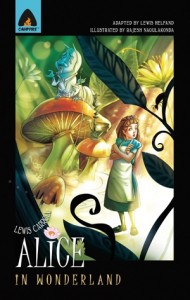
Adapted by Lewis Helfand, illustrated by Rajesh Nagulakonda, and colored by K.G. Prasanth, Campfire's Alice in Wonderland is a splendid, tasteful, beautiful take on the Lewis Carroll classic. Further, it offers information about Dodgson and the texts that make up the Alice lore before the story and after its finish offers information on mythical monsters that might have inspired the author.

It's easy to adulterate an Alice story, especially given some folks' thoughts in its writer's closeness with little girls and the camera, but this adaptation hits all the right notes. It is so good, in fact, that it is one adaptation that I wouldn't mind giving to reluctant readers or struggling readers in place of the original, and that is not usually a tactic for which I advocate. Pairing and braiding is better, almost always, in my opinion, but that I can praise this text with such an aberrant stance should be read as faith in it as an engaging, witty, and close approximation of the best that the original has to offer.

While I am usually resistant to recommend adaptations, I can wholeheartedly recommend Campfire's Alice in Wonderland.

Monday, July 19, 2010

A Campfire Classic vs. A Campfire Mythology

Campfire has sent me a slew of review copies, and I keep being generally impressed. Tonight, I'm going to compare and contrast a book from their Campfire Classic line, Robinson Crusoe (adapted by Dan Johnson, illustrated by Naresh Kumar, colors by Anil C.K.) with a book from their Campfire Mythology line, Ryan Foley's Legend: The Labors of Heracles (illustrated by Sankha Banerjee, colors by Ajo Kurian).


It's not an unnatural pairing considering the religious overtones in both. Crusoe is sort of a 18th century Jesus, and in the early days of Christianity, it wasn't rare for Greeks and Romans to confuse Jesus with the gods in their pantheon. There's more than a little Christ in Hercules.


Regarding the Robinson Crusoe adaptation, Christianity rules the day. Those looking for the critique of government and economy will have to squint a bit, but those who like to read the text as a Christian allegory or Christian coming of age story will be most pleased. Indeed, I can see the text having much utility in Christan schools or Sunday school classrooms.


The coloring in both texts continues the Campfire tradition of offering an intriguing palette. At their best, the images seem to be painted and vibrantly give the pages a warm, active glow. This is especially true for the Heracles book. In contrast, the colors in Robinson Crusoe sometimes live up to Campfire's standards but other times look more like an overdone oil pastel, muddy and ragged. To the artists' credit though, a haggard, rough, jagged line is appropriate when illustrating the trials and tribulations of a mere mortal. Heracles, a man-god, is better suited for beauty.


While the adaptation of Robinson Crusoe sheds a lot of nuance from the original text, Ryan Foley more skillfully parses elements of Hercules' mythos. While I wonder about the historical accuracy of having a young Greek boy paired with a female mentor, Foley frames the narrative such as lovely Lady Demiarties tells the story to young Prenditus, who asks questions at times that Lady D simply says must be answered another day.


Foley also does an excellent job of making sure the more... adulterated elements of Hercules' labors are depicted in a family-friendly manner while also inserting a bit of humor into the text. Perhaps its the extra centuries of lore, or the inherent nebulous nature of myths vs a rather finite core from a source text like a novel, but Foley just seems capable of squeezing more out of his text that Johnson does with his.


For example, in a wonderful example of superimposing, an ovoid panel featuring the face of Eurystheus is placed in a horizontal, rectangular panel in which Heracles shovels poop from his stables. The oval fits neatly "in" the pile of poop, a perfect place for the shithead king.
Then there's the undeniable bit of tastiness that is Heracles petting Cerberus: "Who's a good dog? Huh? Who's a good dog? You are. Cerberus is a good dog."


Both books offer extra information at the end. Johnson offers history of other famous shipwrecks rather than explore the nixed sub-themes of Defoe's masterpiece, and Foley offers the history of several other key Greco-Roman deities to help readers keep the hulking half-god heroes of antiquity distinct.
I enjoyed reading both. I love Daniel Defoe's Robinson Crusoe, so much that I actually explored the theme of middle spaces in my application for doctoral programs, but not necessarily for the same reasons that Johnson's adaptation will bring to the fore. Still, it's an impressive book that will absolutely serve its best purpose as a text exploring Christian themes. Folley's Legend: The Labors of Heracles is an absolute blast, however, a ten out of ten to Robinson Crusoe's worthy 8.

Again, to sum it: It's not that Campfire's Robinson Crusoe isn't strong, it's just not as strong as Hercules.

Thursday, April 29, 2010

Campfire Books (Steerforth) Releases Time Machine, other Adaptations

If I'm not already on record as being worried about the recent spate of graphic novel adaptations of canonical texts, I need to establish the fact here: I feel their accessibility makes it too easy for teachers to cop out on considering graphic novels, allowing educators to limit their research on the form and focus only on supplemental titles at best rather than finding the true quality stand-alone original narrative gems that really set the medium apart.

However, I have a soft spot for H.G. Wells' The Time Machine in traditional and pictoral form for several reasons. When I was in college, I found a great illustrated pamphlet version of the text, which it appears I've lost now, much to my regret. As well, in the only time I was ever able to teach upper classmen exclusively, which was during my student teaching in Pisgah, NC, I taught the novel to a group of mostly male reluctant readers, and we loved it. We drew pictures of what we thought the time machine looked like. We considered memories as time travel. I got to share with them a not-so-subtle penis joke. (Curious aren't you? Well, after the Time Traveller seems to have developed some feelings for Weena and has come to depend on her as a lifeline of sorts, he loses her and feels utterly alone and scared. To iterate this point, I dramatically exclaimed, "Imagine the loss he must feel! The sense of isolation! After all, can there be anything worse than to be a man without a Weena?!?") Everybody laugh. Curtain fall down.

So when Steerforth sent me an adaptation of this title from their new Campfire series of graphic novels, which cover classics, mythology, biography and originals, I took note. Lewis Helfand adapted the text serviceably, but the art (pencils by Rajesh Nagulakonda) was exceptionally striking, especially the coloring (by Manoj Yadav). The morlocks looked more like Golem than they did the hulking, hairy monsters I'd envisioned, but that was the only major flaw I found in this adaptation, which could be used to frontload a reading of the print text or as a quick-read supplement to thematic units on Imperialism, -topias, Science vs. Conscience, etc.

The adaptation also featured a bio of Wells and some information about technologies being developed in the Wells era.

Kudos to Campfire for such a fun effort with such a fun story. With 33 other titles hitting the market over the next two years, distribution through Random House, and brilliant art in each based on the previews I've seen, I expect Campfire to become a major player in the graphic novel market.