Stickermule

Custom Stickers, Die Cut Stickers, Bumper Stickers - Sticker Mule

A Public Service Announcement! ;)

A Public Service Announcement! ;)

Monday, August 30, 2010

Reviewing the _Reading With Pictures_ Anthology


The first volume of the Reading With Pictures Anthology is now available. Proceeds from the book will go to sponsor research and outreach projects associated with Reading With Pictures, a group of comics artists, educators, and researchers who seek to explore the connections between education and comics.

I enjoyed reading the anthology. Dr. Michael Bitz's introduction was the perfect frame, and I appreciate how he mentions "the fragile relationship between comics and the reading establishment," citing IRA's spur-of-the-moment cancellation of a full day's worth of GN-related programming last year and inadvertently helping RWP solidify their mission and desire to produce the book. That happening has been terribly under-reported and examined.

The various shorts, from generous comics artists associated with RWP or just willing to offer their resources, cover a variety of genres and messages. Many are inherently pedagogical and some are even a little didactic, but others seem created for the pure juissance of the comics reading experience.

The Fillback Brothers history of images as linguistic signifiers starts the book and pairs well with David Faroz Precht and Cho Youn Chul's "Visual Cues" toward the end of the text.

Among my favorites were the aforementioned; the "Just James" selection, in which I'd like to think mention of characters named James and Katie are references to a couple of folks who have recently published books on comics and literacy (don't shatter my illusion, please!) and in which comics, composition, and literary elements are explored; the physics-inspired "Mail Order Ninja" short that explores the square-cube law; Raina Telgemeir's short but poignant "A Conversation I Had While Teaching a Comics Class;" Pyle and Sacco's "The Order of the Silent Pencil," which deals with literacy and in-school subversive vs. in-school traditional notions of learning to read and write; and Fred Van Lente and Ryan Dunlavey's "Comics and the Classroom: a Match Made in History," which relates some of the historical connections between comics and education and from which this gem of an image (and new office door cartoon) is drawn:


It's hard to say if the anthology is for kids or for teachers. Certainly the short stories are child-appropriate, but the reasons behind the anthology's creation never seem too far removed from the content therein, and one can read the text as offering information and lesson ideas for teachers more than offering kids interesting reads. That's not a weakness of the book, of course.

For example, in my "Dramatic Modes of English Language Arts" class, we cover comics as a form that meets the 6-pronged definition of English Language Arts as explained by NCTE/IRA. I ask students to choose 1 book from among the following: Big Fat Little Lit, The Best American Comics, or the Smithsonian collection of graphic novels.
My pre-service English teachers use that text to help them explore connections with pedagogy and comics, but the Reading With Pictures Anthology seems to overtly cover that ground whereas these other texts need some coaxing to do so. Hence, I'm thinking of using the anthology the next time I teach the class.

Indeed, the text might have its most use in application and practice, with pre-service teachers and in professional development seminars first, then in the classroom once professionals have considered the stories and their use beyond a simple reading.


Regardless of initial use or intended audience, the anthology does not disappoint. There's enough evidence for comics and learning coexisting to help the cause, though one wonders how much success the text might have reaching beyond "the choir," a problem all of us in comics-and-literacy face, and enough fun for anyone.

Fans Force Change in Casting Call for _Runaways_ Movie

Reminiscent of the hooplah over non-Asian actors in The Last Airbender, the news here also centers on a beloved Asian American character from the series, which I can't recommend enough, especially in the earlier years. Niko's casting call did not specify race, which ICV2 suggests signifies a default to "white" in the film industry, but fans took notice and rabble-roused their way to a change. Click the URL embedded in this link's post for more details.

August 28 was "Read Comics in Public" Day

I messed up and read all mine on Friday, D'oh! Here's hoping this becomes an annual tradition that grows and grows, like Comic Con or Free Comic Book Day.

Friday, August 27, 2010

Stoopid Move from Maryland Politician Nancy King


Nancy King, who is running for the senate in Maryland, has been running mailers that suggest that if teachers are laid off, the world will come to an end because students will have to read comic books.

Sounds silly, and it is.


Dean Trippe has written the senator a letter explaining a bit about comics' and literacy's connections. (See link embedded in this post's title, which also reprints the mailer, hilariously featuring one child reading not a comic, but Previews. That reader is obviously reconsidering her pull list).

What's worse, Maryland is the home of the Maryland Comic Book Initiative, one of the highest-profile, public integrations of comics into public schools ever.

What's that the kids say about trying so hard you actually miss the forest for the trees? Oh yeah, "EPIC FAIL."

Of course, if the general public is still oblivious to the advantages of comics in the classroom, or at least in the hands of children, I guess it doesn't really matter:

If a kid in a forest reads a comic and learns a new word, and there's no one around to hear him learn, does anyone give a damn?

Come see me at the 2010 Miami Book Fair!

This event just keeps getting bigger every year, as does its graphica programming. I'm happy to be a part of the action this year.

The title to this post is a link to more information on the fair from Graphic Novel Reporter, which itself promises to release more details as they come available.

What I do know is that I'm scheduled to appear on November 18:

Featured Speakers for Thursday:
Prof William Ayers, To Teach: The Journey, in Comics ;Chris Schweizer, Crogan’s Vengeance and Crogan’s March; Professor James “Bucky” Carter, NCTE board member and author;
Professor Adam Johnson, Stanford University’s Graphic Novel Project

Yep, November will be a busy month for the Buckster. I leave Miami to go directly to Orlando to talk about graphic novels at NCTE, and I have at least 3 projects set to debut in the month of Thanksgiving. Maybe I'll see you in Florida in 2010!!

Thursday, August 26, 2010

Wednesday, August 25, 2010

I Just did The Monster Marsh!


Or, more specifically, I just read two of Robert Marsh's Monster and Me graphic novels. I read Monster Moneymaker, a hilarious story reminiscent of The Chocolate War, but with monsters, and Monster in the Outfield, in which the blue hairy beast known as Dwight helps his keeper, 12-year-old Gabby, and her team mates beat her school's teachers at a game of baseball.

The series works under the premise that every kid has a monster, but most people keep theirs hidden. Not Gabby, though, who lets Dwight out of the closet and free to cause as much mayhem as his good heart will let him.


The series is funny, pleasingly weird and has just the right blend of wackiness and ribald. Tom Percival's unique art is both strangely effective and effectively strange and never fails to get the story across.

The books are geared toward striving readers at the elementary and middle school levels and are just one of a series of comics-inspired books from Capstone Kids, a division of Capstone Publishers, which seeks to serve the needs of prek-12 readers. I have no idea how Capstone has escaped my prying eyes to date, but I'm glad I learned about them through Marsh's exquisitely silly and enjoyable books.

Tuesday, August 24, 2010

_Super-Powered Word Study_ is Available!


For pre-order, that is, but the book is officially public now!


Here's the press from Maupin House:


Whether you’re a principal, teacher, summer camp instructor, parent, or student, you’ll enjoy the vocabulary-building adventures in Super-Powered Word Study. Weekly word study instruction is combined with short mini-comics that illustrate the meanings of words and word parts in context, making the exploration of roots, suffixes, and affixes fun and engaging for all students in grades five and up. Reluctant readers and ELL students of all grades are especially motivated by comics’ high-interest visual narratives.


Super-Powered Word Study includes fifteen weeks’ worth of stimulating study and creative activities that ask students to think about language, consider word formation, and create their own stories—all in just twenty minutes a day! Each week introduces two word parts students interact with through riddle cards, word study notebooks, word sorts, word hunts, and practice assessments they create for their peers. Word sort lists, comics, writing assessment prompts, and optional extension activities offer endless opportunities for creative writing and language exploration. A comics primer and a DVD with all of the comics stories, riddle cards, word study notebook pages, sample comics scripts, and comics templates give teachers the support they need to build vocabulary knowledge and encourage students’ imaginations to run wild. The DVD also supports each of the fifteen lessons with interactive eCard word sorts, eComics with clickable clues, and opportunities for students to create their own comics and assessments.


Make your word study super-powered!

Monday, August 23, 2010

CFP's: Sequential Art, Graphic Novels, and Comics in Education/ Spidey Anthology

CFP: Sequential Art, Graphic Novels, and Comics in Education

Edited by Robert G. Weiner and Carrye Syma of Texas Tech University Library

In recent years the use of graphic novels, comics, and sequential art in education has exploded. This is due not only to the boom in superhero movies that are based on comic book characters, but also to the wide literary range that graphic novels now have. There are now literally hundreds of college and university courses all over the world that are using graphic novels in their curriculum. The days when comics were just seen as children’s trash, with no redeeming literary or educational value, are hopefully behind us.

Contrary to the idea that comics “dumb” down material, it takes both sides of the brain to read and interpret sequential art stories: the right side to interpret the pictures and the left side to understand the narrative text. Our goal with this collection is to provide the educator and scholar with a collection of essays that show how graphic novels and comics are being used in the classroom today, as well as some historical pieces that detail how the educational fields often have and have had a “rocky” relationship with the use of comics in educational settings. We want both theoretical and practical essays showing how sequential art can be and is being used to teach and illustrate concepts and ideas.

We are especially keen on pieces related to higher education, military and government uses of comics to educate, but all aspects of comics and education are under consideration. In addition, we would like to have educators from a wide spectrum of the educational fields from K-12, to undergraduate and graduate educational levels. Those using sequential art in adult education and pre-school are encouraged.


Some possible questions/ideas that could be addressed include:

The Military’s use of comics to teach.
Graphic Novels and comics in library science education.
How relationships can be understood through the use of graphic novels in human science education.
Teaching mathematical concepts using graphic narrative.
Grade school use of comics.
Middle school use of comics.
High school use of sequential art (say something like Maus to teach the Holocaust).
Comics and Film to teach about blockbuster cinema.
Philosophical issues raised by graphic novels (The Watchmen in a philosophy class about ethics).
Biological and scientific concepts using graphic novels.
The use of mainstream superhero stories in the classroom.
Superman, Batman, Spider-Man to further understand the concept of the hero Mythology (i.e., Odysseys, Hercules etc.).
Graphic Novels and history, how effective a tool is the graphic novel in teaching a historical concept?
Sequential art in teaching foreign language or English as a second language.
Comics in literacy and adult education programs.
Graduate courses using graphic novels.
The History of sequential art in education.
Medical education using comics

Please send 200 word abstracts by January 15th 2011 to Rob Weiner Rob.weiner@ttu.eduFinal papers will be due February 28th 2011. No exceptions.

Please note the submission of an essay does NOT necessarily mean publication in the volume.

Essays will be going through a rigorous peer review process and we have asked a number of scholars to serve in this capacity. We are striving to put together as an excellent collection with diverse viewpoints covering all aspects of comics and education. Authors are also expected to follow the editor’s style guide and be willing to have their work edited.

Thank you,

Carry Syma, Texas Tech University Library
Rob Weiner ,Texas Tech University Library

~~~~~~~~~~~~~~~~~

Also, remember the Spidey collection for which Dr. Weiner is currently seeking submissions!

Graphic Novels Not So Risky Business in Business School Classrooms


Inside Higher Ed has an article on professors at business schools using comics or graphic novels to teach business concepts.

Jeremy Short's students at Texas Tech's business school read and discuss Atlas Black: Managing to Succeed as a means of learning business basics. The text was written by folks at Portland State and Auburn, along with Short. A professor at the University of Vermont uses these texts as well. The University of South Carolina's Thomas Moliterno does too.

I'm not sure if these Atlas books are comic books or graphic novels. They're called graphic novels in the article but seem to have the shape and feel of the pamphlet-style comic books you'd see on news stands.

As well, there seems to be some lack of knowledge from the writer and his or her sources regarding the differences. Certainly the comments on Inside Higher Ed's public response area suggest a "dumbing down" is taking place rather than a simple reconstruction and presentation of the data.

It's also interesting that there is a sense that there is consensus among academics outside of education, particularly in business schools, it seems, that graphic novels are only written for entertainment. Woo that Maus, it was riot, wasn't it? That exploding giraffe head in Pride of Baghdad? Had me laughing for days. (Warning: Watch for dripping sarcasm).

I think what this suggests is the schism between what academics think constitutes "worth" and what education academics know works regarding teaching. Isn't is just a little strange and bassackwards that people responsible for teaching content material don't seem to know about how their students learn best? What's more, they get to be the authorities on what constitutes excellence in their given fields.

Makes you want to read one of the comic books that really is just for entertainment, doesn't it? Just to escape the ironic ignorance!


At least there are some folks that are exploring this form's pedagogical potentials is classrooms outside the ELA one. Graphic novels and comics are wonderfully interdisciplinary, afterall.

Friday, August 20, 2010

Vote for Me for ALAN Executive Board


I'm currently a nominee for the Executive Board of ALAN, the Assembly on Literature for Adolescents, a very active and thriving subgroup of NCTE that ,among other things, publishes The ALAN Review, a journal which I recently guest-edited.


While I usually do not stump for myself regarding nominations, this is a position I really want to serve. My connections with graphica and YA literature and literacy are obvious, and I have always appreciated ALAN's open, forward-thinking attitude.

If you're a member, I'd love your support once you get your ballot in the mail.Other nominees are: Lynne Alvine, Erica Ricki Berg, Dee Douglas-Jones, Christian Z. Goering, and Paul Hankins.


I'm James Bucky Carter, and since this blog is free, I did not pay for this message! ;)

Thursday, August 19, 2010

Alexander Simmons Pushes for Literacy/Creativity through Comics, Could Use a Hand to Expand to AFRICA!!!

Press release:

NYC-BASED KIDS COMIC CON INVITED TO SENEGAL, AFRICA FINANCIAL SUPER-HEROES NEEDED

If you found out about a great program that has helped kids in three regions of the U.S. expand their literacy and self-esteem, would you help it keep growing? For almost five years now, Alex Simmons and his Kids Comics Con have brought kid-friendly comics and their creators together with New York City kids who otherwise might never see them. Doing so has encouraged a love of reading, improved literacy, and, most importantly, given kids license to imagine, to think, and to create.

After four years of growing success, Simmons was asked in 2009 to take his KCC show on the road, and that’s what he did, bringing the “KCC Road Show” to the snowy hills of Buffalo, New York and blazing beaches of Miami, Florida. Both events were great successes.

Now the Kids Comic Con has been asked to bring the KCC Road Show to over 700 students, their families and the community of the Senegalese American Bilingual School in Senegal, Africa on December 1st, 2010. The American Cultural Center in Senegal wants to send him to additional cities there, potentially expanding the impact this project could have.

Simmons wants to deliver to Africa what he’s done for American kids, but he has been forced to confront the Dr. Doom of today’s economy: financing. To make this positive experience happen, Simmons has setup an online fundraiser on a web site called Kickstarter.com. Simmons reports this project will be funded, but only if he and his team can raise at least $19,616 by 11 a.m. on Thursday, Sept. 16. “Like one of those comic book death traps of old, the clock is ticking, and the rope holding the deadly blade above this project’s head is starting to fray,” Simmons said.

So the Kids Comic Con is calling all financial super-heroes to assemble, ride to the rescue, swing in at the nick of time, and otherwise save the day by helping to fund a worthwhile international exchange of ideas.

To make a pledge go to the KCC web site at: http://www.kidscomiccon.com/, and click on the Kickstarter link on their home page. Or go to http://www.kickstarter.com/ and type “Kids color” in the SEARCH PROJECTS box. You can also find links on the Kids’ Comic Con Facebook Page.

And for additional information please contact Alex Simmons at: Alex@KidsComicCon.com.

~~~~~~~~~~~~~~~~~
Alexander Simmons, who you may know from his great work on Archie comics, has been promoting literacy and creativity through comics for several years now and is one of the true good guys in the biz. If you can offer some support, please do. I know I will!

2010 Ignatz Award Nominees


Thanks to the Beat for sharing the info!

Wednesday, August 18, 2010

Best. Ray. Bradbury. Fan. Artifact. Ever.


Just too awesome not to share....(Possibly not safe for work). Um... how to tie this to comics and literacy? Here's a video of the singer's object of admiration saying he learned to read and write from reading comics!

Ben Bova, You Ignorant Slut

Ben Bova's words on graphic novels, graphica adaptations of print works, and the "decline" of literacy are making the Interweb rounds. And, believe it or not, he's being called out for his shortsightedness and lack of evidence supporting his assertions (my favorite comment to his words so far inspired the title to this post)by folks who aren't teachers or teacher educators. Perhaps we have truly turned the corner, folks......

Sunday, August 15, 2010

Of Fatherhood and Superheroes

Marvel has done so much so well over the last twenty years, or since Joe Quesada got the title belt, that there is too much to praise. But, I think whoever replied to "Our readership is getting older. How the hell do we keep ourselves attractive to 40-year-olds without slipping into porn?" with "By remembering that the idea that 40-year-old comics readers are all introverted virgins is a crock of shit. A lot of them are dads now, so let's connect with them by giving some of our characters children" deserves a six-figure salary.

Brilliant.

The work with Daken, Wolverine's son, and the sons of Hulk, has been amazing. And, in keeping with my uncanny sense of connection with Marvel, developed right as I was becoming a dad for the second time. So, I appreciate seeing James "Logan" Howlett struggle with a child who is making his same mistakes. I appreciate seeing characters like Hulk trying to break cycles deeply embedded.


See Incredible Hulk #611 for an example of that latter stated case. Greg Pak can straight-up write, and while I have not been a fan of the goofy multi-Hulks story lines going on recently, he's wrapping things up nicely.


Incredible Hulk 611 made me cry for several reasons and has my vote for best single issue of a superhero comic for 201.


Imagine, all these years we've seen the Hulk as a rampager, when it's possible that all along it took an entity as strong as the Hulk to protect the world from the wrath of Banner's pent up rage stemming from the abuse he witnessed and suffered as a child. Awesome stuff. Then have Hulk/Banner as father approached by a son bent on making him angry? Woah. And when child Skaar embraces his dad, finally knowing what he represents, illustrating that when we hate our fathers it's often because we don't know how to express our simultaneous love for them or have it validated, and also showing superhuman levels of forgiveness that can only come from children.....


Well, read the issue and tell me if you aren't moved, rattled, and shaken and struck, like one might expect to be if one found him/herself in a Hulk book, but in a totally different way.

Thursday, August 12, 2010

Pin-Up Style Promo for _Super-Powered Word Study_

Wouldn't you love a full-sized poster of this image for your classroom? I added the letters and the MP logo at the bottom and cropped the title art from the front cover and put it in the top left. When my co-author Erik A. Evensen, who handled the art for the book, sent me this image (which will be part of the back cover), I felt it was too good not to share!

Featured: Polly "Popular" Lopez; Trans-Phat; the Communicator; Green Tonya: She-Student with a Sword, and the Vegetarian.

Wednesday, August 11, 2010

New Blog on Graphic Novels in the High School English Classroom

Maureen Bakis has launched "Graphic Novels and High School English," an impressive blog/ning where she is sharing reviews, resources, etc. I also have a feeling we'll be seeing more of what Maureen does with her students regarding graphica, so this is a good site to be aware of and keep an eye on as more exciting things develop. You may have to sign up to access content, but it's free and worth it.

Women Comics Artists Go to SDCC 2010, Chronicle Event in Comics

Awesome link to some comics on the biggest comic book convention in the USA. Thanks, The Beat!

Diamond's John Shableski Weights in on Kids, Literacy, Comics, and Potentials

This great op-ed covers what is going well with publishing, comics, and literacy and suggests where things need to improve. It also advocates for comics in the classroom and draws attention to something I heard about but missed at last year's NCTE:

You might be surprised at how many mainstream authors fell in love with reading books because of comics. I see them at comics conferences where they recall stories of their favorite comic characters with warmth, passion and enthusiasm. Just last year, the author Junot Diaz told an auditorium full of educators and librarians at the National Council of Teachers of English Conference (NCTE) that he feels kids should only be allowed to read comics in school until they were in 7th grade so we would engage them. For a man who has won the Pulitzer Prize, happens to teach at MIT, and grew up reading comics, that should give you a sense of the value that graphic novels bring to reading.

That's a pretty big endorsement, eh?

What I like about John's piece is that it shows a lot of heart. He's calling for publishers to reach out to young audiences, but he's also asking them to produce quality work. To facilitate the learning of youngsters, not pander to them and their teachers with false promises and hastily-published products.

Tuesday, August 10, 2010

Jamie Peeps Shares History/Comics Adventure

Her students crafted comics as part of History Comix Camp

Campfire's _Moby Dick_

Another admirable and entertaining effort from Campfire, Moby Dick features the elements most adaptations focus upon: the action, the whaling, the obsession. Some of the nuance and innuendo makes it into this adaptation, but mostly we get the "nautical action film" version.

That being said, it's a good read. I hate that it ends so abruptly. The last encounter with the white whale and its results are too compressed for my taste, especially given the decent pacing of the story up to that point, but Ishmael's character is well-developed, as are Queequeg, Starbuck and Ahab. The art fits the story perfectly, especially the rough lines and hoary hatchings from artist Lalit Kumar Sing, who gives the rough-and-tumble seamen just the right look.

I'm not sure if Moby Dick gets much attention at the secondary level anymore. Even there, my guess is several hundred pages are removed or ignored. But, if a teacher does use Moby Dick, this text would be an excellent accompaniment. As with all the Campfire books, it's not just an adaptation. There is information about Herman Melville's life and some very interesting illustrated information about whaling, whale ships, and Mocha Dick, the real-life whale that inspired the story.

Though its compression flaws towards its wrap-up dissatisfied me, I was impressed with this effort overall.

Campfire's _Alice in Wonderland_

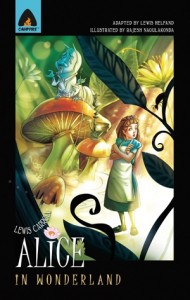
Adapted by Lewis Helfand, illustrated by Rajesh Nagulakonda, and colored by K.G. Prasanth, Campfire's Alice in Wonderland is a splendid, tasteful, beautiful take on the Lewis Carroll classic. Further, it offers information about Dodgson and the texts that make up the Alice lore before the story and after its finish offers information on mythical monsters that might have inspired the author.

It's easy to adulterate an Alice story, especially given some folks' thoughts in its writer's closeness with little girls and the camera, but this adaptation hits all the right notes. It is so good, in fact, that it is one adaptation that I wouldn't mind giving to reluctant readers or struggling readers in place of the original, and that is not usually a tactic for which I advocate. Pairing and braiding is better, almost always, in my opinion, but that I can praise this text with such an aberrant stance should be read as faith in it as an engaging, witty, and close approximation of the best that the original has to offer.

While I am usually resistant to recommend adaptations, I can wholeheartedly recommend Campfire's Alice in Wonderland.

Waiting for Superman Film to Debut Soon

The makers of the documentary film Waiting for Superman sure know how to use a comics reference (or are they channeling Nietzche?).

It's already getting some big press, and teachers are responding. Here's an editorial by Dan Brown, a teacher at one of the schools profiled in the film, for example (thanks, MH!). Here's a review from EW.Com. Here's a review from Politics Daily. It reveals the inspiration behind the film's title:

The Superman in the title comes from a quote early in the film by Geoffrey Canada, founder of Harlem Children's Zone, who remembers his disappointment as a child and comic book fan to learn that there is no superhero in our culture that can fly into a crisis and set injustice right. But Mr. Canada proves there are still heroes. The engaging, charismatic teacher's vision to end the cycle of poverty serves 17,000 New York City children in Harlem's 100-block area.

Sorry, Friedrich.

Looks like 2010 is going to be an interesting year in education. And how very,very interesting to see a comics mythos thrown into the mix. Will this bode well for comics-and-literacy advocates or foster some sort of backlash? Or will the Superman reference go noted but largely unexplored?

News from MakeBeliefsComix!

From Bill Zimmerman, creator of MakeBeliefsComix.com:

MAKEBELEIEFS COMIX LAUNCHES FREE SUMMER FUN FACEBOOK FEATURE FOR ESL, LITERACY STUDENTS; THEY’LL CREATE COMICS ON NEW THEMES EACH WEEK, AND SOME WILL BE POSTED ON OUR FACEBOOK WALL

Dear friend of MakeBeliefsComix,

I’m excited to let you know about some of the new things available on MakeBeliefsComix.com, the online comic strip generator used in literacy programs.

MakeBeliefsComix.com each week is posting a new theme or topic for students to create a comic strip with our comic strip generator and submit to us. After reviewing all submissions, we’ll select a sample to post on our Facebook wall.

'The theme for [the first week of August was]: ‘’You and Your Friend Share Happy or Funny Memories.’’

Our educational online comic strip site also has added another feature that enables users to post their comic strips on their very own Facebook walls.

Those who create a comic strip and send it to themselves will receive an email with two links: one to view and print the comic, and the other allowing them to post the comic to their Facebook wall to share with friends and family.

Posting or publishing these comic strip creations in a public arena helps validate all the effort a youngster puts into creating the comic.

Since MakeBeliefsComix.com was launched four years ago, over 2 million people from 175 countries have visited our free educational resource.

Google and UNESCO named us as among the world's most innovative web sites that encourage reading and literacy and we won the Parents' Choice Foundation’s Recommended Award.

This year the American Library Association selected MakeBeliefsComix for its annual ‘’Great Web Sites for Kids ’’ listing.

The site offers 80 different characters, blank talk and thought balloons to be filled in with text, story prompts and printables, and accepts text in English, Spanish, French, Italian, Portuguese and Latin.

Our site is used by educators to teach language, reading and writing skills in an easy, fun way. It also is used by students in English as a Second Language programs to facilitate self-expression and storytelling, as well as to gain computer literacy.

Some educational therapists use the online comics for children with autism or for those who are deaf to help them understand concepts and communicate. Parents and children also can create stories together, print them to create comic books or email them to friends. There also are printables and writing prompts on the site.

Please try the new summer fun feature with your students and children! We want to be the best educational web site we can be for you. We hope you will share what we are doing with your colleagues, your family, and friends.

~~~~~~~~~~~~~~~~~~~~~

Bill really is doing some great work, so I hope you'll consider checking out his site.

As well, later this month his new interactive comic book for boys, Your Life in Comics: 100 Things for Guys to Write and Draw, will be issued by Free Spirit Publishing. Readers will be able to help create the book by filling in talk and thought balloons for different situations, as well as creating their own comic strips within the book.

Interactive comics assisting literacy, creative writing, and composition! Gotta love it!!!

2010 Graphic Making Contest Award Winners!


Thanks to Mark Clegg for sharing this link to this contest sponsored by the San Jose Public Library, with help from Hijinx Comics, SLG Publishing, and TRY Japan Culture Group.

You can click the link embedded in this post's title to see the top three winners in each of three categories, Children's Contest, Teen Contest, and Adult Contest.

The Comic Book Project Turns 10 Years Old!


It seems hard to believe that Michael Bitz's creation has been around for a decade, but it has. And thank goodness, as the work of those involved has offered qualitative data that creating comics is a complex and very worthwhile educational endeavor.


For those interested, the theme of this year's nation-wide project is "History Goes Graphic!" A press release informs that,"Students will plan, write, and design original comic books that demonstrate a deep understanding of past events and people. Going beyond the names and dates, students use their creativity to make history come alive in the form of a comic book."


Here's a link if you want to participate.


The press release also draws attention to a comic created in Imperial County, California. Entitled I am Migrant, the comic "chronicles the life experiences of migrant youth and their families." That's pretty important stuff around these parts!

Monday, August 09, 2010

Greg Burgas' Argument for Comics as the Most Versatile Art Form

Awesome Story About Lily Renee Phillips' Comics Life/ Real-World Struggles

_Koko Be Good_ Be Pretty Darn Good

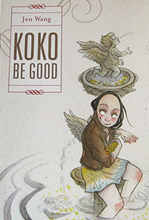
Jen Wang's first graphic novel, Koko Be Good, is about two unlikely friends trying to be better than they think they are by glomming on to others and one tag-along second-stringer who knows who he wants to be but feels pressured to ignore his passions.

Koko, an eclectic 20-something, has been living for herself for a while, the rest of the world be damned. Jon is giving up his love of music and every other semblance of his own identity to follow his older lover Emily to her homeland of Peru. Faron is an amazing youngster with acrobatic talents, a strong guy punch-and-kick combo, and a love for musicals that he feels marks him as less than manly.


When John and Koko haphazardly meet, their lives change and they begin to understand their true callings. Koko decides to "be good," whatever that means, Jon decides to live his own life, and Faron, ever along for the ride, at least decides to embrace his loves.


The book works and works well. While I don't think we're supposed to resolve that "being good" means being true to one's self -- not exclusively, anyway -- Wang captures a sort post adolescence zeitgeist for the 21st century like Dan Clowes' Ghost World did for the late 20th.


The earth tone-based coloring is amazing. The entire text feels like terra cotta. The palette ranges from an eggshell white, through a host of oranges and browns, to wet charcoals and the occasional inky black. Matched with an expressionism for characters and a realism for scenery, the art alone is worth the experience of reading the book. But, the story is just as enchanting.


Friday, August 06, 2010

Article on Comics and Literacy from From the Mixed Up Files blog

...features our good friend Chris Wilson, among other goodies.

Talk on College Courses on Graphic Novels at Columbia/Barnard

As part of some high schoolers' pre-college courses, but still.

Preview Chatter on the Comics in Super-Powered Word Study

Click the link to visit Maupin House's blog, where I talk a little about each of the 15 mini-comics in the upcoming Super-Powered Word Study.

Thursday, August 05, 2010

Available for Pre-Order!: Super-Powered Word Study

Just happened to find this while doing a book search on Amazon. I had no idea this page was up, but you can pre-order my next book by clicking the link embedded in this title! If memory serves right, it comes with both a CD-Rom and DVD.

Must Read: _The Unsinkable Walker Bean_

I just finished Aaron Renier's graphic novel The Unsinkable Walker Bean and found it to be the most enjoyable, fun, and exciting graphic novel I have read this year.

A nautical adventure beset with magic, mystery, pirates, puzzles, and mythology, the text is exquisitely colored and drawn in a style reminiscent of the Tin Tin adventures but with a contemporary, harder edge.

Pudgy protagonist Walker Bean, innovative, clever, endearing and driven, is instantly relatable and lovable as the youngster who seeks to save his sick grandfather while battling his dad's disinterest, among many other fantastical foes.

The friends he makes along the way are well-developed characters, and the story has a well-paced build. While this text doesn't end, except to mention the upcoming book 2, it does wrap up nicely and does not leave one with a sense of being tricked out of a complete narrative experience.


While I don't mean to degrade this wonderful book when I suggest that so far 2010 hasn't been as impressive a year for graphic novels as 2009 was, The Unsinkable Walker Bean has definitely made my list of the year's best graphic novels.

Superman's First Apperance Saves Family from Losing House

Another great story that illustrates that sometimes superheros, comics, and books in general really can save people.

Wednesday, August 04, 2010

More Dore Ripley at GNR: Comics Adaptions of Edgar Allan Poe

Dore Ripley traches ad Diablo Valley College and at Cal State East Bay. She has used graphic novels in several of her courses and continues to illustrate their value to her college students.

The Image that got away (Just for fun!)

While not all 15 comics shorts from Super-Powered Word Study were represented in the unofficial promo video I recently posted, this image below was supposed to make it. Can you tell what we're spoofing here?

Monday, August 02, 2010

Review of _Tall Tales_ (Bone)

If I told you I wanted to share with you reflections on a story called "Big Johnson Bone vs. The Cobbler Gobbler," would you think my thoughts would be safe for work?

Despite the adulterated interpretation that particular short story might inspire, the latest installment of Jeff Smith's Bone series, Tall Tales, crafted with help from Tom Sniegoski, retains the core texts' jovial spirit and enjoyable readability. Sure, there are obligatory gas gags and over-inflated rhetoric, but that's all part of the fun.


The first story in Tall Tales is a framing device. Smiley and Bartelby the baby rat creature are now leaders of young Bone scouts rather than comic relief, and as they lead three scouts into the woods, they begin the series of tall tales. The first is very short and features Fone and Phoney acting true to form as they consider doing or not doing their laundry at Rose's request. Save for a few pages of frame narrative sprinkled about, the rest of the stories revolve around Big Johnson Bone, a larger-than-life Daniel Boone character with a stiff lower jaw and a legendary aire. And a funny name.


The first of the Johnson Bone tales is that of his birth, when, right from the womb, he whipped old man winter and brought the world spring. The second is a story of his young adulthood, when he falls in love with the rootin-tootin' Gertie while trying to defend his crown as the top food eater in all the land. Gertie's claim to fame is her ability to put away cobbler "as well as other food-type items," and Big John, as he is called in this short, mercifully, is impressed.


Alas, once John helps her win the eating contest by a smidge, the gas she passes is time the last the two ever see one another.


As someone who has recently defended Bone from censorship cases, the innuendo -- or possible innuendo -- here bothered me. I felt as though Sniegoski and Smith were trying to egg on those who claim that the other Bone books are more sexual and incendiary than they seem to be to most readers. True, one might say the perversion is in the mind of the reader, but if one wants to keep his texts considered kid-friendly and all-ages reading, I don't know why one would plant such obvious seeds.


The final story adds to the mythos of Big Johnson Bone and the stupid, stupid rat creatures, offering development on the legend of why rat creatures cut off their tales. It's the longest of the three and the biggest romp. The funnest too, if not because of the uncomfortable nuance of "The Cobbler Gobbler," a nuance that younger readers might not even consider, of course, making the text, generally speaking, a good one for most readers, just like the rest of the Bone books.


Tale Tales also features Smith's trademark tenderness and charm along with its adventure and bombast. Despite a bit of authorial trickstering I could have done without, Sniegoski and Smith add to the Bone saga admirably.

Friday, July 30, 2010

Review of _Brain Camp_


Brain Camp is a collaborative effort from Susan Kim, Laurence Klavan and Faith Erin Hicks. It reads like a watered-down tweener version of Black Hole, as if the three wanted to tell a Charles Burns story of adolescence but couldn't really get into the nitty-gritty. The narrative has its moments but lacks development and depth -- perhaps underestimating its tween-teen audience -- and often feels as if it were composed as a series of compromises. Had the storytellers not compressed, and had they dug deeper into the darkness they try to reveal -- the book would have been a much more interesting, mature narrative.

Both Brain Camp and Black Hole deal with young people making strange changes. In Brian Camp, apparently average kids at a camp designed to make them smarter, faster, and homogeneous are becoming like-minded geniuses while also becoming hosts for bird-like aliens. Two 13 year old underachievers, Jenna and Lucas, figure out the plot while getting the pseudo-hots for one another (their teenybopper desires what makes them special among their similarly-aged peers. Yeah, it's a bit of a stretch). They foil plans to turn an entire group of summer campers into hosts, but they seem to lose the war when the big man in charge is named secretary of education.

A Kirkus Reviews blurb distributed from publisher :01 says the book offers "sly social commentary with a fizzy dash of stomach-lurching horror." There is some sort of commentary going on. As a former middle school Gifted Specialist, I appreciated how the authors seem to suggest that we're too quick to label kids or want all children to be "exceptional" based on a very narrow definition of that word. I can even see the text as one that gifted students would appreciate because of how often they feel pressure upon earning or having the label of "gifted" bestowed upon them. But, only using the text with students labeled as gifted would miss the point. Further, the theme might be of interest to some readers, but the lack of depth, which comes off as tailored towards a certain perception of young readers and shackles the narrative, will most likely turn off many. This might be a graphic novel that young folks read once, but I can't see it as one to which many will want to return.


Thursday, July 29, 2010

Wednesday, July 28, 2010

Too Good to Last: Friends of Lulu Shutting Down in Less than a Month

Like Billy Budd or The great Haysoos, things too good for this world have limited time on it. The all-things-women-in-comics Friends of Lulu is closing its online doors.

Tuesday, July 27, 2010

Reflections on Kazu Kibuishi's _Copper_: "I Treat the Letters Like Images"

Copper represents my first serious, sit-down experience with the work of talented Kazu Kibuishi. I've thumbed through his Flight volumes enough to put them on my wish lists, but I've not yet devoured them as is my hope for future days.

That said, Copper is a delightful introduction to his talents. The stories, mostly one-pagers with a few recurring vignettes across the collected shorts which were originally published on the web, are reminiscent of Winsor McKay's Little Nemo in Slumberland, as most of them are adventures based in the imaginations of Copper and his dog pal Fred.

The beautiful and flashy page layouts and proclivity for some of the capers to be dreams in disguise also pair the text with McCay's classic. Indeed, if there is one web comic turned collection that I'd love to see reprinted at the gigantic size of some of the Sunday supplements, it'd be Copper.


To understand the two main characters, consider folks from another classic series, Peanuts. Copper, described as curious, and Fred, mentioned as fearful, are really two sides of the same coin, which makes their time together that much more enjoyable for readers as the duo play off of one another with ease. Think about what you'd get if Charlie Brown kept his neuroses but gained Snoopy's activity (agency?) and sense of adventure, while Snoopy added to his own anxieties by taking on some of Chuck's (angst?) from time to time.


A stickler for thoughts about process as well as product, I was thrilled to see Kibuishi share his "making of" process for Copper after the collection ended. Regarding lettering, he said something that I've heard other comics artists say before but that I feel is important to consider:


"I prefer to hand letter my pages because I like to have control over the composition of every image in the drawing stage.....I treat the letters like images." Letters as just other images to be considered in the overall composition. Yes, yes, yes! Graphein in the 21st century, folks!!

In comics, the difference between the written word and the drawn image, or, shall we say, the written image and the drawn word, can be negligible. And, perhaps that's the best way to see them at all times.


Imagetext is in the text is the image is the text is the textual, afterall!
I've got a revew copy of Kibuishi's Amulet in my office. After having so much fun with Copper, I may have to move it to the top of my pile.

SDCC numbers expected at 125K

Monday, July 26, 2010

Graphic Novel Course at Missouri State

Syllabus for Comics Course (Honors-Level) at University of Maryland

San Diego Librarian Extolling Comics and Literacy Links

Deborah Ford advocates for comics in the library and in the classroom -- and San Deigo Comic Con just happens to be right in her back yard every year!

Oh, Canada (Council of Learning)!

Another paper has picked up the CCL report on comics and male literacy. This article from Epoch Times follows an article from the Vancouver Star that made the rounds a few days ago.

Saturday, July 24, 2010

2010 Eisner Award Winners Announced...

...last night at SDCC. Congrats to the winners, especially Tom Spurgeon, whose Comics Reporter is one of the top 3 comics news websites to which I link.

Thursday, July 22, 2010

_Super-Powered Word Study_ Cover!


Featuring 15 weeks worth of word sorts revolving around a different pair of affixes or roots each week, creative writing-based assessments, extension activities, and exciting comics stories to help students learn and use words in context, Super-Powered Word Study will be available to schools, teachers, and kids across the nation in a few short months from Maupin House. Here's the amazing front cover.

Librarian Recommends GN's for Book Club Selections

See why Bonnie Brzozoski of the Austin Public Library (TX) says they're so good for'em!

_Lunch Lady_ series Writer Offers Advice for Teaching Comics

Graphic Novels Rock ALA 2010

I gotta get on the inside of this ALA stuff. I love GN's; they love GN's. I just don't have an interest in most other librarian interests.... But, this certainly seems to be a place to be.

Read SFSU Students' Thesis on Comics in the Composition Classroom

Ellen Hua Ma's work is posted at The Graphic Classroom via Scribd. She's joined the inimitable Chris Wilson as a writer there, so I hope you'll check in to see even more of her work.

Hofstra U Offering GN Course Focusing on Writing This Summer

...joins universities like Florida, Stanford, Yale, Virginia, Houston, MIT, Syracuse, etc., etc., as campuses teaching comics classes. And to think, it might be another year before I can teach a course specifically on comics. I'd rather get back in that game sooner than later, as you can imagine. :)

Wednesday, July 21, 2010

Thank You, Canada!

...and thanks to Frank W. Baker for drawing my attention to this study about comics, literacy, and their potential intersections among male readers.

Amazon Reports E-Books Outselling Hardcovers 143 to 100.

ICV2 reports that Amazon has been selling 143 E-books to every 100 hardcover for the last three months.

Is this a sign that things are finally changing? Is the new generation of readers going to constitute a Throwaway Culture with their lack of desire for keeping hard copies? Will the more traditional readers constitute dying Hoarder Culture?

And will it matter? Will one be better than the other? As the saying goes, you can lead a hoarder culture, but you can't make it think....

I'm intrigued by the article but don't see it as a harbinger. Show me some numbers comparing E-book sales to paperbacks, and then I'll I know better where things stand.

Monday, July 19, 2010

A Campfire Classic vs. A Campfire Mythology

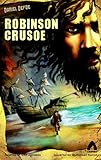
Campfire has sent me a slew of review copies, and I keep being generally impressed. Tonight, I'm going to compare and contrast a book from their Campfire Classic line, Robinson Crusoe (adapted by Dan Johnson, illustrated by Naresh Kumar, colors by Anil C.K.) with a book from their Campfire Mythology line, Ryan Foley's Legend: The Labors of Heracles (illustrated by Sankha Banerjee, colors by Ajo Kurian).


It's not an unnatural pairing considering the religious overtones in both. Crusoe is sort of a 18th century Jesus, and in the early days of Christianity, it wasn't rare for Greeks and Romans to confuse Jesus with the gods in their pantheon. There's more than a little Christ in Hercules.


Regarding the Robinson Crusoe adaptation, Christianity rules the day. Those looking for the critique of government and economy will have to squint a bit, but those who like to read the text as a Christian allegory or Christian coming of age story will be most pleased. Indeed, I can see the text having much utility in Christan schools or Sunday school classrooms.


The coloring in both texts continues the Campfire tradition of offering an intriguing palette. At their best, the images seem to be painted and vibrantly give the pages a warm, active glow. This is especially true for the Heracles book. In contrast, the colors in Robinson Crusoe sometimes live up to Campfire's standards but other times look more like an overdone oil pastel, muddy and ragged. To the artists' credit though, a haggard, rough, jagged line is appropriate when illustrating the trials and tribulations of a mere mortal. Heracles, a man-god, is better suited for beauty.


While the adaptation of Robinson Crusoe sheds a lot of nuance from the original text, Ryan Foley more skillfully parses elements of Hercules' mythos. While I wonder about the historical accuracy of having a young Greek boy paired with a female mentor, Foley frames the narrative such as lovely Lady Demiarties tells the story to young Prenditus, who asks questions at times that Lady D simply says must be answered another day.


Foley also does an excellent job of making sure the more... adulterated elements of Hercules' labors are depicted in a family-friendly manner while also inserting a bit of humor into the text. Perhaps its the extra centuries of lore, or the inherent nebulous nature of myths vs a rather finite core from a source text like a novel, but Foley just seems capable of squeezing more out of his text that Johnson does with his.


For example, in a wonderful example of superimposing, an ovoid panel featuring the face of Eurystheus is placed in a horizontal, rectangular panel in which Heracles shovels poop from his stables. The oval fits neatly "in" the pile of poop, a perfect place for the shithead king.
Then there's the undeniable bit of tastiness that is Heracles petting Cerberus: "Who's a good dog? Huh? Who's a good dog? You are. Cerberus is a good dog."


Both books offer extra information at the end. Johnson offers history of other famous shipwrecks rather than explore the nixed sub-themes of Defoe's masterpiece, and Foley offers the history of several other key Greco-Roman deities to help readers keep the hulking half-god heroes of antiquity distinct.
I enjoyed reading both. I love Daniel Defoe's Robinson Crusoe, so much that I actually explored the theme of middle spaces in my application for doctoral programs, but not necessarily for the same reasons that Johnson's adaptation will bring to the fore. Still, it's an impressive book that will absolutely serve its best purpose as a text exploring Christian themes. Folley's Legend: The Labors of Heracles is an absolute blast, however, a ten out of ten to Robinson Crusoe's worthy 8.

Again, to sum it: It's not that Campfire's Robinson Crusoe isn't strong, it's just not as strong as Hercules.

Marvel's _Runaways_ Getting Film Treatment


Even with the X-Men First Class movie getting so much press, I have to say I'm more excited to see Runaways getting the film treatment. Runaways is the late 20th/21st century teen team in comics, in my opinion. Like the Teen Titans were to the 80s. Sorry, Young Avengers. As I and some of my students have pointed out, Runaways is like Hinton's Outsiders, with super-powers: poignant, engaging, and capturing a certain zeitgeist of youth culture.

Call for Essays: Spider-Man, Spider-Women, and Webspinners: Critical Perspectives


Got something to send this collection edited by Robert G. Weiner and Robert Moses Peaslee? I know I do! Read on for details from the editors:

When Stan Lee and Steve Ditko first penned a short story about a young man named Peter Parker who gets bit by a radioactive spider and becomes the hero known as Spider-Man, little did they know they would be creating the most popular super-hero in history (next to Batman). Like most “happy accidents,” the creation of Spider-Man almost did not happen. It was initially a throw away a story in a magazine that was getting cancelled anyway.

Stan Lee and Steve Ditko had hit upon a character that was different from all the others and one that everyone could relate to. Peter Parker (Spider-Man’s alter ego) was a teenager who had money/girl/family problems that he continued to struggle with even though he had “amazing” powers. He was in high school and had to learn some hard lessons of life. When Parker first got his powers, he used them to make money and get fame. But when he failed to stop a burglar who would eventually kill his Uncle Ben in a robbery attempt, he learned that “with great power, comes great responsibility.” Since Stan Lee wrote those words in 1962, they have become the most quoted comic book words in history and have served as a cautionary note pertinent far beyond the boundaries of the comic or film frame.

Since 1962, there have been no less than 10 different titles featuring Spider-Man, 5 different animated series, a live action series, animated movies, a live action series in Japan, and 3 very successful movies grossing a total of $2.4 billion and breaking box office records

The editors are seeking articles of around 4-6,000 words (No LONGER) discussing the phenomena of Spider-Man or its off-shoots related to the comics, films, animated series, games, television series, history etc.

Some possible topics to be addressed include

  • The real meaning of “with great power comes great responsibility” and Uncle Ben’s life and influence on Peter Parker
  • Dr. Octopus almost marrying Aunt May
  • May Day Parker, Spider-Girl and the alternate universe
  • Spider-Girl as a fan driven title
  • J. Jonah Jameson and his hatred of Spider-Man
  • Spider-Woman the first female off shoot
  • The various Spider-Girls
  • How did Amazing Fantasy 15 change the world?
  • The Death of Aunt May
  • The Clone Saga
  • The various Spidey costumes: Black, Red/Blue/Maroon
  • Venom and Carnage: Why did these particular villains become the most popular of all Spidey Villians?
  • Spider-Man’s role in Civil War
  • The Gwen Stacy affair
  • Spider-Man’s uneasy relationship with the police
  • The Green Goblin (Norman Osborne) and his love/hate relationship with Peter Parker
  • The various Goblins: Green Goblin1&2/Hobgoblin/Demigoblin (What ties them together? Differences?)
  • The artistic style of Steve Ditko
  • The roots of Spider-Man (The old pulp hero The Spider)
  • The writing of Gerry Conway
  • The art of John Romita Sr. and John Romita Jr. on Spider-Man
  • The New Fantastic Four-Spider-Man, Ghost Rider, Hulk, and Wolverine
  • The relationship between Madame Web and Spider-Man
  • Spider-Man’s role in the New Avengers
  • The work of J. Michael Straczynski on the title
  • How did Todd McFarlane change the Spider-Man world both through his art and writing?
  • The first Marvel/DC crossover-Spider-Man meets Superman
  • Why was the live action Spider-Man television series a big flop?
  • Spider-Man 2099-A different kind of Spider-Man
  • Comparisons between Nicholas Hammond and Tobey McGuire as Peter Parker
  • What kind of creative licenses did the movies take that differ from the sequential art stories? How were they similar?
  • Zombie Spider-Man
  • Mary Jane comics and novels: teen romance in the Spider-Man world
  • Spider-Man as an ideal children’s hero
  • Spider-Man fan films and fiction
  • Spider-Man as an ethical gauge for human behavior
  • One of the first Super-Hero record albums: Spiderman: Rock Reflections of a Superhero
  • The Scarlet Spider-who is he? What is his role in the Spidey universe?
  • The Ultimate Spider-Man: What are the similarities and differences between the Ultimate version of the writing of Brian Michael Bendis on Ultimate Spider-Man
  • Spidey Super Stories: An experiment in reading for children
  • Spider-Man overseas? Why do the Europeans love Spider-Man as much as the Americans? What is his universal appeal?
  • Mattie Franklin (Spider-Woman 3) and her relationship to J. Jonah Jameson as a surrogate father
  • Peter Parker’s sister?
  • The Red Skull and the killing of Peter-Parker’s parents
  • The Vulture: A senior citizen as a villain
  • The relationship between Captain America and Spider-Man
  • Spider-Man and his Amazing Friends an animated series featuring Firestar and Ice-Man
  • The Spider-Man family of heroes
  • John Jameson and the Man-Wolf
  • The Transformers: Spidey meets a Hasbro trademark
  • The upcoming Spider-Man movie reboot
  • Spider-Man as a barometer of the various historical periods in which he appears.
  • The psychoanalytic aspects of Spider-Man, Peter, Mary Jane, etc.
  • Spider-Man, Marvel, and the structure of the entertainment industry
  • Spider-Man as ideology or counter-ideology
  • Spider-Man, -Woman fandom and audience practice
  • Spider-Man online
  • Spider-Man as an urban (or particularly a New York) dweller

Please send 200 word abstracts by November 1st 2010 to

Rob Weiner at rob.weiner@ttu.edu

Final papers will be due December 1st 2010. No exceptions. Please note the submission of an essay does NOT necessarily mean publication in the volume. The editors are striving to put together as tight a collection as possible with many diverse viewpoints covering all aspects of Spider-Man’s career.

Authors are also expected to follow the editor’s style guide and be willing to have their work edited.

~~~~~~~~~~~~~~~~

p.s. Like that image of Spidey? Click the pic or visit this link.


Introducing _Super-Powered Word Study_!: Spec Art

(Color mock up for possible cover art)
Coming this fall, Super-Powered Word Study combines word sorting of roots and affixes with elements of dual coding theory, language exploration and awareness theory, creative writing and the best of visual literacy and comics-as-literacy research to bring folks in grades 5 and up exciting weekly activities designed to enhance students' vocabulary and linguistic inquiry skills.

Click the title to this link to learn a little bit more about this project from Maupin House, its publisher. Also, you can do a keyword search for "upcoming projects" on this blog for some teaser images.

While I can't yet show you the cover to the book, I happily show you some spec art for the project below. Enjoy, and if you like these images, just wait till you have the opportunity to see the entire project, set for release fall 2010!

(Various cover designs)

Wednesday, July 14, 2010

New List of Xeric Award Winners Made Public

Since I know several Xeric Grant winners personally (Hey Erik! Hey Jaime! Hey Jai!), I can attest through conversations with them that these monetary awards to help comics creators publish their work are invaluable. Peter Laird's a good dude, and Leonardo, Donatello, Raphael and Michelangelo have assisted a lot of talented people over the years.

_Wilson_, A Bartleby that Prefers....

Dan Clowes' latest graphic novel Wilson -- his first not serialized before being collected -- retains the feel of both a serialized narrative and the rest of Clowes' work. There's the trademark dark humor, subtle at times and rupturously offering social commentary at others, especially when Wilson, the eponymous protagonist, attempts to connect with others. Wilson is deeply personal yet touches on the universal and retains the ties to existentialism and general 2oth/21st century angst that defines so much of Clowes best works: Ghost World, Ice Haven, and David Boring.

What sets Wilson apart as a reading experience, though, is the depth of its ambiguity and the immediate understanding that Clowes may be fucking with us like never before. Wilson can be read as a straightforward narrative about a somewhat hypocritical deadbeat with delusions of betterness, not grandeur, who seeks that sublime epiphany that will give him purpose and offer him reentry into the universal embrace of human existence and essence.

Yet, when the comics form is considered, Wilson can be read as a much more taxing narrative. For example, Clowes' word balloons often look a lot like thought balloons. Are we supposed to believe that Wilson actually says everything that is written and tailed to him? Are there times -- or is there the opportunity, purposefully presented by the author -- to read what he seems to say as something he wants to say or only says to himself? Is the duplicitous nature of Wilson's character on display to everyone who cares to notice, or only to us readers?

As well, the serial feel of the mostly one page vignettes reminds us of how comics play with time and space, not just between each panel, but between chunks of time that may be mere seconds, days, hours, years, or even generations. Wilson clearly ages in this text. His hair goes from brown to dark gray to a lighter gray that to me suggests thinning. But by how much? Yes, Clowes uses several different cartooning styles to represent his characters, offering us visual and color signifiers to resolve as we see fit, but how much time and growth has really taken place for Wilson?

Nowhere is this question more exquisitely on display than in the last page of the novel, where Wilson stares at a raindrop from the corner of a bare room and seems to have the moment of clarity he's been seeking. But, how much time has passed between this vignette and the one preceding it? Many of Clowes' texts end with an existentialist ambiguity laced in action and/or inaction dynamics, but Wilson takes it to the next level. It's not just "what is he doing?" but "where is he at?" He has the "ah-ha," but is he in a convalescent home? Is he in his right mind? Too little of his surroundings are shown, but he appears to be alone and perhaps unable to act on whatever realization he may have had. In the end, Wilson is as he was in the beginning -- as much as we can know of him anyway: a complexity of man who seems to prefer doing, but just as naturally, even self-effacingly, prefers not.

Wilson represents a story typical of Clowes impressive milieu but makes more use of the ambiguities the comics form offers both readers and creators. While Wilson shows strength of character via the irony of being unremarkable, Wilson tugs at the savvy comics reader's sense of form and function and gives just enough critical rope for the comics-informed person to get knotted up in via the possibilities of reader response interpretation.

Wilson leaves readers seeking complexity happily clamouring while Clowes snickers in the corner, the only one who will ever know...

Tuesday, July 13, 2010

If You Liked _Adventures in Cartooning_...

...you'll probably like the new Adventures in Cartooning Activity Book, which really ought to be called an interactivity book.

Everyone's favorite knight is back, this time bored out of her mind during a rainy day. After complaining a bit, her friend suggests she make a comics story and then leads the way through an adventure that the reader gets to help craft.

While the first Adventures book seemed good for all ages regardless of probably trying to target younger kids and teens, the workbook has a decidedly children's book feel to it, but as someone who asks students at all levels to make comics in order to understand the work that goes into them, I can see the book being used in workshops for teachers and teacher educators.

Its one weakness might be that it offers information about comics form at the end, after the narrative experience, where it might have done better to offer it at the beginning, but, overall, this little text is a fun addition to the Adventures line that scaffolds comics creativity via interactive narrative before offering templates and terminology for readers to unleash their own comics-making beasts.

The Adventures in Cartooning Activity Book should be available from First Second any day now.

2010 Harvey Awards Announced

I didn't want to post a link about this yesterday, when Harvey Pekar's death was in the news, but the no-relation Harvey Awards nominees have been announced for 2010.

Hmmm...wonder how many titles are getting the rationale treatment from me and my team of writers? More on that at a later date....

Monday, July 12, 2010

Review: _Ghostopolis_

I had never heard of graphic novelist Doug TenNapel until I received a review copy of Scholastic's 2010 release Ghostopolis. I'm glad I know of him now. While Ghostopolis is not a complex or overly nuanced text, it has enough symbolism and raises enough philosophical issues about living and dying that many young readers should be able to enjoy this journey into an after-life. It also has tons of action and a quick pace, despite its girthy 266 pages, for those who aren't as philosophically inclined.

The story revolves around Garth, a dying child inadvertently zapped into the realm of the dead by a loser ghost catcher, Frank Gallows. Garth is a sort of "chosen one" figure in his new surroundings, and Frank finds love and redemption in his attempts to rescue the boy even as Garth finds courage to live -- once an evil dictator is demolished and everything works out for all the good guys.

As a narrative, information is revealed in a contemporary manga tradition that I find bothersome: as it goes, only when absolutely needed, and without very much build. It often reads like a web comics written in installments or like storyboards for a movie or cartoon series rather than a full-on, self-contained graphic novel. But, this technique is one that permeates certain types of comics and cartoons and should be familiar to younger readers who seem to enjoy a "children's play" pathos.

TenNapel's thin ink line works for the narrative, and the coloring from Katherine Garner and Tom Rhodes is superbly matched to the story. An interesting, pre-adolescent meditation on fantasy and mortality, Ghostopolis caters to the young reader's sense of contemporary storytelling and offers that little bit more for those who are ready to see it.

New APP from TOON BOOKS

Silly Lilly and the Four Seasons joins the ever-growing list of books online for your and your children's reading enjoyment. As always, multiple languages are available to make the experience even more educational! Compare and contrast words in French and English, or even Mandarin!

GNR Profiles Another Teacher Using GN's in the Classroom

This time it's Kent Allin, who teachers seniors at Bayside Secondary School in Ontario, Canada! Allin shares thoughts on his graphic novel course and lets some students have their say as well.

Review of Ayers' and Alexander-Tanner's _To Teach_

The graphic novel adaptation of William Ayers' classic To Teach is an excellent addition to the growing body of texts integrating graphica with literacy and education. The text shows that comics can facilitate not only k-12 education, but teacher education as well.

The book does have it's disappointing moments. For one, Scott McCloud's style, concepts, and words are ripped off in the first few pages and McCloud's influence is extremely under-acknowledged as a source and resource for this text, though it is obvious to anyone who follows comics and literacy that works like Understanding Comics were very influential in choosing phrasing, panel layout, and even art style. At times I found myself saying, "Those gutters don't have to be empty space, Bill!" Using them for footnotes and references would have been a nice nod to works that influenced the original version and this graphic novel edition.
Secondly, Ayers comes off with a signature radical heavy-handedness, which can be off-putting to those who don't share all of his political views. For example, his conversation about white privilege is particularly underdeveloped and seems to lump all white people into one category without regard to socioeconomic status or other factors, a grave and frustrating error to my point of view, and the teachers he profiles as exemplars may constitute a granola-fest of lefties in the minds of some readers.

However, when it comes to stripping down Ayers' message down to its most important essence -- pedagogy should be "enlightening and liberating" and full of constructivist activities and mindsets that make all participants -- students, teachers, and other stakeholders -- active learners who come to the setting with gifts and strengths that should be acknowledged, celebrate,d and built upon -- the text hits a home run.

As a teacher educator, the best way I can endorse the book is to add it to my curriculum, which I will do ASAP. I often teach the main English Education methods class at my current institution, and I make a point to share the sociocultural and sociopolitical realities of teaching. I value students knowing, as best they can, exactly what they're getting into. I value this because it is my hope that students who know what to expect regarding the "nitty-gritty" will be more prepared to acknowledge it and survive it than those who go through programs where the difficulties of teaching are glossed over so graduation numbers stay high and colleges of education retain their status as cash cows.
It is my hope that my students will not be blindsided by all those little factors that add up to contribute to teacher burn-out and attrition rates that are staggering. Not being blindsided, I hope, will translate into handling the pressures of teaching better and longer.


In addition to texts like the ubiquitous Bridging English and Smagorinsky's excellent Teaching English By Design and Stern's Teaching English So I Matters, my students and I also read Wyatt and White's Making Your First Year a Success, which shares insights into how to handle the pressures you really can't know fully until they hit you.

I think To Teach can do an excellent job of reinforcing the constructivist and progressivist philosophies inherent in the "English teacher" texts and balance out the conservative nature of Making while also bolstering its penchant for exploring realities.

Ayers' cartoon avatar deals with pushy, dimwitted administrators caught up in the standards movement; he struggles to keep his classroom learning-friendly, and he finds himself constantly making value judgements that will define who he is as a teacher.

Seeing how Ayers balances his dead-on pedagogy with the demands of others will be of great value to future teachers, and To Teach, despite some aggravating flaws that might go unnoticed to those not familiar with precedent texts (making that weakness all the more egregious), is an invaluable text that should stand the test of time in graphic novel form as it has in its traditional printing.


Looking for more?: Katie Monnin recently interviewed Ayers about his book. Click here to read!

Harvey Pekar Passes Away

I just learned about the death of Harvey Pekar (PEE-car), who might be best known for the film adaptation of his American Splendor. Pekar's work was the epitome of slice-of-life realism, and I'm sorry he won't be making any more work for us. Go read Our Cancer Year, American Splendor, and The Quitter if you haven't. They're all very candid and moving in their own way. May he rest in peace.

Friday, July 09, 2010

Go Read: _The ALAN Review_ 37.3

In the most recent issue of The ALAN Review, there are great articles on film and comics -- even an article written in comics form. It's a good-looking issue.

I was very honored to have guest-edited the issue, and you can see me playing a character I might as well have called "Mr. Incredulous" in my introduction. I was given the charge of situating these essays on the acceptance of newer or possibly "new-to-you" forms into and as YA Lit and decided to give my intro a twinge of the ironic, sardonic, and downright snarky.

I figured, what would the staunch literary traditionalist say about this issue? I concluded it would be something like "It's come to this??" But, deep down, this traditionalist would also be excited (or at least adequately emotionally flustered) about where the articles were pushing adolescent literature and literacy.

You might also see me refute the idea that we're becoming a more visual culture. "WHAT???? Why would YOU say that??" you might ask.

Allow me to explain:

We have to take into account that many of the folks who are telling us that we're moving from a print culture to a visual culture are very much wrapped up in print culture. So, what might be the norm for them might not be the norm for everyone else. Scholars who have to get tenure through the printed word -- and often, that also means the printed page, not alternate forms, for better or worse -- might not have noticed that many of us have been in a visual culture for generations, centuries, even, if they don't value making interdisciplinary connections in their fields of the humanities or social sciences. Perhaps, long ago or even still, there were/are no posters in that office in the Ivory Tower.

As well, some folks seem to glom on to this idea of visual literacy like human beings have only recently developed eyeballs. Remember, the textual is also the visual. There's not a distinction there really, except in how certain graphein (to invoke Kress, or for comics scholars, Groensteen) have been signified or codifed. We read using our eyes; similarly, we use them to view paintings, read comics, etc. Isn't anything we do that filters information through the eyes an act of visual literacy on some level?

Or, as I put it with my students: When do you think we were more attuned to our visual senses, especially in how they related to our other senses? When we were hunting and gathering while playing Grand Theft Auto, or when we were actually hunting and gathering for survival?

So, I don't really think we're entering an era where we're becoming a more visual population, its just that we've become more aware of how the visual is being used to persuade us and influence our thinking and actions. This has lead to us also becoming more aware and accepting of how we can use visual elements of culture to educate folks across the overlapping literacies, from functional to critical, than we might have been fifty or a hundred years ago.

So, really, we don't need to over-sell visual literacy. As those who haven't felt the love of the printed word or the pressures of publishing might remind us, not only have visual forms always been with us and part of us, they often sell themselves as forms of literacy. If only we're willing to see what's available for our viewing.

Not that a little media awareness and knowledge of rhetorical technique isn't a helpful thing, of course. The ones that need the selling the most are those who are most dead set against it as a concept or reality. The real Mr and Mrs. Incredulouses. I'd like to think we can reach everyone, but I've been in education for a long time now. Perhaps the way to handle those most opposed to forms of literature and art that integrate more visuals than more traditional forms is to watch them reading their "imageless" books and humor them as they fool themselves into thinking they are having a pure literary experience without any of those pansy-ass visuals getting in the way. ;)

"But those letters are images too" you want to call out, but let them build the evidence for us while thinking they're making the case against. Sometimes, that is all you can do.

Anyway, go read TAR 37.3. Enjoy the articles -- and Mr. Incredulous!

Thursday, July 08, 2010

Crazy New Censorship Case: Kid Loses Mind Over Manga!

And to think, my files for the upcoming Rationales for 100 + Graphic Novels reached the copy editor at our publisher yesterday, the same day as this story broke. Certainly, if I need to add or revise the introduction, this tale will make it.

Did you read the inks? That's right, Manga can make you crazy. Surely you don't have to have any emotional distress at all before reading a manga and going completely insane. Me? I'm just surprised the book in question is Psychic Academy and not Twilight: The Graphic Novel.

Wednesday, July 07, 2010

Dabeling in Graphic Novels for Young Adults

I missed this big announcement from the most recent ALA convention. Expect more adolescent literature-type GN's soon

Tuesday, July 06, 2010

Want Me To Invade Even More of Your Life?

I'm now on Facebook, in a professional manner, of course. Feel free to "friend" me. Please, let me decrease your productivity at work. ;)

Monday, July 05, 2010

Interesting Article in War Comics

Court Transcripts: Superman vs. Wonder Man

Hardcore fans know what I'm referring to. Captain Marvel wasn't the only character DC went after. To think, we once lived in a time where you could get sued for making a knock-off of Superman.......

Sunday, July 04, 2010

Happy 4th!


I've written one of the few scholarly articles on this 1950s patriotic cape. See "There'll be Others Converging" in the archives of International Journal of Comic Art!

Happy 4th!

The Shield, the first patriotic super-hero, predated Captain America by several months. Pep Comics really took off after issue 22, when it introduced a soon-to-be iconic teenage carrot top, Archie.

Saturday, July 03, 2010

The "A" stands for "Awesome"

Erik A. Evensen (MFA, Ohio State University) and I are teaming up on a comics-and-literacy related project due out this fall. Erik is an award-winning artist who earned the Xeric Grant to help him publish his first graphic novel Gods of Asgard, which is about to gain global distribution. In this clip, you can see him profiled by Lakeland Public Television, based in Minnesota. You'll also see him working on some preview art for our project! :)

Thursday, July 01, 2010

WTF??: Zuda Offline

Dammit! Zuda Comics, DC's web comic presence, is shutting down and repackaging how it will distribute its titles. This means no more free Bayou by the page, which sucks. It also means I probably need to rewrite part of an essay again. Hey, you write about the online world, you mess with Lady Change. Wonder if Zuda will be archived and accessible through the Way Back Machine?????