A Public Service Announcement! ;)

Showing posts with label 2010. Show all posts
Showing posts with label 2010. Show all posts
Saturday, February 05, 2011
Harvey Awards and Eagle Awards Seeking Nominations!
Click here for the Eagles and here for the Harveys. The Eagle Awards have a nomination for best comics-related book, if anyone wanted ot nominate a certain blogger..... ;)


Thursday, January 20, 2011
Ninja, Please! : Ruben Bolling's Comic on the Huck Finn Controversy
 Yes, I think the n-word should stay in all editions of Adventures of Huckleberry Finn. Erasing history only helps us to repeat it, and not facing uncomfortable feelings and conversations doesn't do anything to make anything better.
On the other hand, as a ninja, I know how hurtful it can be to hear someone use an n-word in a derogatory manner. And, I know how hurtful it is to have your particular n-word appropriated in the place of another hurtful n-Word. "Ninja, What?" "Where my ninjas at?" "What up, my ninja?" When will the pain cease?
When these kids realize that real ninjas bring real pain, that's when! Hye-yah!
Forgive me for my crass spin on "Ask a Ninja," but do give thanks to Ruben Bolling for offering some comics commentary on this latest flapdoodle and hoo-hah.
Wednesday, January 19, 2011
Best Web Comics of 2010, According to Derik A Badman..
..and linked from Dylan Horracks, so you know there's some quality thinking going on! I don't give web comics near enough attention, but I hope to remedy that a bit in my New and Multimodal Literacies course this semester, and in future courses too..
Tuesday, January 18, 2011
And Now, A Shitty Review...of *The Zabime Sisters*
 Classes start for me tomorrow, and due to a university-wide failure of the webmail system, I am unable to complete the last task I had on today's agenda: sending out virtual copies of my syllabi.
My loss is your... "also loss," however, as this gives me time to write a review of Aristophane's The Zabime Sisters, a book getting high praise from Matt Madden and YALSA/ALA, which listed it as among the best graphic novels for teens this year.
I don't get it, at all. Or, if I do get it, I see it as more evidence that 2010 year was a relatively weak one for graphic novels.
The story is one of three sisters growing up in the jungle town of Guadeloupe. They get bored, get a little drunk, a little flirty, and then go home. The most interesting characters are the boys who fight over them, or for their own reputations, simply because fighting is a way in which the young men of the village earn status and divvy up their self-imposed caste system. There is little growth for the female leads, and while I'm typically a fan of slice-of-life fiction, I like it to go somewhere. The Zabime Sisters doesn't offer much direction for reader or the girls.
What's worse, the dry brush ink technique that has been praised by others seems to me poorly applied. The characters often blend into the thick scrapes of landscape, and while I suppose this could have been intentional, the affect falls as flat as the story for me.
I'm not saying this graphic novel is terrible, but it doesn't strike me as deserving of as much praise as it has garnered. Madden calls it a bit of a departure from Aristophane's other work, which I really do want to check out, a happy consequence of reading this translation. I prefer the term the Frenchman used to describe The Zabime Sisters, himself, though: modest.
The Ultimate "Best Of 2010" List of Links...
..synthesized by Tom Spurgeon, of course! The man's a machine!!!
Sunday, January 16, 2011
2011 Great Graphic Novels for Teens
Wednesday, December 15, 2010
Tigra and Pym Discuss Parenting in *Avengers Academy* #7

I gotta say, I think Incredible Hulks and Avengers Academy are the best two superhero comics series on the market.
Friday, December 03, 2010
Publishers Weekly Gives ALAN 2010 Some Press
And since graphic novelists George O' Connor and Barry Deutsch were presenters, I can mention it here!
Friday, November 19, 2010
Kirkus Reviews Offers Best GN's for Teens 2010 List
El Paso's own Cinco Puntos Press has a title on the list too!: Mr. Mendoza's Paintbrush by Luis Alberto Urrea and Christopher Cardinale. (Thanks to CP for giving me a review copy at NCTE. I'll offer my own review very soon).
Monday, November 08, 2010
Publisher's Weekly Best Comics List
I agree with Tom Spurgeon on Comics Reporter that this list seems a little specious.
The Comics Equivalent of Wal-Mart Hanging Up Christmas Stuff Post-Halloween...
...is the posting of "Best Of" lists. Click the title for Amazon's best GN's of 2010 and their list of best-sellers. Equivalent.
Come See Me and the Entire School of Comics and Graphic Novels at the 2010 Miami Book Fair!
Introduction and Welcome
10:00–10:05 a.m.Carol Fitzgerald, Founder of GraphicNovelReporter.com
Session 1
10:05–10:55 a.m.Using Graphic Novels to Open a Different Door to Literacy with Dr. James “Bucky” Carter
Why do graphic novels and comics work so well as a breakthrough tool in reaching challenged and reluctant readers? How does a graphic novel or comic hold the attention of gifted readers and reluctant readers alike? Dr. Carter discusses the effectiveness of the comics medium from a personal perspective, and helps educators discover how to use comics to help students develop a love for reading and learning. Dr. James "Bucky" Carter is the author of Building Literacy Connections with Graphic Novels (NCTE).
Session 2
11:00–11:50 a.m.Your Life In Comics: Using Do-it-Yourself Comics to Foster a Love of Reading, Writing and Creativity with Bill Zimmerman
Most educators understand that playing can also mean learning and this session will show how the fun process of creating comics can encourage children to practice language, reading, writing and communication skills. Bill Zimmerman is an award-winning author and has written more than a dozen books used by families, children and schools, including his most recent title, Your Life in Comics: 100 Things for Guys to Write and Draw.
Lunch
11:50–12:50 p.m.
Session 3
1:00–1:50 p.m.Connecting the Library and the Classroom: Developing a Brilliant Partnership and Resource for Teacherswith Librarian Kat Kan
Kat Kan is a leading voice in the development of the graphic novel category for public libraries. This session will address the value of resources available to educators, parallels between prose and graphic novels and how graphic novels can support in-class learning. Kat Kan has worked in school and public libraries. She has served on the Best Books for Young Adults Committee, among others, and she chaired the YALSA Graphic Novels Task Force, which recommended the creation of the Great Graphic Novels for Teens Committee. Kan also created the selection criteria for Brodart Company’s graphic novel collection development program and currently selects the recommended titles for their core lists.
Session 4
2:00–2:50 p.m.Developing a Graphic Novel Project for the Classroom with Dr. Adam Johnson
When professors Adam Johnson and Tom Kealey created the Graphic Novel Project at Stanford University, they discovered an incredible opportunity to introduce a collaborative environment where students from a wide variety of disciplines could come together to script, draw, edit and publish a graphic novel. What does it take to create and publish a graphic novel within a classroom setting? How do the students benefit from the program? Dr. Adam Johnson developed and implements the Stanford University Graphic Novel Project.
Session 5
3:00–3:50 p.m.The Art of Story Telling in the Graphic Novel Formatwith Professor Chris Schweizer
When it comes to creating the look and feel of a graphic novel, the author/creator draws on a wide range of influences and experience to bring characters to life. How does a swarthy pirate really sound? How do you show fear or real joy? To create a story in the graphic novel format, an artist and author has the fantastic opportunity to use separate skill sets. Chris Schweizer created the graphic novels Crogan's Vengeance and Crogan's March (Oni Press).
Friday, November 19
Educational Sessions for Comics and Graphic Novel Creators of All Ages
Session 1
10-11:30 a.m. Women Making Comics, A New Generation
For years comics and graphic novels were viewed as mostly a “boy thing.” Lately, the participation of women in comics-making has grown exponentially. From stories for the ‘capes and tights’ genre to biographies, adaptations and memoirs, get the scoop from four members of this new generation of women creators on writing comics and graphic novels. How do they approach story telling? What comes first, drawings or dialog? Where do they start the process, and does it come out the way they had planned? Amy Ignatow, The Popularity Papers Raina Telgemeier, Smile Tracy White, How I Made It to Eighteen Amanda Conner, Power Girl
Session 2
11:30-1:00 p.m. Brain to Hand to Paper: Getting Your Comics/Graphic Novel Done
Have a great idea for character? A story? A series? Get it done!
Four creators talk about the process and offer advice on how you too can get your comic book /graphic novel completed and published. Barry Deutsch, Hereville: How Mirka Got Her Sword Mark McKenna, Banana Tail Alex Rodrik, Bushido Wasabi David Steinberg, The Adventures of Daniel Boom AKA Loud Boy
FREE. Registration required. Please use registration form at the upper right of this page (above presenters' photos). For additional information, please call 305.237.3841or 305.237.3298.
10:00–10:05 a.m.Carol Fitzgerald, Founder of GraphicNovelReporter.com
Session 1
10:05–10:55 a.m.Using Graphic Novels to Open a Different Door to Literacy with Dr. James “Bucky” Carter
Why do graphic novels and comics work so well as a breakthrough tool in reaching challenged and reluctant readers? How does a graphic novel or comic hold the attention of gifted readers and reluctant readers alike? Dr. Carter discusses the effectiveness of the comics medium from a personal perspective, and helps educators discover how to use comics to help students develop a love for reading and learning. Dr. James "Bucky" Carter is the author of Building Literacy Connections with Graphic Novels (NCTE).
Session 2
11:00–11:50 a.m.Your Life In Comics: Using Do-it-Yourself Comics to Foster a Love of Reading, Writing and Creativity with Bill Zimmerman
Most educators understand that playing can also mean learning and this session will show how the fun process of creating comics can encourage children to practice language, reading, writing and communication skills. Bill Zimmerman is an award-winning author and has written more than a dozen books used by families, children and schools, including his most recent title, Your Life in Comics: 100 Things for Guys to Write and Draw.
Lunch
11:50–12:50 p.m.
Session 3
1:00–1:50 p.m.Connecting the Library and the Classroom: Developing a Brilliant Partnership and Resource for Teacherswith Librarian Kat Kan
Kat Kan is a leading voice in the development of the graphic novel category for public libraries. This session will address the value of resources available to educators, parallels between prose and graphic novels and how graphic novels can support in-class learning. Kat Kan has worked in school and public libraries. She has served on the Best Books for Young Adults Committee, among others, and she chaired the YALSA Graphic Novels Task Force, which recommended the creation of the Great Graphic Novels for Teens Committee. Kan also created the selection criteria for Brodart Company’s graphic novel collection development program and currently selects the recommended titles for their core lists.
Session 4
2:00–2:50 p.m.Developing a Graphic Novel Project for the Classroom with Dr. Adam Johnson
When professors Adam Johnson and Tom Kealey created the Graphic Novel Project at Stanford University, they discovered an incredible opportunity to introduce a collaborative environment where students from a wide variety of disciplines could come together to script, draw, edit and publish a graphic novel. What does it take to create and publish a graphic novel within a classroom setting? How do the students benefit from the program? Dr. Adam Johnson developed and implements the Stanford University Graphic Novel Project.
Session 5
3:00–3:50 p.m.The Art of Story Telling in the Graphic Novel Formatwith Professor Chris Schweizer
When it comes to creating the look and feel of a graphic novel, the author/creator draws on a wide range of influences and experience to bring characters to life. How does a swarthy pirate really sound? How do you show fear or real joy? To create a story in the graphic novel format, an artist and author has the fantastic opportunity to use separate skill sets. Chris Schweizer created the graphic novels Crogan's Vengeance and Crogan's March (Oni Press).
Friday, November 19
Educational Sessions for Comics and Graphic Novel Creators of All Ages
Session 1
10-11:30 a.m. Women Making Comics, A New Generation
For years comics and graphic novels were viewed as mostly a “boy thing.” Lately, the participation of women in comics-making has grown exponentially. From stories for the ‘capes and tights’ genre to biographies, adaptations and memoirs, get the scoop from four members of this new generation of women creators on writing comics and graphic novels. How do they approach story telling? What comes first, drawings or dialog? Where do they start the process, and does it come out the way they had planned? Amy Ignatow, The Popularity Papers Raina Telgemeier, Smile Tracy White, How I Made It to Eighteen Amanda Conner, Power Girl
Session 2
11:30-1:00 p.m. Brain to Hand to Paper: Getting Your Comics/Graphic Novel Done
Have a great idea for character? A story? A series? Get it done!
Four creators talk about the process and offer advice on how you too can get your comic book /graphic novel completed and published. Barry Deutsch, Hereville: How Mirka Got Her Sword Mark McKenna, Banana Tail Alex Rodrik, Bushido Wasabi David Steinberg, The Adventures of Daniel Boom AKA Loud Boy
FREE. Registration required. Please use registration form at the upper right of this page (above presenters' photos). For additional information, please call 305.237.3841or 305.237.3298.
Monday, November 01, 2010
2010 Friends of Lulu and Eagle Award Winners Announced!
Friends of Lulu and the Eagle Awards for 2010 have been announced.
Thursday, October 21, 2010
New GN Award: The Lynd Ward
The Pennsylvania Center for the Book, Penn State and the University of Pennsylvania announce that:
The Lynd Ward Graphic Novel Prize will be presented annually to the best graphic novel, fiction or non-fiction, published in the previous calendar year in the United States by a living American citizen or resident. The announcement of the award will take place each spring and the prize of $2,500, the two volume set of Ward’s six novels published by the Library of America, and a suitable commemorative will be presented each fall to the creator(s) of the award-winning book at a ceremony to be held at Penn State.
Friggin' Sweet! And I didn't know that Ward's work had been donated to the libraries at Penn State!
The Lynd Ward Graphic Novel Prize will be presented annually to the best graphic novel, fiction or non-fiction, published in the previous calendar year in the United States by a living American citizen or resident. The announcement of the award will take place each spring and the prize of $2,500, the two volume set of Ward’s six novels published by the Library of America, and a suitable commemorative will be presented each fall to the creator(s) of the award-winning book at a ceremony to be held at Penn State.
Friggin' Sweet! And I didn't know that Ward's work had been donated to the libraries at Penn State!
Tuesday, October 19, 2010
Review of *Best American Comics 2010*
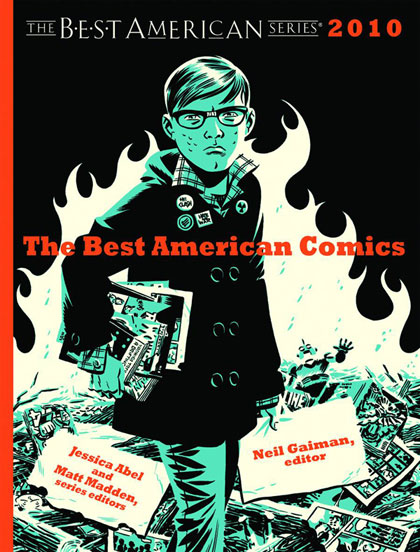
An angry adolescent peers at you while a fire rages behind him. He seems to say, "Burn my comics, will you? Fine! I'll burn down your house!"
Alas, the house seems to be his family's, so it's actually his house too, but his defiance is undeniable.
And that, my friends, describes the cover and the reading experience that is Best American Comics 2010. Edited by Neil Gaiman, the anthology has interesting pieces that are accessible to a reader but that push away, as if to suggest, "I'm complicated!" when one considers why Gaiman made his choices.
Of course, this line of thinking suggests a sort of "cult of the superstar" surrounding Gaiman, but that's part of the fun of this series: seeing who the new editor is, being impressed, then seeing what he or she thinks makes the grade for inclusion.
Series editors Jessica Abel and Matt Madden suggest a Golden Age of comics accessibility, and Gaiman's introduction plays off the comment by mentioning that a CIA study suggests that "comics are the easiest way to assimilate information." Gaiman soon adds pull to push, though, mentioning Lynda Barry's previous Best American Comics sentiments that comics are democratic while anthologies are by nature discriminatory, especially one that asks its editor to consider what "American" means alongside "best."
That's not to suggest he's complaining. Gaiman simply wants his audience to feel a bit of his experience and to realize that push and pull are the guiding dynamic of his work for the series.
I suspect we can see that in the first two selections as well. I honestly think that Gaiman probably wanted to lead with "Ceci N'est Pas une Comic" but decided it would be too politically scathing a start, thereby helping a section from Lethem and Dalrymple's Omega the Unknown occupy the first pages.
Standouts include Lilli Carre's excerpt from The Lagoon, which interjects magical realism in a section with lots of slice-of-life entries, and Ames and Haspeil's excerpt from The Alcoholic, which is bound to be cited in thesis upon thesis on comics and 9/11.
The excerpts from Asterios Polyp, Genesis, and A.D. New Orleans After the Deluge seemed to be obligatory, as did the short from Scott Pilgrim, but that's sort of the joy in seeing them in there. Gaiman gets to play with commercial successes and critical successes as he sees fit. And throwing in a little name recognition vis a vis the movies can't hurt, right?
I can't help but see Gaiman throwing papers around a small room, nerve-wracked, saying to himself, "I can't not put so-and-so in there! Look at the press and notoriety they've gained this year! It's good for the medium! And isn't '2010' in the title to the damn thing??" :)
The story that surprised me the most was "The Bank," which, based on the art, I thought I would hate, but I ended up enjoying the 1980's tale of The Clash and other main characters, um, clashing and pulling against the push of popular music. The hyper-charged vibe from that text, which oozes a sort of 80s masculinity, is aptly juxtaposed with Chris Ware's sniveling sad sack entry from the Acme Novelty Library.
Note to Chris: They do make other types of men worthy of being a main character! ;)
I also enjoyed the sweet "Lobster Run" more than I expected and appreciated the reintroduction to Fred Chao, who is more diverse an artist than I've considered. The push of that action-driven love story is balanced by the pull of the next selection, which also explores the theme of intimacy, but via two homosexual males meeting for drinks after calling it quits. "Ex Communication" is endearing in its difference to the text that precedes it but similar enough in theme that this section flows well, possibly even adding more sentimentalism to a reading of "Norman's Left Arm," the story following these two, than is necessary.
Of all the selections, only Michael Cho's "Trinity" made me rush to the front matter to learn what larger collection it was part of (but this is because I had already read many of the other texts excerpted). I absolutely must learn more about Taddle Creek and appreciated finding a story that spoke to my generation's concept of modernity and progress and fear. "Trinity" would have made an excellent juxtaposition with "The Alcoholic" in that both texts together, perhaps along with "Ceci N'est Pa," illustrate the defining anxieties of those born pre- 9/11 and those born near or afterwards and just how different the definitive worries are for folks of a certain era in comparison with younger folks' zeitgeist stresses. Placing those texts one after the other would have been too obvious a choice, though, and having them scattered away from one another allows for a consideration of theme and sub-theme in a way that having them in sequence would have cheapened.
Completing the anthology is another short from Chris Ware which sums up the tensions of the text while also contemplating the fissures of fiction and nonfiction, the comics form, and even a little bit of life itself. "Fiction Versus Nonfiction" plays with memory, representation, meaning- making, and the various joys of reading. Ware reminds us of the interplay, the push and pull of being known and being foreign, of being real and... not quite...
Who better to have assimilated a collection of such texts than the man who knows how to mine that space better than almost any other? Make no mistake, Gaiman knows what he is doing, and the end result is another intriguing edition of the Best American Comics series.
Thursday, September 30, 2010
1 in 4 Comics Readers is a Senior Citizen
One of the prevailing myths I often hear from academics/educators who study comics is that teachers need to be careful not to co-opt this form of literature from their students. The assumption is that comics reading is the domain of youth culture rather than pop culture, that comics "belong" to kids rather than to everyone.
The truth is that for a few decades now, the average age of the comics reader has been rising. Many feel that 40 year old men have made up the bulk of comics readership for the last twenty years. And, of course, there's that fact that in comics' heyday, almost everyone read comics. In other cultures, sequential art is enjoyed by multiple segments of the population as well.
To further attempt halting the concept of comics as youth culture, consider that Simba Publishing just releases a report stating that 1 in 4 comics readers is over 65 years old.
As the press release reads, "Despite notable efforts from many in the industry, comics and graphic novels continue to be repeatedly mislabeled as just another children’s book category,” said Warren Pawlowski, online publishing manager for Simba Information and an analyst within the company’s Trade Books Group. “With nearly a quarter of the comic reading audience beyond the age of retirement, there is a misconception that needs to be corrected.”
Yep. Or should I say, Yessiree! Also see here for a broader overview of the comics and GN market. If you have the Benjamins, that is! (You'll see what I mean)
The truth is that for a few decades now, the average age of the comics reader has been rising. Many feel that 40 year old men have made up the bulk of comics readership for the last twenty years. And, of course, there's that fact that in comics' heyday, almost everyone read comics. In other cultures, sequential art is enjoyed by multiple segments of the population as well.
To further attempt halting the concept of comics as youth culture, consider that Simba Publishing just releases a report stating that 1 in 4 comics readers is over 65 years old.
As the press release reads, "Despite notable efforts from many in the industry, comics and graphic novels continue to be repeatedly mislabeled as just another children’s book category,” said Warren Pawlowski, online publishing manager for Simba Information and an analyst within the company’s Trade Books Group. “With nearly a quarter of the comic reading audience beyond the age of retirement, there is a misconception that needs to be corrected.”
Yep. Or should I say, Yessiree! Also see here for a broader overview of the comics and GN market. If you have the Benjamins, that is! (You'll see what I mean)
Sunday, September 26, 2010
GNR Synthesizes NCTE 2010's GN-related Programming
 Click this post's title to see a brief rundown the graphic novels-related programming taking place at NCTE in Orlando this November.
Interesting, that one with the description about graphica's "abstract
promises."
Sometimes the level of "literal want" from teachers can be frustrating, i.e. sometimes some educators seem to think that things that aren't spelled out for them 100% and might require them to use a little bit of their own knowledge and creativity aren't worthwhile.
It's like the system has sucked out so much of their independence and creative thought that they've become programmable robots.
The "I'm busy! I need it all spelled out for me!" argument -- I'm sympathetic to it because I know teachers are asked to be so many things, but I'm angry at it when I see teachers acting like they have the inability to synthesize, evaluate and construct novel ideas based on a set of basic or broad premises. I'm downright heartbroken when I realize some of them probably don't have those abilities, or they had them once but have had them slowly wither like a dying limb on a tree otherwise completely capable of sustaining life and real living.
Anyway, I should point out that I'm pontificating based on a phrase, not actually seeing the presentation that used it, which I'm sure will be awesome.
Please do check out these GN-centric sessions at NCTE!
Monday, September 20, 2010
Matt Fraction Wins a PEN USA Literary Award
Marvel writer Matt Fraction is the first comics author to win a PEN USA Literary Award. He wins for "Graphic Literature" and will forever be the first to do so, since 2010 is the first year these awards have been given from the center which strives to "stimulate and maintain interest in the written word, to foster a vital literary culture, and to defend freedom of expression domestically and internationally."
Congrats, Matt Fraction!
Congrats, Matt Fraction!
Tuesday, September 14, 2010
2010 Lulu Nominees Annouced
Friends of Lulu, on the brink of extinction earlier this year, has rallied and posted its 2010 nominees for works for, by, or about women.
Monday, September 13, 2010

Subscribe to:
Posts (Atom)