Stickermule

Custom Stickers, Die Cut Stickers, Bumper Stickers - Sticker Mule

A Public Service Announcement! ;)

A Public Service Announcement! ;)

Monday, April 13, 2009

Student Review and Lesson Ideas: The 9/11 Report

For my English 5350 graduate course we were assigned to do a review on at least two of the graphic novels that we have read for class. I was lucky enough to get one that is truly very gripping. The 9/11Report: A graphic Adaptation is a graphic novel based on the final report of the National Commission on Terrorist attacks Upon the United States. The authors of the novel are two names which not new to the comic industry, Sid Jacobson and Ernie Colon.

Similar to what the foreword of the graphic novel is explaining, an article in the New Yorker states that although the 9/11 Commission Report became a best seller, the way that it is laid out will not reach a diverse audiences and that is why the adaptation of the book into graphic novel format was greatly need (Singer, 2008). That is exactly what Jacobson and Colon did by creating a graphic novel based on the event that took place on the tragedy that took place on September 11th, 2001.
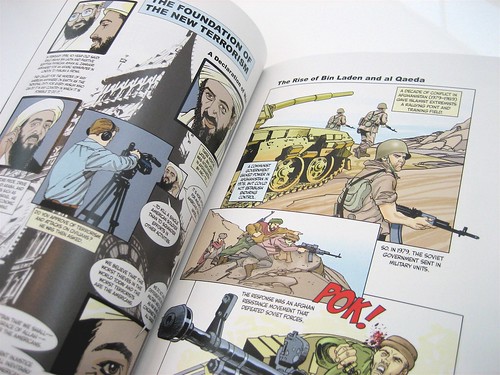
From the standpoint of someone who is familiar with the situation only through what was heard from surrounding people or from occasionally clips seen on television, this graphic novel is a great way to learn about what truly happened on 9/11 and on dates closely surrounding 9/11. The creation of this graphic novel is all around great. The creators give so much detail in this rather small graphic novel. At the beginning of the novel the creators tried and in my mind did a pretty good job of developing a time line of what was going on at specific times in the four airplanes that were hijacked. As mentioned above, the novel presents its readers with different situations that surrounded and probably lead to the tragedy on September 11th, 2001 that as a reader you wonder why the government didn’t do things differently to try to better prevent the tragedy from happening. Not only because of how greatly informative this novel is, but also for its fantastic graphics which catch the attention of so many young adolescents , this is definitely a book that needs to be incorporated into today’s schools’ curriculum.

I feel that this graphic novel can fit into many different subjects, but because the fact that I hope to be an English Language Arts Teacher, I tried to think of ways in which The 9/11 Report: A Graphic Adaptation could fit into a Language Arts class. One way that is obvious is doing a lesson based on vocabulary. I feel that this is a good idea mainly because of the immense amount of intense vocabulary. Another way that a teacher could use this is by teaching about visual representation and visual interpretation.
One could ask there student to develop a graphic novel on an important event that has taken place in their own lives. Another idea of how this could be incorporated into the a classroom is if you are basing your instruction on tragic events this would be a perfect novel to teach about 9/11. I believe that the creators of this graphic novel did such a good job that it could be used in so many different ways and that is another thing that makes it so great.

-- Ana D. Valtierra

Student Review and Lesson Ideas: Chiggers

Chiggers is a fun graphic novel written by Eisner Award Winner Hope Larson. Chiggers is an interesting and enjoyable story about a adolescent girl named Abby who is going through what all young people go through, friendship and identity issues. The title itself comes from an inside joke that the campers circulate around the camp. “They’re, like, these little, tiny bugs that crawl under your skin and die, and they itch a lot. Way worse than mosquito bites” (pp.24).

The graphic novel revolves around Abby and her return to summer camp. Abby being very young and a bit naive adolescent is returning to her what seems to be yearly summer where she expects to see all her old friends and start from where they left off, but thing did not turn out exactly how she wanted them to.

Being the first person to be dropped off at camp, Abby anxiously waits for everyone to arrive and for her fun to start as soon as her old friends arrive, but Abby excitement quickly ends. Rose is the old friend who Abby especially cannot wait to see, but from the first encounter between the two, Abby quickly realizes that things at camp are going to be a lot different this year. This year her friend Rose is a Cabin Assistant and a bit too busy to really get to talk to Abby, let alone spend time with her. All of Abby’s other friends from last camp also seem to be different. One has piercing, others have boyfriends, or some just think that they are too mature and cool for Abby. The only person who seems to be the only person who does not think that she is too cool for Abby is a young girl named Shasta who was a new to the camp and had been struck by lightning. In Chiggers it seemed like Abby would do anything to try to fit in with her old “friends.” Abby often did things that we as readers could see were not characteristic of her such as treating Shasta horribly and taking insults from them. Eventually Abby finally realizes that all she has to do to be happy is be herself.

Although this book seems to be very realistic, we as readers are also introduced to supernatural occurrences. One thing made me think about this is when Abby and Teal run off together we get a visual of them being elves and another is when they develop wings like fairies. In a discussion in class we talked about the magical realism of the novel. The fantasy world is just like a reflection of what their camp is; it is only real for that particular time and it will only last till the end of the summer.

As mentioned above it is a really fun story to read especially for younger girls in Middle School or even the early High School. It is follows the format of the movie Mean Girls. It is not the most educational story that one can find, but I believe that it is a great book to have in the classroom. Those who are interested in reading it can either read it a home or on their free time at school. I think all kids will be able to relate to this book mainly because everyone goes through the types of changes that Abby is going through.

One lesson that I feel that could be taught using the graphic novel Chiggers is a lesson that deals with identity. Abby seems to be struggling to find out who she is or who she wants to be and at the Middle School and early High School ages many students are dealing with the same thing; therefore, creating a lesson dealing with something that relates to them will definitely have them engaged.


--Ana D. Valtierra
Student Review and Lesson Ideas: American Widow

American Widow, by Alissa Torres, portrays the harsh reality of a young widow desperately searching for answers about her late husband Eddie Torres, who was killed during the attacks of the World Trade Center on September 11, 2001. The themes of loss, surviving through adversity, and the search for a new identity are a few possible themes portrayed in this touching graphic novel. What I found most appealing about this novel was that a woman’s memories and heart-wrenching experiences were so clearly and passionately illustrated. It’s almost as if Alissa Torres were sitting next to me, describing in detail the horrific aftermath of losing a husband and fighting to make a new life for her and her child.

American Widow can be used in secondary classrooms to teach different themes that may be relevant to the lives of secondary students. Before teaching this graphic novel, I would begin class with a mini-history lesson of September 11, 2001 to refresh students’ memories and thoughts about this historical tragedy. If I were teaching a class of juniors, I would remind myself that these students were only seven or eight years old when this occurred so they will have to discuss what they remember about this day, who was involved, and the resolutions this nation took to defend itself.


Objectives:

Students will learn new themes through this graphic novel.
Students will compare/contrast themes with other novels or whole texts.
Students will apply meaning to reality or real-world situations.


When studying a unit on surviving adversity and fighting to create a new life, teaching American Widow as part of the Holocaust would be relevant because there are numerous Holocaust survivors’ stories and memoirs just waiting to be read and discussed in the language arts content. When choosing to study a novel such as Night by Elie Wiesel, American Widow can be used as a secondary source of loss, survival, and forming new identities after horrific life changing experiences. Both main characters in these stories are faced with loss of faith, a search for answers, and eventually choosing to write about life’s unfair struggles and tribulations to reach diverse audiences.

Secondary Lesson Idea

High school juniors would begin with front-loading activities by reading American Widow first to establish the three themes of these novels. By exercising “front-loading” in the classroom, students do most of the unit’s activities before reading the primary or whole text of the unit to gain a better sense of similar themes characters experience during different time periods.

While students are reading American Widow, they will be asked to select significant lines, phrases, or quotes they feel are important and write their explanations using a double-diary entry log. Since this is a graphic novel, students may also choose to write about significant panels that contribute to the themes or emotions portrayed by the author. After reading this graphic novel, students will discuss the relevance of the themes, and the significance of the author writing about her experiences of September 11, 2001.

Discussion Questions:

After reading Alissa Torres’ graphic novel, what do you think gave her the motivation to create her true story in a graphic novel format instead of a traditional novel format?

Select a scene, picture, or panel and discuss why it was significant to you.

If Alissa Torres was in our classroom, what question would you ask her about this novel or her life-changing experience?

If a sequel was created for this graphic novel, what do you think it should be about? What are your suggestions for a sequel?

How does this graphic novel relate to today’s conflicts and controversial war?

Mini-Lesson Idea:

Introduce Pablo Neruda’s works and discuss their importance in this graphic novel.
“You will remember that leaping stream where sweet dreams rose and trembled” (Neruda).

Post-reading Activity

After reading Night and American Widow, students will create a visual representation of the two texts using power points or other methods students would like to use to demonstrate similarities in significant historical events that have shaped the nation’s history and future.
Using American Widow in a secondary classroom is a unique teaching method because it addresses many English Language Arts standards and because it is a non-traditional approach to understanding the history of the Holocaust and the history of the United States. Survivor’s memoirs and true stories are an excellent way to engage all readers of all ages.

-- Marcy Alvarado

Student Review and Lesson Ideas: American Born Chinese

American Born Chinese depicts the life of an adolescent Chinese boy and the struggles he encounters throughout his childhood and education. Although there are several stories occurring throughout the novel, they all tie in with characters struggling against discrimination, the quest for self-identity, self-acceptance, and truth.


It is clear that Jin Wang’s family moves to America to give him a better life and more opportunities for Jin. Jin Wang’s curiosity with the transformer action figure is symbolic of Jin’s desire to become someone greater and more accepted than the identity he was born with. This is relevant to younger secondary school students because they often find themselves trying to fit in with different crowds of kids to feel accepted and wanted by others. “A robot in disguise. Like this one! He changes into a truck…See? More than meets the eye” (28). The robot that is able to transform to something unexpected is appealing to Jin Wang because he secretly wishes he could transform himself and give others the opportunity to discover more than meets the eye.


“Returning to true form” is a reoccurring theme throughout this graphic novel. The Monkey King feels he is destined to rule but has no desire to return to the form he was given. After reading this novel, middle school students could choose one story to discuss and write about. Students will identify with one or more characters and describe what the main theme is throughout the novel.


Objectives:
· Students will identify adolescent themes through a cultural assimilation story.
· Students will discuss the importance of remaining true to themselves or to their “true form.”
· Students will discuss how this graphic novel is relevant to their lives in and out of the classroom.


Background Web Quests
Students will research information regarding the Chinese culture, customs, and traditions that affect the characters’ lives and choices in this graphic novel. This will help students understand the importance culture plays in growing up in a country where diversity is often times scorned or not readily accepted.


Discussion Questions
· What is the main struggle each character is faced with?
· Why is it important to remain true to yourself or to always return to your true form?
· Discuss the importance of parents’ rules regarding expectations for children. Are your parents’ expectations similar to Jin’s parents as far as education and expectations?
· Choose one page, panel, or phrase to discuss with a partner. Discuss why the page, panel or phrase stuck out to you. What is the significance of it and how does it relate to the graphic novel as a whole?


Extension
Students will create a few panels portraying Jin Wang’s life after high school. What will he be doing in his future? Will he fulfill his expectations his parents desire for him or will he escape his true form and create a new destiny? Students will present their predictions to the class and explain each panel through a short presentation.
-- Marcy Alvarado

Student Review and Lesson Ideas: Blankets


Blankets is the coming of age story of Craig Thompson during the early 1990s Wisconsin. In the novel, Craig tells the story of how he found a guiding light amongst the uncertainty of teen life and home life. The story revolves around Craig and his friend-and-sort-of-girlfriend Raina, and how both of them need each other to get through their lives (at this point being 18 years old). Bt far from being your basic any and every hormonal 18 year old problem(s), Craig deals with the uncertainty of what is to become of him in the future and not only that, but it is coupled with a questioning of his religions beliefs. While Raina has to deal with her parents separating, having to help raise her mentally challenged adopted siblings, and way to often having to play the role of head of household and responsible adult.

When Craig and Raina meet up and spend time together, not only does having one there for the other (and vise versa) help with their situations, it gives them a chance to develop a romantic intimacy that respectively at their given time both Craig and Raina use this experience to spring board into the next phase of their lives. The love Craig gives and takes is helpful in coming to terms with his crisis in faith, that in turn gives him the fortitude to move out and grow as an individual out in the real world. The love that Raina gives and most deservingly needs and receives certainly helps her get through her family’s disintegration. In the novel, even though both characters do use each other to get the most out of the emotional and mental rut they are in; it is not done in a negative way, rather it is done more in a therapeutic symbiotic relationship.

This novel is perfect for any and all High School teens; but being that Craig is a Senior in High School, it may be better suited for Juniors and Seniors because they are all (to a given extent) going through the same motions, emotions, fears, frustrations, and uncertainties of adolescence and creating a strong individuality from any and all occurrences and experiences in their lives. These are some exercises that can accompany reading Blankets:

1) Have students point out several themes the novel presents: family values, faith, growing up, the future, etc. And have them write how one or many of the themes they find in the novel help the story progress.

2) Have students reflect on certain personal experiences that may be mirrored by the text. Were they feeling similarly to Craig, or did they react in a different way? If anything in the novel has not been experienced in any way by the students, have them write what they think they would do in the exact same situation.

3) Have students compare and contrast Blankets with another novel or the novel it may be paired with to analyze the benefits/drawbacks of both graphic novels and textual novels.

-- Javier Guerra

Student Review and Lesson Ideas: A.D.: After the Deluge

A.D. is the story of the aftermath Hurricane Katrina left in New Orleans as it is intertwined and told by people that lived in New Orleans at the time; and how their lives were changed by one common event. The novel retells the events of Katrina in the lives of five people (Leo, The Doctor, Kevin, Hamid, and Denise) and their families and friends. During the hurricane and its aftermath, each of the individual must make a decision or are part of a decision, of whether to stay and wait out the storm or leave (just in case) and return when it is safe to do so.


In the case of leaving, Leo and his girlfriend Michelle decide to leave and stay with a friend in Houston, Texas; Kevin and his brother are sent to California to stay with a family friend. This includes Hamid’s family, who he sends to Houston while he and his brother decide to stay and look after his store. The Doctor also stays, only because he thinks it is one of the “usual” storms that NOLA gets; while Denise must stay to care for her mother and her niece and her baby.


The novel begins on Monday, August 22, 2005, as the hurricane is nowhere to be found and slowly starts to grow; ends on September 1, with a follow up 1 ½ years later on February 6, 2007, when all the individuals in the novel tell Neufeld what they returned to and how they are doing now. It has been said that you can never go back home, as far as leaving home and returning later on and realizing things have changed. But A.D. certainly is a twist on this idea; whether you stayed home or returned after being forced out, due to factors not in one’s control, home is definitely no longer the same.


A.D. is a perfect novel to use when learning about the human system and experience. How not only man can affect nature, but how nature can also affect man; and from it, what could, is, can, and has been done since to present or alleviate such disasters and human suffering during natural crisis. Being that the novel is accessible online, soon to be out in print, it gives great links to add to the story/occurrences of Katrina to better help in learning and precariously experiencing the event. The following are exercises for the novel:

1) Students can explore themes of Man vs Man, Man vs Nature, and Human Nature (Psychological), and determine what each character could or should have done differently. Then, whether based on those decisions, would it really have mattered during Katrina?

2) Students can write what they would have done in the same situation, and then research safety measures that have been created for natural disasters (focusing on hurricanes) and then rethinking and rewriting their original responses to what they would have done in the same situation. The online version would help out with this because of the added links.


3) If students recall Katrina they can describe their feeling about the disaster and the aftermath for New Orleans residents. If they cannot recall, they can still describe how they feel now, after having learned about the disaster and having read the novel.


--Javier Guerra

Student Review and Lesson Ideas: La Perdida

This graphic novel is a page-turner and definitely contains all the necessary elements for a narrative saga. In spite of this, there is something intrinsically offensive in the rhetorical framework that appears to be substantially essentialist as certain traits are portrayed as intrinsic or mandatory to the state of existence that governs the lives of a country and its people. If an uninformed reader who has never traveled or been exposed to Mexican culture were to read this, he or she would come away with a linear view of a culture driven by the drug trade, governmental anarchy and rampant violence that is categorically directed at women.


And yes, I understand that this novel is conveying an “ex-patriot” experience in Mexico City but I feel that the rhetorical implications extend far beyond that singular dynamic. Furthermore, a binary is established that positions Anglo American culture and society at a distinct advantage. From the beginning, the half-Mexican Carla Olivares and her Anglo one-time boyfriend Harry, are portrayed as possessing intrinsic or “a priori” privilege that is God-given and serves as a veil of protection. Also the tone of the plot dynamic suggests that both Harry and Carla are rooted to an institution that affords a sense of balance and stability that they can always return to when they tire of wild living. The social ties that connect them to the United States and their families are identified as through legitimate means via stable family situations and the sound economic practices of their progenitors (although Carla is of lesser means, her family appears to be established and not due to any swindles). They are also positioned within the novel as the object of covetous thus spawning and nurturing the notion that the American capitalistic lifestyle is what is the most desirable and the viable yardstick through which all other groups are gauged and accessed.

The Mexican nationals are primarily portrayed as degenerate, conniving, abusive and amoral individuals who prefer criminal activity to legitimate channels of economic endeavor. Furthermore, for the most part, the Mexican nationals are portrayed as foolishly earnest and ignorantly sloppy desperadoes who are really never even afforded the rhetorical gift of potency as competent criminals. With the exception of a few obscure friends of Carla’s brother Rod, the Mexican characters are absorbed in the full-time task of attempting to perpetrate a scam on someone. With that in mind, the plot develops into a full scale kidnapping of Harry which leads to Carla’s eventual involvement and several murders. Even the Mexican Communist revolutionary is exposed as a blatant hypocrite who is another complicit agent in the plot to obtain the fruits of capitalism through extortion.

The novel does not offer a satisfactory anecdote. Yes, Harry’s father is revealed to be the owner of some imperialist companies exploiting conditions in Mexico but the information is given as an aside. And yes, I get the sense that the primary cartel leader may be an “ex-patriot” American posing as a South American. Still, the ending reaffirms the initial assumptions of the novel. Nothing in the plot offers an alternative point of view that would usurp ubiquitous assumptions or suggest a route towards change. Harry and Carla Olivares survive the ordeal with their special status and privilege intact.

Now I must admit that the information given does not offend the boundaries of verisimilitude. There is an aspect of existence here on the border in El Paso and in Mexico which somewhat parallels the lives of characters in La Perdida. ( I have lived here for twenty four years) I have personally known various such desperadoes living on the edge of existence and peddling for any little, minute advantage that will carry them into the next day. And yes, I would dare say that certain cities could be considered as sustained through drug economies. When you have a city in which the median income is $15,000 and sixty percent of the student populations of the various school districts are receiving free and reduced lunch and yet a percentage of these same students live in $400,000 homes and when many homes are bought with cash, you know there has to be a source of unreported income. Yes, this side of life exists. And yet this is not adequately representative of the Mexican community. There are many families who reject this drug related lifestyle and who work earnestly at legitimate jobs. There are a significant number of individuals with advanced college degrees and strong cultural ties. There are those with engineering and medical degrees who attend symphonies and send their children to catechism and violin lessons.

Contrary to the suggestions of La Perdida, not all Mexican men beat women and act like prolific gigolos. Thus, the novel does not offer a balanced view of reality. Ironically, the main character Carla, assumes responsibility for the deaths of two of her close, drug dealing friends, who upon her suggestion, seek asylum in the American embassy. I feel that the author needs to assume responsibility for such a linear view of a culture. Incidentally, in her long list of acknowledgments, Abel only mentions two people with Mexican surnames who assisted her in this project.


Lesson Plan Ideas:


One project might be for students to look at the way both English and Spanish are used in the novel. Initially, the author has the characters speaking in Spanish with English translations. As the story progresses, and the main character Carla learns Spanish, the English translations merge with the Spanish. Then the novel becomes a dialogue in strictly English but it is not standard English. This English conveys literal translations of Spanish phrases into English. As most of us know, the literal translations do not always convey the meaning as it is intended. I believe this is done in order to convey what incorrect Spanish would sound like to a native speaker in a manner that English speakers can identify with.


Students might compile a list of Spanish words in the novel and couple these words with their English translations and various connotative and denotative meanings.

Students might engage in a “Deconstructionist” exercise in which words and phrases that are presumed to be analytic or true by definition are examined for flaws in interpretation and meaning. The students might construct two lists of words with opposite meanings or opposing characters on opposite sides of a page and reserve a middle section. In this middle section, they can describe ways the words with opposite meanings and or opposing characters are not so different. They will look for flaws in binary distinctions between words and their meaning, concepts and people.

This novel could be paired with an essay entitled “The Task of the Translator” by Walter Benjamin. Students might read the essay and identify key arguments regarding what constitutes a good translation (a translation need not always be an actual translation – it could be rhetorical or figurative) or a cultural communication. Then they would examine various rhetorical strategies and literary elements in La Perdida and decide whether the ideas suggested by Walter Benjamin can be found or not.

This novel could be paired with a book on cultural studies or politics such as:

Decolonial Voices: Chicana and Chicano Cultural Studies in the 21st Century by Arturo J. Aldama and Naomi Helena Quinonez. Indiana University Press, 2002.


Capital: A Critique of Political Economy by Karl Marx. Frederick Engels editor. Charles
H. Kerr & Company, 1906.


This graphic novel could also be paired with Ernest Hemingway’s novel The Sun Also Rises. The student could compare and contrast the two different portrayals of an “ex-patriot” experience. The students could also write essays in which they compare and contrast the cultural perspectives in the two novels. The students could compare and contrast the characters’ involvement or lack thereof with the native populations. The Sun Also Rises takes place in Paris, France and several cities in Spain in the 1920’s. The students might discuss how portrayals of the ex-patriot experience have changed over time.

-- Nadia Morales

Student Review and Lesson Ideas: Deogratias

Deogratias is a graphic novel of a minimal length but one which might need to be read twice and with an ample amount of supplementary contextual information. And even then, engaging the truth becomes a meticulous process of revelation, not through direct statement of fact but through innuendo, suggestion and second hand accounts(at least at first). Furthermore, the confession of the ultimate crimes remains vague and information regarding the degree of complicity is absent. The translator, Alexis Siegel incorporates several pages of contextual information that is perhaps intended as an anticipatory element that will help the reader absorb the narrative. Still, I found myself completely unprepared to mentally deal with the adumbrations regarding the subjects of genocide and cannibalism.

The novel unveils parallel realities of existence in which the pedestrian world of logic and cause and effect compete with the sublime reality of physical addiction and insanity. The story discloses the life of one young boy, possibly orphaned and living somewhere between the streets, the Christian missions, the brothels and the mercenary recruiters. His life becomes a daily struggle with alcoholism, drug addiction and later insanity. He suffers from delusions that he has become a dog who eats dead bodies due to the guilt he feels over treacherous acts of torture, rape, murder and possibly cannibalism he has committed against people he knew as childhood friends. The overarching cause of the atrocities might be attributed to the ethnic struggles between the Tutsi and the Hutu tribes of Rwanda and yet this explanation seems grossly inadequate.


I was left wondering how a young, innocent boy evolved into a torturous, murdering cannibal and the most dangerous kind of sociopath. And yet he is not completely a sociopath. His journey into insanity in the wake of his deeds is evidence of his moral struggle. The novel could be extended and developed into a study on how life on the streets serves to neutralize feelings of human empathy and personal conscience. Was it the physiological changes due to drugs and alcohol or the psychological impact of a life devoid of solid social bonding? If there is a moral to the story, it is implied in the life of this young boy, who is subject to a substantial discourse of contingencies and who has never known boundaries or rules of any kind. Even the missionary priest who is supposed to teach morality is rendered inept to the task as his widely known affair and love child with one of the town’s prostitutes has extinguished his credibility (Strassen 12).


And on another level, the purpose of the Christian missionary presence is called into question. The moral message fails to transform the society possibly due to the lack of a good example. In addition, the priests and the religious workers appear to assume a “laissez faire” attitude regarding the horrors being committed by the Hutu against the Tutsi. The tone conveyed appears to be one that is essentialist in nature (attributing individual acts as evidence of ubiquitous characteristics that are rooted in genetics or cultural norms) and one that dismisses the barbaric acts as somehow a foregone conclusion and beyond empirical control. Throughout the novel, the revelatory style of narration suggests predestination or the unveiling of some sort of sublime, metaphysical occurrence. I was left wondering why the author ironically named the boy “Deogratias” or “thanks be to God.” I also found myself objecting to the apparent lack of human agency (the characters appear as sleepwalkers) in the narrative which implies an ideological complicity with predestination that affects the interactions between the social, economic and political forces that constitute the story.


Lesson Plan Ideas:

This graphic novel could be taught in conjunction with a unit on the Rwandan genocide. The students would be asked to research news stories on the subject from the archives of at least five reputable agencies to include Reuters, The British Broadcasting Company, The New York Times, the United Nations report on the genocide and several publications local to the country of Rwanda. They might be asked to discuss the rhetoric of Deogratias in their journals and contrast this narrative with actual news accounts. A class discussion would follow in which each student would summarize their interpretations as juxtaposed with factual reports contained in their journals.

Deogratias could also be used as a springboard for sociological studies in which the students will research the ways in which societal contingencies – economic, religious, ethnic, political and governmental – influence the moral development of a person.

The students might conduct research on what constitutes sociopathic behavior and discuss their findings in their journals.

After reading Deogratias, each student might form a single theory regarding the cause of Deogratias’ mental state. The students would write one paragraph in their journals explaining their reasoning. The students could conduct research on drug addiction, alcoholism and insanity and apply factual information to their own interpretation of Deogratias and their individual line of reasoning.

The students could research the history of Rwanda, ethnic identities, the United Nations’ policies and the role that other forces played in the perpetration of the genocide. The historical research could be conducted in conjunction with a “Deconstruction” exercise in which the students gather a list of ethnic characteristics of Hutu and Tutsi through their research. They would construct a binary list of opposites and then identify places in the novel in which those binary distinctions are undermined or proven to be false.


-- Nadia Morales

Sunday, April 12, 2009

Dave Eggers, Teens Writing, and the Brooklyn Superhero Supply Store

I would have soo gone to this store last time I was in NYC, had I known of its existence and connections to literacy!

Wednesday, April 08, 2009

Graphic Novel.Com Updates with Creator Interviews, More

From the press release:

Creator Interviews

Gene Luen Yang and Derek Kirk Kim

The long-awaited The Eternal Smile, new from Gene Luen Yang and Derek Kirk Kim, is finally here. Meet the two creators behind the book in this interview and learn how the two friends decided to work together-and whether their friendship can survive a Star Wars vs. Star Trek debate.

Ariel Schrag

Ariel Schrag documented her high-school years in four raw, unflinching memoirs. With the release of the fourth and final edition, Likewise, which chronicles her senior year, she talks about what it's like to share your coming-of-age with the world.

Mitch Clem

Mitch Clem started Nothing Nice to Say, a webcomic about "the awesomeness and the absurdity" of the punk rock scene, back in 2002. Here he talks about the recently released anthology of his popular and controversial series.

Domingos Isabelinho Posts Interview with Author of Exit Wounds

A student of mine recently read and reviewed Exit Wounds, a graphic novel on my "need to read" list, for our "Teaching the Graphic Novel" graduate course. As well, a previous guest speaker on campus, comics writer Jai Nitz, sang its praises. So, I'm posting a link to a youtube-style interview with the creator, Rutu Modan. Enjoy, and thanks, Domingos, for posting the video! :)

Tuesday, April 07, 2009

Diamond Bookshelf Interview with HS ELA Teacher Who Teaches Watchmen

Proof that they exist! John C. Weaver has been getting some deserved attention lately for talking about how he handles a complex and mature text(with dangling blue wangs) with his HS seniors.

NCTE 2009


I'll be on the program for the 2009 NCTE national convention. Some of the folks working on my next edited collection, a new colleague from Fordham, and I will be giving a roundtable talking about comics in the contact zone. More information as it develops. I've never been to Philly before, so I'm excited about visiting.

Thursday, April 02, 2009

The Process of Adapting Prose into Comics

I readily admit that I prefer stand-alone graphic novels with multiple embedded literary elements to those that try to adapt classics, but here is a great article on the process creators, etc., go through when considering how and what to adapt.

For better or worse, there is a growing market for sequential art adaptations. Though I fear these will be the only graphic novels teachers will consider when given choices, essentially taking an easy way out and not really learning anything new, there's also the possibility that adaptations might pique interest in other types of comics.

Wednesday, April 01, 2009

More Obama in the Comics


In fiction and satire this time, no less. I'm starting to think publishers are going a little crazy with the Obama appearances. If he shows up as a member of the League of Extraordinary Gentlemen, I may never read comics again (and I voted for the guy!).

Sequel to Dalrymple's Pop Gun War Posted Online

Or part of it, anyway. While editing a chapter on Pop Gun War in my first edited collection, we mention this text as a sort of sleeper hit that would soon get much more critical and pedagogical attention. Well, that doesn't seem to have happened like I thought it would (yet), though the original is a great story and Farel Dalrymple has done well for himself since releasing it (I'm not even sure if it is still in print), but maybe the sequel will remind people of Sinclair and his magical realist flights of fancy.

Pop Gun War does have my highest recommendation, though, and if the sequel is a little longer and more complex than this hopefully-expert, I'll be eager to read it when it comes out in print. Or, perhaps the entire sequel will be a web comic. If so, I'll be reading then too!

Tuesday, March 31, 2009

Celebrating Cesar Chavez's Birthday

I've had the opportunity to work full-time at two universities that take unique holidays. One of the few good things about my time at USM was that we got to take Mardis Gras off. Not being Catholic or even much of a reveler (I'm not much for drunken crowds. Plus, there's that story my dad tells me about visiting Nawlins one year and meeting a nice-looking woman with whom he wanted to have relations, but it turns out dude looked like a lady). Now I'm enjoying UTEP, and here we get Cezar Chavez's birthday off as a holiday. I admit to not knowing much about this figure, but if I want to learn more, there are some graphic novels to help. Here's a review of one. Here's another.

"Panels don't Have to Be Square," and Neither do Books on Making Comics

A princess knight, Edward the horse, a fairy, a candy-stealing dragon, and the love of comic art make The Center of Cartoon Studies Presents: Adventures in Cartooning one of the best ever all-ages "how to" books on creating comics. Heck, one of the best ever regardless of audience.

By using simply-drawn characters who illustrate concepts such as page and panel breakdown, means of communicating spoken language and visual ques such as setting, emotion, and scale, James Sturm, Andrew Arnold, and Alexis Frederick-Frost have created the most democratic and accessible comics tutorial yet published.


Perhaps I'll start using the book when I encounter teachers who proclaim "I just can't draw!" at my seminars. (Funny, k-12 students say this too but have always been quelled when I model my own silly drawings. Many practicing teachers are much more stubborn in releasing their anxiety). The book, which does have an on-going fantasy narrative enmeshed with the easy-to-understand lessons which hardly seem like lessons (learning when you don't know you're learning is perhaps the most effective kind of pedagogy!), will certainly make it on my favorites list when it comes to quick, accessible, and democratic texts on comics craft.


Monday, March 30, 2009

Fresno State Article on Comics/Comics Courses

Thanks to M.R. for drawing my attention to this article from Fresno State's The Collegian. Oh, I'm sorry: that's actually California State University, Fresno since this article isn't about a sports team. ;)

Hear Me Geek Out on Watchmen, Moore

UTEP student Matthew Munden interviewed me about many things Alan Moore and about the Watchmen movie a few weeks ago. Basically, we just geeked out, but it was really fun talking with him. :)

Mom Up in Arms Over Innuendo in Spider-Man Trade

A Nebraska mom thinks a Spider-Man trade paperback is marketing more than good guys vs. bad guys to her six-year-old. Of course, she doesn't mention details, and she apparently missed that Marvel, the company publishing the book, has rated it as appropriate for teens.

Good to see that censorship-related activity continues to be so predictable, because that makes it easier to handle. Of course, this isn't a case of schools or teachers vs. parents, just one mom getting more media coverage than she probably needed.

ICV2's reporting on this story can be found here. I'm still deciding on whether or not to write the school district. Typically, I try to send a little something....

UPDATE: Here's a copy of my letter to the superintendent of this school district.

Hi. I am James Bucky Carter, an assistant professor of English Education who focuses on comics-and-literacy-related issues.

I have recently read about the concerns over Spider-Man: Revelations. I own the individual issues which comprise the book and have revisited them this morning. I strongly urge you to keep the book in the library system of your public schools.

The first story in the book is Marvel's tribute to 9/11. It is a stirring tale with much emotion, as in Marvel's fictional universe, almost all heroes are set in NYC, and in reality, so are Marvel's offices. The text is as much meta-text as it is fiction, because those who write fantasy, and the heroes and villains they create, must come to terms with an event so horrific, it was once something thought only possible in comic books.

The next two stories deal with many social and family issues, such as identity, trust, forgiveness, and drug addiction. These are also two stories written during the time that Peter Parker was employed as a teacher. Surely the character study potential in these stories is great: Why would the man obsessed with the phrase "with great power comes great responsibility" be moved to teach?

The final issue does feature Mary Jane in appropriate clothing for what she is doing. She's in a nightgown while sleeping, a towel after bathing, and a bathing suite at a model shoot. But, the story is more about a complex relationship between two people who love each other in mature (as in complex but responsible ways) than it is about sex. This is also the "silent" issue, the comic where few words were used to tell the story. Teachers and/or students can learn much about composition by comparing the silent issues with those with word balloons or even by comparing the script at the back of the book with the art on this final issue of the graphic novel.

Again, I urge you to retain the book in your library system in one site or another. The book is best suited for those in middle school and beyond, so allowing those students the best access to it might be advisable.

As well, I am available to discuss comics-and-pedagogy-related material via e-mail, telephone, or through visits. I am associated with the NCTE Co-Sponsored Speaker program and have talked with public school teachers on comics in the classroom across the country.

Sincerely,
James Bucky Carter
my e-mail
my phone number

Saturday, March 28, 2009

Coming Soon from Michael Bitz of the Comic Book Project

I just ordered my copy of this book, available in May. It's a 4-year longitudinal, qualitative study about how teens consume, create, and identify with Manga and comics. I know Dr. Bitz and his work, and I am very excited about this release! Order your copy now. Really, click the link to Harvard Education Publications Group, call'em up, and order a paperback copy for less than $30.

Friday, March 27, 2009

Thursday, March 26, 2009

National Writing Project article: "Digital comics Spur Students' Interest in Writing"

Thanks to MH for sending this along.

Article summary info from NWP:

By: Grant Faulkner
Date: January 29, 2009
Summary: Fourth grade teacher Glen Bledsoe has his students create comic strips together, which engages their creativity and teaches them writing, critical thinking, and other skills.

And the article has a nice sidebar of "Related Resources" too, if I do say so myself. :)

Tuesday, March 24, 2009

Quick-Thinking Fake Spider-Man Saves Real Boy's Life

My wife is a special education teacher, so I've heard of autistic students with the same sort of fascination with Spidey or Superman or Batman as the child in this must-read article. Mostly it's Spider-Man, though. Since autistic children often have trouble reading facial expressions, I wonder if Spider-Man's colorful costume but rather emotionally neutral (and therefore nonthreatening?) mask is a draw?

Thanks to Orion for drawing my attention to this moving piece of journalism from the BBC.

This is what the accountability/standardized tests push has Wrought

Congrats proponents of standardized tests-heavy public education, you've finally done it. You've created an atmosphere so averse to learning, made a test so anxiety-inducing, you've made elementary students cry.

This is truly a proud day in contemporary education.

You know, when I was ninish, I cried when Gwen Stacey died, but it was because I was overwhelmed with pathos and good storytelling. Marking A,B, C, or D was nothing compared to reading Spider-man trying to save the love of his life from a fall, only to snap her neck when his web reached her, saving her from hitting bottom, but with too much force for her to live through his rescue.

Some days, especially when I read stories like the one linked to in this post's title, I, like Spidey, just want to put my costume in the trash and call it quits on trying to save the world....

Alissa Torres talks about Influences for American Widow

Students in my "Teaching the Graphic Novel" graduate course recently read Alissa Torres' gripping memoir of her post 9/11 days riding the tensions between gratitude and frustration, helplessness and self-advocacy. I don't want to say too much more about American Widow because one of my awesome students will be posting a review in the next few weeks, but I do want to draw attention to this great article at Graphic Novel Reporter in which Torres talks a little about her work.

And check back in the coming weeks for my student's thought on this new and poignant debut graphic novel.

Underground Comix Show at UW-Madison

Want to learn about what some hesitant to incorporate comics in their classrooms might think of when they hear the word "comics?" Not all think super-heroes and funnies; some remember the Underground movement of the late 60s and 70s and think comics = sex, drugs, explicit nudity, sexism, racism, etc. The Underground comics creators had a "nothing is off limits" attitude and created some work that is worthy of study but that probably has skewed some opinions of the overall form and content of comics generally.

This show at Wisconsin (go Bucky Badgers!) will reveal to you what people mean when they talk about comics as "subversive." Of course, the problem is that many still see comics and comics reading as a subversive activity, and to some degree they can be, but it's not anything like it used to be when R. Crumb and his companions were throwin' it down in their primes.

I wish I could go to the show! If you do, post a reply and tell me how it went...

Monday, March 23, 2009

Comics, Power and Society

Professors Arthur Nishimura and Louis Schubert talk about a comics course they teach at the City College of San Francisco. See how Scrooge McDuck and Will Eisner coexist in such a class as Comics, Power and Society.

Another Reason I Love Eddie Vedder

2009 Hugo Awards Include Graphic Texts for First Time

Once limp-formed award trophy very excited about the news (*giggle*):

Friday, March 13, 2009

Quotes on Comics

Introducing a blog/site that is exactly what its name implies: quotes on comics. Very cool stuff.

Bart Beaty Talks about Teaching Comics in Canada

Sounds like a pretty good story, eh?

Nick Magazine Talks about Upcoming Comics Awards, Etc.

Jews and American Comics

Thanks to MH for informing me about the book Jews and American Comics, which is reviewed at Graphic Novel Reporter. It is hard to overestimate the impact Jewish Americans have had on the American comics industry.

Wednesday, March 11, 2009

#20,265

That's the current Amazon.com sales a rank for a little ol' book you may have heard of: The King James version of The Bible. Watchmen? Still #1. Jesus retains a huge edge in overall sales, though.

If all things are through God, Watchmen really has turned out to be one heck of a collaboration.


Shaggy-haired bearded men unite!


Tuesday, March 10, 2009

High School Teacher Talks about Teaching Watchmen

I've heard rumors of high school teachers using Watchmen. I even got close to meeting one fellow who discussed it in Charlottesville, Va, at my comic shop while I was engrossed in taking thick description notes of the place for a qualitative research class. Now, Graphic Novel Reporter has some testimony from a high school teacher who is teaching the GN for all to see! Yay!!!

Monday, March 09, 2009

Historic Day!

Publisher's Weekly reports that for sometime today, Watchmen was the #1 seller on Amazon.com. I heard Teri Lesense talk about some of her upcoming research that suggests that seeing a movie before reading the book actually helps students' motivations to do the reading. Looks like there might be a little bit of that going on here?

A graphic novel selling better than any other book on Amazon. And it is my favorite graphic novel, to boot. It might be time to dance naked in the streets, faithful readers. Maybe I'll suggest that to my "Teaching the Graphic Novel" class tonight, as we conclude our study of Watchmen, lol....

Sunday, March 08, 2009

Yeah, I saw it: Watchmen Movie Talk

An admirable but flawed attempt at bringing the classic graphic novel to the big screen, Zack Snyder's Watchmen shows the director was probably right to repeatedly tell sources that if anyone got the chance to screw up the source material, he wanted it to be him.

The film is not terrible. It won't be mentioned in the same breath as The Spirit, I don't think. The first hour is pretty atrocious, but once the action gears up, and once Dan and Laurie are thick into their budding relationship, things get good.

The fight scenes are great. Blake's struggle for survival against Veidt is probably the singular element that supersedes the comic. We see a fighter going out in warrior fashion, yet his beatdown is still brutal enough for one to have sympathy for him. The multiple images of Sally Jupiter in his apartment also help the audience form some sympathy for the otherwise difficult-to-love Comedian (assuming they know the backstory, that is). The moments where one feels he got what he deserved don't come until later in the film.

And Night Owl finally looked like a bad-ass, maybe too much so. He and Laurie don't just immobilize, they apparently kill many of their attackers, even before they put on the capes and cowls again.

Even the final confrontation with Ozymandias is adrenalin-pumping fun. Veidt's superior strength and speed are made obvious. And I enjoyed the moment where Adrian "embraced" a final barrage of punches from Dan in a moment that was clearly changed such that the "everyman" could make the endpoint, regain some street cred, and give the audience some sense of power.

The love story between Dan and Laurie is what sells the film. But it is in what the film does not adapt concerning this story, paired with too much exposition from Laurie to explain Dr. Manhattan's powers and history, that weakens the movie.

"Do that thing you do," a perfect example of Laurie preempting the godhead of the graphic novel for the sake of advancing story, may become the "jump the shark, Fonzie!" plot faux pas of super-hero movies.

There were many moments where the violence was more excessive than it needed to be; Dr. Manhattan should have been given more weight/authority, or at least the ability to speak for himself more often, and Rorschach needn't have handled that cleaver the way he did (thanks Saw films!).

As for the acting, it was adequate. Dan and the Edward were probably best acted, then Rorschach and Manhattan. Laurie was great to look at, and the chemistry between her and Dan was probably enough to excuse otherwise deadpan delivery. Laurie's best-acted scenes were her most "emotional" ones, I guess I'll say, to be modest.

Having read the book multiple times, enjoyed the motion comic, and viewed the film, I'm happy to say that the source material hasn't been touched in terms of quality. I am worried,though, that the film will become the default accepted interpretation of the book's many subtleties and tensions, which would be a tremendous error of judgement.

Some critics like to score films with stars or thumbs. I think the symbol for Watchmen sums this one up pretty well: One smiley face, stained.

Friday, March 06, 2009

More Press from El Paso times

Some of the students in my graduate-level "Teaching the Graphic Novel" course are quoted in this article on Watchmen the movie. Both the local paper and The New york Daily News interviewed me about the film. It's a fun time to be a Watchmen scholar. :)

Stanford Graphic Novel Project Enters Year 2

Now, if students at Stanford are learning that crafting and composing in the sequential art form is challenging and rewarding and certainly rigorous, it's gotta be a good idea for the rest of us, right?

From a Graphic Novel Reports article on this exciting project:
This is the second year of the Stanford Graphic Novel Project, an endeavor to teach narrative through graphic storytelling. Our goal is to treat the graphic novel as a collective, collaborative project and as a team create a book during the winter term of each year. With co-instructor Tom Kealey, our 2008 class wrote, storyboarded, illustrated, designed, and published a 224-page graphic novel called Shake Girl. Fifteen students drew the 700 illustrations for Shake Girl in six weeks. This year, our students are currently at work on a 256-page graphic novel set in the Democratic Republic of Congo.

Visit the link to Graphic Novel Reporter to get the full story. And remember, the next time an administrator, teacher, or parent questions who you are trying to use comics to teach writing and composing, tell them the uber-intelligent students at Stanford are actually leading the way. Go Cardinal!

The truth of the matter is that creating sequential art is no easy task. It is fun, engaging, exhausting, and intellectually stimulating, but it is no cake walk. My graduate students in "Teaching the Graphic Novel" turn in an 8-pager mini-comic for their midterms in a few weeks, along with a process paper. I'm excited to see if they'll admit the amount of thought that went into their projects while also allowing themselves to admit that they earned a new respect for the form. As I tell teachers, the best way to understand the comics-making process is to try it yourself.

Thursday, March 05, 2009

Wha Wha Wha Whaaaat??????

Almost as good as Watchmen Babies: V for Vacation.

The New York Times Graphic Novels Best Sellers List?

Hard to ignore the medium when a major source like this is giving it such attention.

Wednesday, March 04, 2009

21st Century Skills Backlash?

According to Education Week, there may be a backlash against notions of 21st century literacies and those, like me, who promote them.

How soon before some high-fallooting Ph.d.-waving asshole stands up and says, "Now we got folks tryin' to teach em' comics in school instead o' Shagspert!"? The countdown is on....

As the Stephen Sawchuck penned article "Backers of '21st-Century Skills' Take Flak" suggests, though, the backlash is not really a backlash, it is just continued resistance that Education Week and Cultural Literacy purists are drawing more attention to. As is stated by a very wise Linda Darling-Hammond, the curriculum debates inherent in new vs. traditional literacies, etc. have been going on for at least the entirety of the 20th century.

There is a good analogue here to comics and literacy scholarship. Even though my work and the recent work of others has folks thinking about comics and graphic novels, many other scholars and teachers have been writing on the subject for as long as there have been comic strips and comic books in America. Think late 1930s as a starting point. There's a reason I quote Dewey and Vygostsky in the intro to Building Literacy Connections with Graphic Novels....

As well, the analogue also extends to notions of "either/or." It shouldn't be "instead of" but "in conjunction with." We can't have critical literacy-based curricula because we need to focus on functional literacy skills? Cultural literacy needs to trump all literacy? Only Shakespeare plays and no Shakespeare podcasts or Manga to supplement them?

It's not an either/or proposition. Literacy is a continuum. That's why I am so keen on focusing on how comics can help students develop functional literacies, cultural literacies, critical literacies, and certainly New/Multimodal/21st century literacies. Getting at one literacy skill doesn't and shouldn't mean ignoring others.

We all want all students to read (functional literacy). We all agree that factual knowledge provides (cultural literacy) a good base for being considered educated. Why can't we all agree that considerations of power, justice, and point of view (critical literacy) as they relate to factual knowledge help students develop greater understandings and also help them develop inquiring, curious minds? Well, some might not want others to have those types of minds, of course.

And that's the tension between those who seem to have a beef with new literacies and those who want to focus on other types at the exclusion of critical literacies: The functional/cultural camp is afraid that the critical camp is trying to subversively overthrow American values -- and there may be some truth to that -- and the critical camp is afraid the functional/cultural camp is sneakily, subversively trying to keep underprivileged populations "in their proper place" -- and there may be some truth to that too.

But we are living in the 21st century -- even here in Texas -- so the term "21st century skills" generally applies to the skills students will need to live well in the world they'll inherent for the next 91 years. Knowing how to read print is a necessity. Knowing how to read non-print is a necessity. Knowing history and basic math, science, and language arts skills is essential. Knowing how to think critically about who makes decisions in the world and how they get formed is important. Knowing how to navigate new spaces while understanding their precedents -- important, important, important. 21st century skills are all -literacy skills.

So, if Spider-Man helps an ESL student gain functional literacy, while a Manga Shakespeare helps build the comprehension of a 10th grader while he reads it along with a viewing or reading of the play, and examining Joe Sacco's Palestine helps a World History class understand the tensions in Israel, while American Born Chinese helps a class understand identity and ethnicity and a group of senoirs are deconstructing Watchmen as an example of 1980s nuclear hysteria/pre-millinium hysterics in relation, let it be.

Our kids live in the 21st century. Any skill they need from school, whether they get it there or not, is a 21st century skill.

Smithsonian Webcomic on Forensic Anthropology

"Written in Bone" follows some scientists through a dig and find in Maryland. A fun attempt to make sifting through dirt seem interesting, it is an admirable effort, if not a little dry. Not bone dry, mind you, but not earth-shattering.

Still, I love it when something with as much clout as the Smithsonian Institute uses comic art to educate!

Tuesday, March 03, 2009

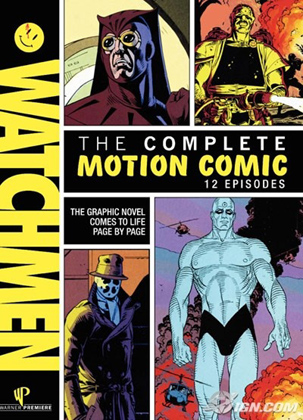
Watchmen Motion Comic DVD Coming Soon

ICV2 reports that the motion comic version of Watchmen, sort of a comic book on tape, with video reminiscent of those 1960s Spider-Man cartoons, is set for DVD release soon.

I have the motion comics downloaded to my ipod and find them fascinating. They're well-done, my only criticism is that there is one narrator for all parts, even the women, but the guy is good.

However, they don't stand up to the original text. I had the opportunity to compare some scenes from the book to their equivalents in the motion comic with students in my "Teaching the Graphic Novel" course, and it was clear this format can't capture the intricate intertextuality of the source material.

An excellent example of this comes in Chapter I, after Dan leaves Hollis. The "Obsolete Models" sign gets a lot of attention as a signifier in the comic, but even though it sways back and forth in the wind in the motion comic, one can't read the entirety of its text, meaning that unless one has already read the graphic novel, one is probably not going to catch on to this layer of meaning.

Also, none of the print sections at the end of each chapter are reproduced in the motion comic, so those nuances are lost as well.

The dissonance between these two texts has me a little more anxious about the movie, of course. But, I'm very happy to have these multiple textual iterations of Watchmen coming available soon. I do not know if I'll buy the motion comics DVD, since I've already got them, but I will get the DVD of the film so I can compare and contrast the various forms on my own and with my students.

Praise and award Nod for YA GN _Swallow Me Whole_

The Beat reports that Swallow Me Whole, a graphic novel by Nate Powell, is the first GN since Maus to be honored for the LA Times Book Prize.
From a quoted source: "The book follows two teenage stepsiblings, Ruth and Perry, through the ups and downs of school, family, and suburban restlessness — all complicated by the insect armies, swirling visions, and haunting voices that no one else can perceive..."
For the full story, click the title to this post.
As for me, looks like I got a book to add to my reading list!

Nice Op-Ed on Comics Reading from UNF's Katie Monnin

Monday, March 02, 2009

Quoted on Watchmen Movie in New York Daily News

Another one of those instances where a 30 minute conversation comes down to one line, but it's cool to be mentioned in the New York Daily News, especially about a text that I love sooooo much! For the record, I did express to the reporter that I think the Watchmen movie will rock.

Saturday, February 28, 2009

Almost Back from Write to Learn

So the snow caught up with me in Camdenton, MO, and I had to reschedule my flight, but I did enjoy my time at the nearby Tan-Tar-A Resort for the Write to Learn Conference. I had a small but typical crowd as far as personalities go, and I especially liked meeting Nick from Mizzou who was doing another comics-related seminar later in the day (sorry I didn't make it to yours, Nick, I got the "crud" and ended up sleeping most of the afternoon) and plans on doing his dissertation work on sequential art. Maybe I'll eventually convince him to use "panels" instead of "frames" for his terminology (what are you, studying Iser or something? ;) ), but I wish him the best in his studies!

Tuesday, February 24, 2009

Job Posting: Want to Write Educational Comics?

Thanks to Beth D. for sharing this posting from H-Net.org. Looks like the educational comics field continues to expand!


EZ COMICS - AP History Teacher- Content Writer for Second World War covered in AP US History and AP World History

Location: Rhode Island, United States
Institution Type: Other Position Type: Temporary
Submitted: Friday, February 13th, 2009
Main Category: U.S. History
Secondary Categories:
World History

INTRODUCTION :EZ Comics ( www.ezcomics.com) , is a Rhode Island based learning and education company with the focus on making fun and creative comics for students with History as the subject. The firm has three comic books so far based on different events and important figures and personalities from the US History.

SCOPE :EZ Comics invites applications for AP US and AP World History teacher /researcher in the field of US History to produce a specification document that includes any or all objective and subjective based questions for the topic 'Second World War' that is covered in the both the above mentioned exams.We seek candidates whose research and teaching interests may focus onĂŻ¿½but are not limited toĂŻ¿½the following areas as per the curriculum outline in the AP US History and AP World History Exam. From AP US History:21. The Second World Wara.The rise of fascism and militarism in Japan, Italy, and Germanyb. Prelude to war: policy of neutralityc.The attack on Pearl Harbor and United States declaration of ward. Fighting a multifront ware.Diplomacy, war aims, and wartime conferencesf. The United States as a global power in the Atomic AgeFrom AP World History:E. 1914 CE to present4. Compare the effects of the World War II on areas outside of Europe.

PURPOSE :This specification document will be used to used to create content for the comic book based on 'Second World War' , keeping in mind the objective of the AP curriculum, that can specifically address the exam questions in the document and in return help students prepare for the AP Exams.

DELIVERABLES:

Deliverable No. 1

INPUT
Candidates should be able to find all the relevant resources pertaining to the Second World War with its scope to the AP US History and AP World History Exam in order to produce the document. The resources will include text books, exam books , sample exams and other such material available.

For example :
a. Cracking the AP World History Exam, 2009 Edition, Princeton Review Chapter 10 :Recent Stuff- Around 1914 to the Present , Pg 243-252
b. Cracking the AP US History Exam, 2009 Edition,Princeton ReviewChapter 13: The Early Twentieth Century, Pg 159-165

Deliverable No. 2

OUTPUT
The document will include all the types of questions tested on the exam such as MCQs, DBQs, Free Response questions that cover the Second World War on both the AP US History and AP World History.The document should include as many questions as it may require to fully cover the wider scope of the exam topic mentioned and that will help a student take the AP Exam. At the minimum the document should includeMCQS : 1000DBQS: 200Free Response Questions: 200

Some examples of questions tested in the AP exam on the Second World War are......

[I don't want to step on H-Net's toes by coping the entire post. Follow the link in the blog post title for complete info]

......Contact Info: Mehul MaldeEmail: mehulmalde@gmail.com
Website: http://www.ezcomics.com

Monday, February 23, 2009

Make some Comics at MakeBeliefsComix.com

Along with applications like pixton and toondoo, MakeBeliefsComix lets students become cartoonists instantly via panel layout, character, and balloon selection. It's a fun site, and it is absolutely free with no strings attached. Definitely worth looking into for making your own cartoons or for getting your kids composing!

Recently, Google and UNESCO selected the site as one of the world's most innovative in encouraging reading and literacy. Educators who teach literacy and ESL students are using it in 180 countries. In addition to English, the site accepts text in Spanish, French, Italian, German, Portuguese and Latin. Join in on the fun, why don't ya?!?

Essay on the Importance of an Arts-Rich Education

Review of _Luke on the Loose_

Harry Bliss' first comic book is the tale of a rambunctious young boy who escapes his father's grasp at the park and then seemingly involves half of New York in his pursuit of pigeons through the boroughs. Apparently lighter than air and easily able to give chase, Luke is eventually rescued by city firemen after he falls asleep on a water tower atop one of Ne York's many brownstones. The ultimate result for Luke is that he becomes one of those leashed children the next time he goes to the park with his father, who doesn't change his own chatty behavior that led to him losing his son in the first place. Luke is his father's son, as he too tries to continue his chase from the day before. It's not there, but it is easy to visualize foam gathering at the corner of his mouth as he attempts to restart his antics.

The book is entertaining. Kids will enjoy seeing Luke cause tons of disruptions as he maintains his singularity of mind. Parents may want to discuss how lucky Luke is not to get hurt in his story. Fun but not fabulous, this Toon Books text should make for interesting reading and good discussion between small children and parents nonetheless.

Grown readers may see a little bit of Linus, Little Nemo and Curious George, even Barnaby, in the story, but whereas this text might remind one of those classic characters and storylines, Luke on the Loose does not rise to their level. Luke is going to need several more well-formed adventures with clearly developed beginnings, middles, and ends before he can think of being elevated to classic status.

Review of _Benny and Penny in The Big No-No_

Geoffrey Hayes' latest Benny and Penny book features the two cuddly mice siblings trying to discern the identity and nature of the new kid next door. After some misplaced notions of ownership and threat are worked out, the three become fast friends. And there's a mud fight thrown in too!

Cute, sweet, and true to the capricious nature of very young children, the Toon Books release is charming and prettily rendered. This is the type of book parents and children should enjoy together in a rocking chair and is a great text for practicing say-back comprehension after several readings.

Article in Educational Leadership 66(6)

Check out my article in the March 09 edition of Educational Leadership. Sure, they put the graphic novel article in an issue with 3 sixes associated with it, but it is not a bad read. I finally got some things off my chest about how some perceive GN's, and I tried to move us beyond the "define then give examples" stage, though I still had to do some of that too.

The article was retitled "Going Graphic: Understanding what graphic novels are -- and aren't -- can help teachers make the best use of this literary form." The phrase "going graphic" is one of many graphic novel article title cliches, unfortunately, but besides that, I was happy with the tightness of the copy editing, etc. And they added pictures, which really made it pop.

It's pretty cool to be in a journal with James Gee, Howard Gardner, Michael Levine, etc. And this publication focuses on principal types, which represent a powerful but less-frequently targeted audience when it comes to getting educators thinking about sequential art in the classroom.

Thursday, February 19, 2009

Best Thing Ever or Sign of the End Times?

ICV2 Reports:


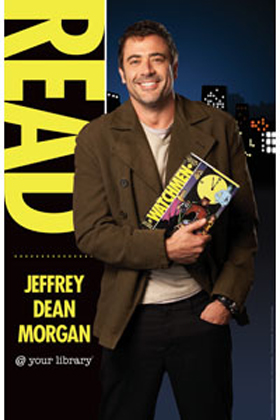
The American Library Association is offering a Watchmen-themed “Read” poster featuring Jeffrey Dean Morgan (The Comedian in the Watchmen film), Watchmen-style graphic design, and the cover of the book. It’s selling the 22” x 34” poster for $16.00. This is one more indication of the breadth of the Watchmen phenomenon and its uses in promoting graphic novels.

ALA has in the past partnered with manga producers (see “ALA
Poster Features Manga”), Marvel, and DC for posters.


This is truly something I never thought I would see. I'm proud and also sort of amused in a sort of "best thing ever sort of way." I'm happy to know that this poster will probably make it into high schools across the country. I know some folks have been teaching Watchmen at the high school level. Hopefully, more will now.


On the other hand, they chose the actor who plays one of the more despicable characters from the book. J.D. Morgan here plays the amoral Comedian, a rapist, chauvinist, and cold-blooded murderer. "Hey kids, meet me in the stacks at your local library!" See how one can read this as more an April Fool's Day joke than a legitimate story? But, it appears to be reality, adding an even more wonderful but somehow disconcerting element to it.


Inside reference to those who have read Watchmen: Question: Would you actually ever meet the Comedian in the stacks of your local library? Answer: "Only once."

Tuesday, February 17, 2009

Phew! What a Night! Lawler, Portillo, Nitz, ETC Rock the House!

Thanks to my guests and to the great crowd for tonight's "El Paso in the Comics" event. Hopefully we can do more events like it in the future. I collected many business cards and samples and will look over each one in due time. I want to give a special thanks to those who had to do some border crossing to get there and who were very kind not to correct my Spanish when I said "Gracias para su ayuda" when I should have said "Gracias para su trabaja" or something that more directly translated into "thank you for your work."

I'm tuckered out, so I'll write more on it later. If you see Lawler, Portillo, and nitz at the bar tonight, buy'em a drink! Nitz'll take a vodka and redbull.

Monday, February 16, 2009

Hangin' With Jai Nitz

Jai Nitz, award-winning comics writer and scribe of series like El Diablo and Blue Beetle, is in town and ready to take El Paso by storm! His first official capacity will be speaking with my "Teaching the Graphic Novel" graduate class tonight before visiting a local high school tomorrow and giving his big talk later in the evening. Jai is smart, gregarious, and broad-minded, so I predict a huge success between now and his return to his hometown! :)

Updates as things develop!

Sunday, February 15, 2009

Revelation on Tedious Topic Related to Teaching GN's

Today I was mulling over the "research" questions people always ask me about teaching graphic novels. I find myself saying many of the same things over again when I talk to people about comics in the classroom -- "graphic novel" is a fine term to use; "sequential art narrative" is even better; there's nothing wrong with calling them "comics;" they're a form or medium, not a genre; Will Eisner did not actually coin the term "graphic novel" in 1977 -- and when they ask about the research, I often inform folks that people have been studying comic strips and comic books in terms of education and literacy since at least the 1930s*.

I have my sources I quote, etc., but now I'm thinking I need to take a different strategy.

"Question: What does the research say about how effective using comics in the classroom is?"

"Answer: What does the research say about how effective using poetry/American Literature/Shakespeare/etc is?"

See, we don't have much quantifiable evidence that teaching Othello or The Bluest Eye or Of Mice and Men or The Catcher in the Rye or Beowulf improves students' literacy skills. If we focus solely on these texts or their larger forms or genres, we're essentially in the same boat as we are with graphic novels: we have tons of anecdotal evidence and personal experience from practicing teachers that show literacy and ELA skills and critical thinking skills can be engaged and seemingly improved via interaction with these texts. But, when it comes to NCLB quantitative data, not so much.

What we do have is data on how effective different teaching strategies can be. So, I'm thinking maybe we've been asking the wrong questions, and I've been giving the wrong answers.

It's a crapshoot whether texts teach independently, since in that case everything is completely dependent on reader variables. But when a well-trained and informed teacher utilizes good strategies to teach students a text, things can change. I am absolutely sure this holds true with any text. Don't believe me? Look at what Michael Bitz has done with The Comic Book Project, or what Nancy Frey and Doug Fisher have done with their students, or what I've talked about upon working with mine.

So, I'm thinking that the more important thing to tell teachers is not just to look at what the research says specifically on teaching comics, but to think about the gaps in evidence we have for the effectiveness of every text in our curriculum, and to think about what makes learning happen: it isn't the book or work itself so much, but the way the teacher and students interact with the texts and with one another. Whether we're dealing with ol' Shagstaff or Craig Thompson, the ans wer has always been in the how, not necessarily the what.

* This longevity is evidence to me that though the popularity of considering comics int he classroom may eventually lessen, as education does seem to be a field of trends -- it will never completely dissolve. Fads don't last 70+ years.

**The more I consider research vs. practical experience, the more frustrated I become. I certainly understand the need for solid qualitative and quantitative work related to teaching, but we can't dismiss auto/ethnographic stories of experience. As I learn more about the competitive world and fissures of educational and professional philosophies, the more I seem to think that the problem with anecdotal evidence is that it comes from the individual.

Think on it: I can tell my story about how comics influenced my reading development and how they seemed to engage my students, and so can scores others, but there are still many who will say that personal anecdotes aren't strong enough evidence. However, if we all tell our stories to a researcher, and they write up our stories and triangulate the data, it gains more respect. It is vetted. Now, if someone can somehow quantify the triangulated variables and run ANCOVA's or ANOVA's or whatever on it, those results are even more impressive.

All research is flawed, regardless of methodology. Useful, but flawed. But when it comes to anecdotal evidence, I wish we'd just cut the crap and say, "The reason it isn't compelling is because your story coming from you doesn't help me get tenured/published." As for practicing teachers, knowing the charades associated with academic careerism, ideological alignment's place in academic careerism, and the inherent falliblilities of each type of research may be just as important as focusing on research-based practices.

Tuesday, February 10, 2009

Full Text of Education Week Article on Comics and Literacy

Thanks to AE for helping me find this link!

Coverage "El Paso in the Comics" in the El Paso Times

Thanks to Doug Pullen and the El Paso Times for giving us some coverage of our speaker series even scheduled for Tuesday February 17 at the UTEP library!

Sunday, February 08, 2009

New Column on Comics and Academia


Comixology has Karen Green, Columbia University Classics Librarian and Graphic Novel selector, doing a column on graphic novels in academia, which apparently means k-16 for her. It's a decent column.

Thursday, February 05, 2009

I Can't Wait for This to Come out! Bring on the _Deluge_!!!

Press Release from Pantheon:


AMAZING EARLY BUZZ FOR A.D.!


Josh Neufeld's debut A.D.: New Orleans After the Deluge (Pantheon Books, August 18, 2009) will be front and center at New York Comic Con Tomorrow: "Comics and New Media" a panel discussion featuring Josh Neufeld (author), Jeff Newelt (senior editor of Smith Magazine, Kate Lee (agent at ICM) and Pantheon's very own Lisa Weinert Friday, February 6 3:30 PM to 4:30 PM Jacob Javits Center (644 West 34th Street).


Anyone with a badge can swing by. If you're unable to attend the convention, worry not! We'll be taping the panel and sending you the links to it here.


I soooooo want this book now!!

Scool Library Journal Covers the Recent NYC Graphica Conference

Here's Marshall George, Ph.D. offering me the first Excellence in Graphica in Education Award. The photo is from the School Library Journal's online coverage of the event, which is very positive and clearly illustrates the energy that was at Fordham on that cold but clear and sunny day in NYC.

The article mentions me quoting from information found in Stephen Krashen's The Power of Reading, 2nd edition, which has a section on comics research that is must-read material for anyone interested in comics and literacy.

I don't look half-bad for someone whose dry cleaners gave him pants that were two sizes too small but who didn't realize it until the day of the conference! And under that open collar? A Superman t-shirt.

If You're in El Paso 2/16-2/18, Check it Out!

Sponsored by the UTEP English Department and English Education Committee:

Not only is there an underground comic book scene in El Paso, but the Sun City has its very own super-hero!

On Tuesday, February 17, The UTEP English Department will host “El Paso in the Comics,” a presentation featuring two local comics writers and keynoted by Jai Nitz, DC Comics writer and writer of the All-Spanish issue of the super-hero series Blue Beetle, which is set in El Paso. The event will be in the Blumberg Auditorium from 6:30-8:30. Admission is free.
James Bucky Carter, Assistant Professor of English Education and comics scholar, will moderate the event. He and Nitz will be joined by Jaime Portillo and Julian Lawler, local comics creators who will speak about how the Border Region is influencing their current and upcoming comics projects.

“Proximics is an interesting thing to study in comics,” says Carter, who is writing the Blue Beetle entry for an upcoming revision of an encyclopedia on comic books. “In super-hero comics, and in DC comics in particular, it is common for heroes to work on macro levels and be based in cities that are stand-ins for actual metropolitan areas. Think Gotham for Batman or Metropolis for Superman. Both are stand-ins for New York. Often, the less populace the home base for the hero, the less serious he or she is taken as a major player on the hero scene. For a DC series to feature a prominent hero in a named city like El Paso says some interesting and exciting things about our region and how it may be viewed in comics and to the comics industry.”

Jaime Reyes is the teenage alter-ego of the most recent Blue Beetle. He is of Hispanic origin and attends El Paso High. The series has dealt with issues such as immigration, border patrol, and border trafficking.

Nitz will speak about writing Blue Beetle #26. Portillo will discuss his recent mature-readers graphic novel Gabriel, in which a vampire is responsible for many of the murders in Juarez, and Lawler will discuss an upcoming project that deals with the issues of voicelessness and violence in the Border Region.

Nitz will also speak to several classes at UTEP and to area high school students during his stay in El Paso. He will also do a signing at Dave’s comics and Paintball on February 18 from 11:00-1:00.

Bios:

Jai Nitz is a Hispanic comic book writer from Lawrence, Kansas. He won the Xeric grant for self-publishing in 2003 for his pulp-inspired anthology, Paper Museum. He won the prestigious Stoker Award for best writer of illustrated narrative in 2004 for Heaven’s Devils from Image Comics. Most recently Nitz wrote Blue Beetle #26, the first all-Spanish comic from DC Comics, showing the adventures of El Paso’s native superhero. Nitz is currently writing the Southwest-set El Diablo for DC. Nitz has written for DC, Marvel, and Image comics, working on characters from Batman to the Fantastic Four to Hellboy.

Jaime “Jimmy” Portillo was born and raised in El Paso, TX. He began his college education at EPCC and continued on at UTEP, where he received a B.A. in History (2002) and Chicano Studies (2005). Jaime released his first book in 2008 titled, GABRIEL, a vampire graphic novel that takes place in El Paso and Juarez. This story received the prestigious Xeric Foundation grant. GABRIEL has gone on to become a highly critically acclaimed book. He is currently collaborating with Arturo Delgado Molina and Dany Morales of Juarez, Mexico’s, DEATH MOON COMICS. He is thankful for the support he has received from his fiancĂ©e Maribel Cisneros, his parents, Enrique and Estela, family, and friends.

Julian Lawler is an El Paso native, born and raised in the desert southwest. He received his B.A with a double major in American Literature and Anthropology from the University of Texas at El Paso in 2008. He has been editor-in-chief of Broken Tree Publications since 1999. He has published numerous comic books including Industriacide, Prophet of Dreams, Zodiac, and the underground comic book Triangle Man. Industriacide #1 was critically proclaimed as "Certified Cool," and labeled breakthrough in the field of comic books. Prophet of Dreams #3 received a "Spotlight On" distinction, which is a recommendation for readers to take a look. He plans to release a new comic book series titled Superheroes, Inc. in 2009, a book that focuses on the El Paso/Juarez area. Julian Lawler has also had several poems published in the Crysalis and the Rio Grand Review. He has published literary criticisms on Bewilderingstories.com as well as a pair of fantasy novels, Prophet of Dreams and Nightland.

Tuesday, February 03, 2009

My First Award as a Tenure-Track Scholar!

At the inaugural Graphica in Education conference in NYC this weekend, I was honored to receive the first-ever Fordham GSE Graphica Excellence in Education Award for my work on helping teachers understand how and why comics and graphic novels can be used in the classroom. I've got a nice certificate coming my way and everything!

I appreciate the award, but having my name called while sitting next to Michael Bitz was a little tough, as when the conference organizers told me a few days before the conference that they'd need me to stick around to help with an award, I assumed they wanted my input on who should win it and I actually mentioned Dr. Bitz as the first person who came to mind due to his excellent work with the Comic Book Project. So, in my mind, I'm sharing it with him, with hopes that he'll get his own flashy certificate as the conference grows in future years.

I can't wait to share the news with my colleagues at UTEP, and if I can, I'll post pix and press reviews of the conference as they become available.

Monday, February 02, 2009

Thanks to NYC for a Great Trip!

Thanks to Fordham University, especially Professor George and soon-to-be Professor Kelley, to Diamond and the other sponsors of the recent Graphica Conference. I enjoyed my time there, was thrillled to give the keynote, learned a lot of neat things from presenters, the crowd, and the speakers, and was overwhelmed to have been presented with an award at the end of the day.

It was also nice to meet many folks for the first time and to reconnect with others. If you're reading, I'll be following up on our conversations in the coming days and weeks! I hesitate to say "it was especially an honor to meet" because I was honored to meet everyone who stopped by to say hello or who had a part in the conference. Here's hoping the conference becomes known as much for building connections among teachers and scholars and publishers as it does for being a major "first."