A revamped version of the Classics Illustrated Frankenstein will soon be releases by imprint Papercutz, which apparently has several graphic novel adaptations from the series for sale. For some interesting contrasting visuals, do a search for "Frankenstein" on my blog and take a look at some excellent artwork.
EN/SANE World is James Bucky Carter's enclave of English Education (EN) resources as well as a haven for those looking for information on Sequential Art Narratives in Education (SANE).
A Public Service Announcement! ;)
Wednesday, October 15, 2008
O My! Sequential Art Students Create O. Henry Collection
Let's face it, if you've been an English teacher long enough, you've taught an O. Henry story. It's relatively easy to get readers to feel the pathos of his stories, but now there's a resource to help you get them to visualize the characters, their reactions, their emotions, etc:
Students from SVA Comic Book Storytelling Workshop have compiled a graphic anthology of his works, including stories like "The Green Door" and "The Whirligig of Life."
Tuesday, October 14, 2008
"Looks Good To Me:" I Live Here
Comics have a long history of detailing the plight of the poor and displaced, or those looking for a new home and life after dealing with crisis or disaster, from Will Eisner to Joe Kubert to adaptations of Kafka to Joe Sacco to the upcoming Hurricane Katrina tale After the Deluge to the following new title, as detailed in a press release from Pantheon:
"Gut–wrenching and hauntingly beautiful" —Glamour
For the past two months, you've listened to me tell you how excited I was about I Live Here. I couldn't be more pleased now to tell you that it's finally on sale! If you don't already know what I Live Here is about, here's the short version: the book—or more precisely the four books that are contained within a slipcase—is a stunning visual documentary, in which the lives of refugees and displaced people become at once personal and universal. I Live Here is a raw and intimate journey to crises in four corners of the world: war in Chechnya, ethnic cleansing in Burma, globalization in Mexico, and AIDS in Malawi.
The voices we encounter are those of displaced women and children, told in their own words or by noted writers and artists, including Joe Sacco, Ann–Marie MacDonald, Phoebe Gloeckner, Chris Abani, and many others. The stories unfold in an avalanche: an orphan goes to jail for stealing leftovers. A grieving mother snaps photos of spaces left vacant by her vanished teenaged daughter. A child soldier escapes his army only to be saved by the people he was trained to kill. An elderly woman recounts the tumultuous history of fellow refugees. Threaded throughout these accounts is Mia Kirshner's intimate travel narrative, brought vividly to life in collaboration with writer J.B. MacKinnon and designers Paul Shoebridge and Michael Simons.
I Live Here is a truly groundbreaking work.
Order your copy here Happy Reading!
--Hillary Tisman
Monday, October 13, 2008
Powell's City of Books (Portland, Oregon)
This weekend I had a dream come true, literally. For years now, I've had a recurring dream where I visit the largest bookstore in the world. Stacks are stories high, the ladders are enormous, and long velvet drapes cover many of the sections until one asks for them to be revealed. That wasn't exactly the layout of Powell's City of Books, but the bookstore in Portland, Oregon, is the largest in the world and was certainly worth the visit.
Imagine being a bookstore that encompasses and entire block, one with graphic novels on shelf after shelf, from the floor to twenty feet above your head -- and that was just *one* section of GN's. Powell's had several sections -a couple of Manga sections (one for general Manga, another for adolescents favorites), an adult graphic novels section (not what you think, but they probably had a section of those too somewhere), and a kids graphic novel section.
Twas bliss. Never have I been in a bookstore so big, they give you a map of the place when you walk in the door. And despite the inexplicable absence of copies of Maus I (II was in abundance), the graphic novel section was impressive. If only I could visit Powell's again as easily as I do that bookstore in my dreams...
Imagine being a bookstore that encompasses and entire block, one with graphic novels on shelf after shelf, from the floor to twenty feet above your head -- and that was just *one* section of GN's. Powell's had several sections -a couple of Manga sections (one for general Manga, another for adolescents favorites), an adult graphic novels section (not what you think, but they probably had a section of those too somewhere), and a kids graphic novel section.
Twas bliss. Never have I been in a bookstore so big, they give you a map of the place when you walk in the door. And despite the inexplicable absence of copies of Maus I (II was in abundance), the graphic novel section was impressive. If only I could visit Powell's again as easily as I do that bookstore in my dreams...
Sunday, October 12, 2008
Thanks, OCTE!
Thanks to all the folks in Lake Oswego, Oregon, for hosting me this weekend. I hope my keynote was OK. The audience certainly was attentive, and I think the early-career teachers in the audience might have particularly gained some direction, based on questions and such. I had a great time and appreciate everyone's efforts, and I'm happy to have made a new friend in Bob Hamm.
One more keynote to go (North Carolina) before my appearances at the national NCTE conference in San Antonio!
Wednesday, October 08, 2008
Political Fun w/ Microsoft Publisher
See, you don't need fancy programs like Comic Life to create comics art with your students (but it is a great application!). Using Microsoft Word and even Microsoft Publisher can be an effective way of creating pieces, for example, the political comic strip I made:
(Surely I'm not the only classic car buff to have noticed the muscle car undertones of the recent political campaigns. My thoughts? As the cartoon clearly implies, "Nobody ever bought a Maverick if they could afford a Mustang!")

Tuesday, October 07, 2008
I Found This Stimulating (Intelectually): Portillo's Gabriel
This summary is not available. Please
click here to view the post.
"Stop Staring at Me, Swann!"
The Swann Foundation for Caricature and Cartoon, Library of Congress, is now accepting applications for the Swann Fellowship for the 2009-2010 academic year. Annual award up to $15,000 to support scholarly graduate research in caricature and cartoon. Applicants must be enrolled in an accredited M.A. or Ph.D program in a university in the U.S., Canada, or Mexico. Deadline: Feb. 13, 2009. Access guidelines and application at:
http://www.loc.gov/rr/print/swann/swann-fellow.html
Contact Martha Kennedy with questions at 202/707-9115 or email swann@loc.gov.
What's Wrong with Calling them Proto-comics?
Or precursors? Or sequential art? Critic Domingos Isabelinho discusses Medieval painting and book illustration, the wordless engraving cycle, Modern and Post-Modern painting and Concrete and Visual Poetry as entities that can help "expand comics as an art form," then critiques each one for how it is or is not comics. Something doesn't have to be the thing itself to have the traits of the thing; nor do we need to worry so much on giving something from the 15th century a 19th or 21st century label. No, there weren't comic books in the Middle Ages, but there was sequential art and visual narrative. Acknowledging the precursors to something seems to inherently suggest that there are going to evolutions an devolutions throughout the ages, but at least Isabelinho is attempting an interesting vivisection of the intersections of myriad art forms with multiple similarities.
Monday, October 06, 2008
Non-Fiction Manga on Japanese Power and War
Thanks to Tom Spurgeon for offering the above link. You'll have to scroll down a bit to get the the translated manga, but it's worth it. Too often school children in America only get the American-European viewpoint on politics and war, so it is good to see other viewpoints expressed. Here's a take on WWII-era Japan we might not often see. It reminds me a little of Barefoot Gen.
Friday, October 03, 2008
Thursday, October 02, 2008
Thanks, ICTE!
I'm currently in Johnston, Iowa, working with the Iowa Council of Teachers of English and am having a blast. Some members wanted me to post a "top ten" recommended reading list, so here it is in no particular order!:
Maus by Art Spiegelman
Persepolis by Marjane Satrapi
Bone by Jeff Smith
The Tale of One Bad Rat by Bryan Talbot
Ultimate Spider-Man Volume 1 by Marvel
American Born Chinese by Gene Yang
Deogratias: A Tale of Rwanda by J.P. Stassen
Runaways by Brian K. Vaughan and Marvel
Pride of Baghdad by Brian K. Vaughan
Pedro and Me by Judd Winick
Now, I often rotate titles in and out of my ten favorites, and these represent middle-and high school-friendly titles. If you want more titles and more mature titles, just ask.
Maus by Art Spiegelman
Persepolis by Marjane Satrapi
Bone by Jeff Smith
The Tale of One Bad Rat by Bryan Talbot
Ultimate Spider-Man Volume 1 by Marvel
American Born Chinese by Gene Yang
Deogratias: A Tale of Rwanda by J.P. Stassen
Runaways by Brian K. Vaughan and Marvel
Pride of Baghdad by Brian K. Vaughan
Pedro and Me by Judd Winick
Now, I often rotate titles in and out of my ten favorites, and these represent middle-and high school-friendly titles. If you want more titles and more mature titles, just ask.
Monday, September 29, 2008
The Cost of Prison
The Comics Reporter has posted a link to The Real Cost of Prison Project. The organization offers 3 different comic books about prison life and its large, scary reach beyond the facility walls. PDF's of their titles are available for download, but the comics can be obtained for free with a quick e-mail or letter to their home office. I'm not sure everyone's politics will match well with their message, but their work is interesting, one has to admit.
"You Gotta See This!": Tom Spurgeon's "50 Things That Every Great Comics Collection Needs to Have"
Tom Spurgeon has an extensive and fascinating list of must-have items for the comics collector over on his website The Comics Reporter. My somewhat-nearby-neighbor has some great items listed too. Here's the text for item 38:
38. A Stack of Comics You Can Hand To Anybody's Kid
If I were President, I would mandate that every household in America must have a white wicker basket holding an approximately 24-inch tall pile of beat up old comic books for kids to read. So certainly someone with a sizable comics collection should be able to offer a stack of old funnybooks to their sister's kids -- or their neighbor's, or their employer's and so on. I don't think the comics have to be rigorously excellent when they're aimed at this audience, because the repetition that signifies such comics as uninspired might be lost on fresh eyes. That being said, really bad comics might not have what it takes to capture anyone's attention, let alone a kid soaked in today's visually-saturated media offerings.
I'm happy to say I've got a little of many of the things I should have according to Spurgeon (and am excited to rise to the challenge to get the other things!), and I'm not afraid to prove it. My entry for "Item 22: A Selection of Comics That Interest You That You Can't Explain To Anyone Else:"? A Pearl Jam comic book that I am proud to own. PJ fans understand, but anyone else? And how can I defend my stack of Defenders comics?
38. A Stack of Comics You Can Hand To Anybody's Kid
If I were President, I would mandate that every household in America must have a white wicker basket holding an approximately 24-inch tall pile of beat up old comic books for kids to read. So certainly someone with a sizable comics collection should be able to offer a stack of old funnybooks to their sister's kids -- or their neighbor's, or their employer's and so on. I don't think the comics have to be rigorously excellent when they're aimed at this audience, because the repetition that signifies such comics as uninspired might be lost on fresh eyes. That being said, really bad comics might not have what it takes to capture anyone's attention, let alone a kid soaked in today's visually-saturated media offerings.
I'm happy to say I've got a little of many of the things I should have according to Spurgeon (and am excited to rise to the challenge to get the other things!), and I'm not afraid to prove it. My entry for "Item 22: A Selection of Comics That Interest You That You Can't Explain To Anyone Else:"? A Pearl Jam comic book that I am proud to own. PJ fans understand, but anyone else? And how can I defend my stack of Defenders comics?
Thursday, September 25, 2008
"I Will Be Buying This:" Breakdowns
I love Art Spiegelman (perhaps you saw that I ranked him as the most important contemporary graphic novelist in an earlier post? It's not like that's a revolutionary statement to make, or anything, though he may not like the term "graphic novelist.") and have been reading selections of his newest autobiographical book Breakdowns since my UVa days (the shorts appeared in VQR, or Virginia Quarterly Review).
Here's some information on the book from the Pantheon newsletter "Notes from Hillary." Thanks, Hillary, for adding me to your distribution list! :)
You'll have to wait until October 7 to get your copy of Breakdowns but, as those of you who saw the excerpt in the September 15 issue of The New Yorker know, it's well worth it. Breakdowns is the chronicle of Art Spiegelman's story, told in three ways—in 20 pages of new comix that give us the story of his evolution from a MAD–comics obsessed boy to a neurotic adult examining the effect of his parents' memories in Auschwitz on his own son, in a section on the work that he did in the 1970s as an underground comix artist, and in an illustrated essay that looks back at the sixties as Art pushes sixty and explains the obsessions that brought his works into being. Funny, complex, inventive and poignant, Breakdowns is everything you've come to expect from Art Spiegelman. You won't want to miss it. And, you don't want to miss the opportunity to hear Art speak, either. Starting on October 7, he'll be crisscrossing the country and making appearances in Austin, New York, California, Philadelphia, and everywhere in between. If you're in the New York area, you can also catch Art at this year's New Yorker Festival. He'll be giving a talk called "Breakdowns: Comix 101" on Saturday, October 4 at 4:30 pm. Purchase your tickets here.
DC Knows the Future --- almost.....
Pictured here: Supergirl wonders if her assets in the global marketplace will be enough to overcome the economic downturn of domestic economies and if she should diversify her portfolio while rolling over her 401K into a Swiss-Kryptonian off-planet holding firm account. "And then there's social security to worry about......" she mutters.
"Looks Good to Me": Alan's War
Tom Spurgeon reveals this new title from :01. Looks like a good one: a story about a WWII soldier's "past-present."
No More Minx
DC's fledgling imprint Minx Comics, a graphic novel line designed to target the YA literature/female readership, has failed to garner enough interest to continue production. So, it has been axed. The Beat covers the story pretty well, as does Comic Book Resources.
But let's face it, this is probably the first time you've ever heard of Minx, right? I have a few of the samplers, and while the stories weren't terrible, they weren't exactly earth-shattering either. But, then again, they weren't being marketed to me. But, then again, apparently they weren't too popular among those to whom they were being marketed, either.....
It is worth noting that the imprint marked a strong effort from a major comics publisher to offer multiple graphic novel titles to young female readers. Though there are plenty of women who enjoy super-hero comics and plenty of strong super-heroines out there, the perception is prevalent that the form -- or at least the super-hero genre of it -- is a man's domain.
But there are some excellent female graphic novelists out there. I don't care for Alison Bechdel's writing style, but I do respect her work. Jessica Abel is a rising star, and Marjane Satrapi makes my top 4 most important current graphic novelists list (the others are men: Art Spiegelman, James Sterm, and Chris Ware). Lynda Barry also has a growing opus of interesting sequential art. They tend to focus on the same sorts of genres all great graphic novelists seem drawn to -- autobiography, memoir, autobiographical fiction, coming of age in turmoil - rather than capes and tights, of course.
The market is out there, but it looks like it'll take future efforts to solidify it.
But let's face it, this is probably the first time you've ever heard of Minx, right? I have a few of the samplers, and while the stories weren't terrible, they weren't exactly earth-shattering either. But, then again, they weren't being marketed to me. But, then again, apparently they weren't too popular among those to whom they were being marketed, either.....
It is worth noting that the imprint marked a strong effort from a major comics publisher to offer multiple graphic novel titles to young female readers. Though there are plenty of women who enjoy super-hero comics and plenty of strong super-heroines out there, the perception is prevalent that the form -- or at least the super-hero genre of it -- is a man's domain.
But there are some excellent female graphic novelists out there. I don't care for Alison Bechdel's writing style, but I do respect her work. Jessica Abel is a rising star, and Marjane Satrapi makes my top 4 most important current graphic novelists list (the others are men: Art Spiegelman, James Sterm, and Chris Ware). Lynda Barry also has a growing opus of interesting sequential art. They tend to focus on the same sorts of genres all great graphic novelists seem drawn to -- autobiography, memoir, autobiographical fiction, coming of age in turmoil - rather than capes and tights, of course.
The market is out there, but it looks like it'll take future efforts to solidify it.
Tuesday, September 23, 2008
It Worked for YA Lit
Eisner award winning graphic novels and nominees can now place an informative medal on their covers. Well, the people who sell them can, anyway. ICV2 has the details here.
Many YA titles benefit from the placement of a National Book award or Printz award or King award label on their covers. This is a smart way to help legitimize graphic novels in the eyes of hesitant but curious readers, in my opinion. Might it also contribute to canon formation? Probably, but that's not a new phenomena among any form of media, graphic novels included.
Friday, September 19, 2008
"Looks Good to Me": La Perdida
This looks like a great book that might have some local interest for my students at UTEP. Here's how Pantheon starts its press release on this latest work from growing super-start Jessica Abel:
"From the Harvey and Lulu award–winning creator of Artbabe comes this riveting story of a young woman’s misadventures in Mexico City. Carla, an American estranged from her Mexican father, heads to Mexico City to “find herself.” She crashes with a former fling, Harry, who has been drinking his way through the capital in the great tradition of his heroes, William S. Burroughs and Jack Kerouac. Harry is good—humored about Carla’s reappearance on his doorstep—until he realizes that Carla, who spends her days soaking in the city, exploring Frida Kahlo’s house, and learning Spanish, has no intention of leaving."
"Looks Good To Me": Chiggers
Ah, real Southerners know what chiggers are. Well, there are probably multiple definitions. The one I know is "tiny little things that get under your skin and itch like crazy." Maybe that's what is going on as the female lead in this new graphic novel deals with changes in friendship and identity at a summer camp in my home state of North Carolina. For more on Old North Stater Hope Larson's graphic novel Chiggers, visit Comic Book Resources.
Thursday, September 18, 2008
Dark Horse Donates Collection to Portland State
As some one wanting to build a comcis collection at his own university, I was very happy to see this press release:
News: Dark Horse Comics, Inc., Donates Complete Collection to Portland State University Library
Author: Office of University Communications, 503-725-3711 (PSU)
Posted: September 17, 2008
Portland State University alumni Mike Richardson, founder and president of Dark Horse Comics, Inc., and Neil Hankerson, executive vice president, have donated copies of all publications generated by Dark Horse over the years to Portland State, and will continue to provide copies of all future items produced by the company. This generous gift will result in a complete collection of the Dark Horse corpus to be preserved in the Portland State University Library Special Collections.
"As a Portland State University alumnus, I am elated to be part of this monumental Dark Horse archive event," said Neil Hankerson. "Being able to bring this locally grown publishing company together with PSU exemplifies the unifying nature of Oregon and demonstrates the amazing advantages of having comics in schools. This archival program solidifies Dark Horse Comics' legacy, not only as a company dedicated to organic growth, but also as one of the world's foremost comic book publishing companies, committed to contributing quality works to the comic literary canon."
This valuable collection will be a destination resource for researchers in American studies, popular culture, art, sociology, gender studies, English literature and many other fields. So far, more than 2,000 Dark Horse comics, manga and books have been received, catalogued and made available for students and faculty to check out at the Millar Library. Dark Horse publications in more than 15 different languages are already being used as a resource by students studying foreign languages, and by international students enjoying material in their own languages.
"Neil Hankerson and Mike Richardson are stellar examples of engaged Portland State University alumni who give back to their community and to their university," said Helen H. Spalding, PSU's university librarian. "Their generous gift of the corpus of the Dark Horse Comics, Inc., is a significant destination collection for those researching the history of comics, popular culture, sequential art and many more facets of inquiry. Because of the reputation and size of the Dark Horse collection, the Library hopes to attract additional comic collections from other publishers and collectors, creating one of the largest research collections of its kind."
One copy of each available title or product given to the Portland State University Library will be catalogued, preserved and housed in Special Collections with supervised access. An additional copy will be added to the general Library collection, where they will be available to more than 207,000 students and faculty in Oregon and Washington through the Orbis Cascade Alliance, and internationally through the Library's interlibrary loan services.
Coinciding with PSU Weekend, Portland State will recognize and celebrate the gift with a special event on October 16, 2008, at 7 p.m. in the Smith Memorial Student Union ballroom. The event is free and open to the public, and will feature Dark Horse materials and a keynote by Mike Richardson. Media inquiries should be directed to Scott Gallagher at (503) 725-8789 or svg@pdx.edu.
Dark Horse Comics, Inc.
Founded in 1986 by Mike Richardson, who sought to establish an ideal atmosphere for creative professionals, Dark Horse Comics has grown to become the third-largest comics publisher in the United States and is acclaimed internationally for the quality and diversity of its line. By attracting the top talent in the comics field, Dark Horse continues to change the shape of the industry and grow its brand throughout the world. In conjunction with its sister company Dark Horse Entertainment, Dark Horse Comics has more than 350 properties currently represented under the Dark Horse banner, serving as the jumping-off point for comics, books, films, television, electronic games, toys and collectibles. In 2008, Dark Horse distributed its characters and concepts to more than 50 countries, continuing its mission of content creation and distribution in all of its forms throughout the world.
Portland State University Library
At the heart of an engaged university, the Portland State University Library supports the information, research, teaching and learning needs for more than 1,800 faculty members and 27,000 students at Portland State, covering 125 undergraduate, master's and doctoral degrees as well as graduate certificates and continuing education programs. The Portland State Library has over 1.4 million volumes, subscribes to almost 19,000 journals with access to over 45,600 electronic journals and over 32,000 electronic books. In addition, Portland State Library is a collaborative regional depository for federal documents and a member of the Portals and Orbis/Cascade Alliance library consortia, collaborating with other libraries to serve the region and scholarly community at large.

News: Dark Horse Comics, Inc., Donates Complete Collection to Portland State University Library
Author: Office of University Communications, 503-725-3711 (PSU)
Posted: September 17, 2008
Portland State University alumni Mike Richardson, founder and president of Dark Horse Comics, Inc., and Neil Hankerson, executive vice president, have donated copies of all publications generated by Dark Horse over the years to Portland State, and will continue to provide copies of all future items produced by the company. This generous gift will result in a complete collection of the Dark Horse corpus to be preserved in the Portland State University Library Special Collections.
"As a Portland State University alumnus, I am elated to be part of this monumental Dark Horse archive event," said Neil Hankerson. "Being able to bring this locally grown publishing company together with PSU exemplifies the unifying nature of Oregon and demonstrates the amazing advantages of having comics in schools. This archival program solidifies Dark Horse Comics' legacy, not only as a company dedicated to organic growth, but also as one of the world's foremost comic book publishing companies, committed to contributing quality works to the comic literary canon."
This valuable collection will be a destination resource for researchers in American studies, popular culture, art, sociology, gender studies, English literature and many other fields. So far, more than 2,000 Dark Horse comics, manga and books have been received, catalogued and made available for students and faculty to check out at the Millar Library. Dark Horse publications in more than 15 different languages are already being used as a resource by students studying foreign languages, and by international students enjoying material in their own languages.
"Neil Hankerson and Mike Richardson are stellar examples of engaged Portland State University alumni who give back to their community and to their university," said Helen H. Spalding, PSU's university librarian. "Their generous gift of the corpus of the Dark Horse Comics, Inc., is a significant destination collection for those researching the history of comics, popular culture, sequential art and many more facets of inquiry. Because of the reputation and size of the Dark Horse collection, the Library hopes to attract additional comic collections from other publishers and collectors, creating one of the largest research collections of its kind."
One copy of each available title or product given to the Portland State University Library will be catalogued, preserved and housed in Special Collections with supervised access. An additional copy will be added to the general Library collection, where they will be available to more than 207,000 students and faculty in Oregon and Washington through the Orbis Cascade Alliance, and internationally through the Library's interlibrary loan services.
Coinciding with PSU Weekend, Portland State will recognize and celebrate the gift with a special event on October 16, 2008, at 7 p.m. in the Smith Memorial Student Union ballroom. The event is free and open to the public, and will feature Dark Horse materials and a keynote by Mike Richardson. Media inquiries should be directed to Scott Gallagher at (503) 725-8789 or svg@pdx.edu.
Dark Horse Comics, Inc.
Founded in 1986 by Mike Richardson, who sought to establish an ideal atmosphere for creative professionals, Dark Horse Comics has grown to become the third-largest comics publisher in the United States and is acclaimed internationally for the quality and diversity of its line. By attracting the top talent in the comics field, Dark Horse continues to change the shape of the industry and grow its brand throughout the world. In conjunction with its sister company Dark Horse Entertainment, Dark Horse Comics has more than 350 properties currently represented under the Dark Horse banner, serving as the jumping-off point for comics, books, films, television, electronic games, toys and collectibles. In 2008, Dark Horse distributed its characters and concepts to more than 50 countries, continuing its mission of content creation and distribution in all of its forms throughout the world.
Portland State University Library
At the heart of an engaged university, the Portland State University Library supports the information, research, teaching and learning needs for more than 1,800 faculty members and 27,000 students at Portland State, covering 125 undergraduate, master's and doctoral degrees as well as graduate certificates and continuing education programs. The Portland State Library has over 1.4 million volumes, subscribes to almost 19,000 journals with access to over 45,600 electronic journals and over 32,000 electronic books. In addition, Portland State Library is a collaborative regional depository for federal documents and a member of the Portals and Orbis/Cascade Alliance library consortia, collaborating with other libraries to serve the region and scholarly community at large.
Image Comics Gets into the All-Ages Comics Game
PRESS RELEASE – SHADOWLINE LAUNCHES ALL-AGES LINE, SILVERLINE BOOKS!
New Shadowline imprint to exclusively feature all-ages graphic novels and books!
16 September, 2008 (Berkeley, CA) - This October, Image Comics’ Shadowline will debut Image’s first ever all-ages graphic novel and books imprint, Silverline Books.
“Silverline Books is dedicated to publishing quality all-ages books that bridge the gap between traditional storybooks and comics,” said Publisher Jim Valentino. “We believe that there’s a strong need to reach out to younger readers and introduce them to comics with uplifting, non-violent stories in a format they’re familiar with.”
Silverline Books officially begins October 29th with its first all-new release, DEAR DRACULA by Joshua Williamson and Vicente Navarrete; a Halloween-themed story about a boy who gets visited by his hero, the king of all vampires. It continues in November with BRUCE, THE LITTLE BLUE SPRUCE by Shadowline editor Kristen Simon and Image co-founder Jim Valentino, in which the titular tree wants nothing more than a family to take him in on Christmas.
The year ends with two more Silverline titles, including December’s MISSING THE BOAT by Justin Shady (aka Wayne Chinsang) and Dwellephant, about two lazy animals who are too late for Noah’s Ark, and the softcover follow-up to last years double Eisner award nominee PX! BOOK TWO: IN THE SERVICE OF THE QUEEN by Eric A. Anderson and Manny Trembley.
For more about Silverline Books, including five page previews, SRP, page count, format and ISBNs, please visit www.shadowlinecomics.com/silverline.
Thursday, August 14, 2008
PRESS RELEASE - VALENTINO, SIMON AND SILVERLINE SPROUT BRUCE: THE LITTLE BLUE SPRUCE!
Image Comics' Silverline, Kristen Koerner Simon and Jim Valentino tell the tale of a blue spruce searching for a home!
13 August 2008 (Berkeley, CA) - This holiday season Silverline Books, the all-ages book division of Image Comics' Shadowline, presents Kristen Koerner Simon and Jim Valentino's all-ages story of a little blue tree without a home, but not without hope; BRUCE: THE LITTLE BLUE SPRUCE.
"One of my unattained career goals was to do a children's book and when Kris brought BRUCE: THE LITTLE BLUE SPRUCE to me, I instantly knew this would be it," said Valentino. "Not only did I love the gentle message of accepting the differences in ourselves and others but the challenge of drawing a story where the principal character was a tree was too much to pass up!"
Just in time for the Holidays comes BRUCE: THE LITTLE BLUE SPRUCE, a heartwarming tale of Bruce, a blue spruce who wants nothing more than to be chosen by a special family as their Christmas tree. Engagingly written by Kristen Koerner Simon, illustrated by Image Comics co-founder and award-winning artist Jim Valentino and featuring painted color by THE SURREAL ADVENTURES OF EDGAR ALLAN POO's Avery Butterworth, BRUCE: THE LITTLE BLUE SPRUCE will charm even the most cynical of Scrooge's all year long.
BRUCE: THE LITTLE BLUE SPRUCE (ISBN: 978-1-60706-008-6), a 32-page square-sized hardcover for $9.99, will be in stores November 5, 2008.
(cover image courtesy of the Beat)
Wednesday, September 17, 2008
They Start so Young!
Doug Fisher draws our attention to this video from Youtube in which a young creator asks for help in getting his graphic novel project off the ground:
Monday, September 15, 2008
Comic Artist Kyle Baker's X-Spoofs
It's a sign that a form has been established and has its own canons when those involved in its continued creation start to trope and spoof it. Here's an excellent example circa 1989-1999 from Kyle Baker in which a collection of his cartoons poke fun of the by-then mega-popular X-Men characters. This is super-hero comics genre-specific, so if you don't get the in-jokes, you probably have too much back reading to do and should probably just find a geek to explain them to you.
My Web Seminar Coming Up!: September 23,
Doug Fisher and Nancy Frey will be joining me in an NCTE-sponsored web seminar in which we'll discuss ways we use comics to get kids considering the writing process. It's gonna be a cool, so join up today. Heck, bring your entire class along!
Need Help Explaining that Super-Collider To Your Students?
Friday, September 12, 2008
Friday, September 05, 2008
Gutierrez on a Roll!
A single story in the Diamond Bookshelf section? Feh! Single entries are for weaklings. See Peter Gutierrez follow up on the story I described below with an interview detailing comics' connections to the New Literacies and media studies! He's a Hulk of a sequential art narrative in education advocate, I tell you! And a good interview, too!
Thursday, September 04, 2008
Gutierrez Sees Comics as Preferable Medium For Teaching Media Literacy
Montclair, New Jersey media specialist and comics creator Peter Gutierrez has gained my attention and the notice of the NCTE Inbox for his words about using comics to teach media literacy. Posted on the Diamond Bookshelf website in the "School Articles" section, the piece "make[s] the argument for revisiting comics as an inherently effective teaching gateway to a variety of media as well as a means to address broader issues of process and the role of media in society."
Compelling, and completely agreeable to the views of EN/SANE world, it may be read in full here.
OK, I'm off to send Mr. G an e-mail about my SANE SIG idea....
Compelling, and completely agreeable to the views of EN/SANE world, it may be read in full here.
OK, I'm off to send Mr. G an e-mail about my SANE SIG idea....
Wednesday, September 03, 2008
Review Material and Press Releases Wanted
So I recently asked a more established comics blogger about how he gets books sent to him for review. He replied that he didn't do anything special; he just put some contact info on his page. Well, my profile has been updated with my work address.
If you publish comics or graphic novels that you think are appropriate for k-12 students and you'd like to send me copies for review, I'll certainly try to review them or mention them in appropriate articles or even write lesson plans/articles about them.
As well, if you have comics-and-education-related press releases, I'll be happy to consider posting them to the blog and/or commenting on them here as well.
EN/SANE world covers a very specific niche in the comics blogging community, the education community, and the English language arts community. No other site that I know of focuses as exclusively on sequential art narrative's intersections with literacy and education issues as does this one. As of yet, no academic journal exists that focuses exclusively on SANE issues either, so the site can do a real service for those interested in comics and pedagogy.
If you publish comics or graphic novels that you think are appropriate for k-12 students and you'd like to send me copies for review, I'll certainly try to review them or mention them in appropriate articles or even write lesson plans/articles about them.
As well, if you have comics-and-education-related press releases, I'll be happy to consider posting them to the blog and/or commenting on them here as well.
EN/SANE world covers a very specific niche in the comics blogging community, the education community, and the English language arts community. No other site that I know of focuses as exclusively on sequential art narrative's intersections with literacy and education issues as does this one. As of yet, no academic journal exists that focuses exclusively on SANE issues either, so the site can do a real service for those interested in comics and pedagogy.
Tuesday, September 02, 2008
UF Conference on Comics and Graphic Novels 09
Thanks to Aaron Kashtan for sending the press release below. I attended the first-ever UF CCGN but haven't made it back since. It's a fun conference if you can get on the schedule. North Florida is a neat place, and the UF campus is worth the visit alone. They got real live gators on campus! And in a little lake right beside freshman housing. How many a drunken newbie has stumbled back to his or her dorm, only to end up wrasslin' a reptile? I don't know, but the University of Florida is a great place for comics studies, and the conference, if you can involved, is a good one. Here's Aaron's press release.
The University of Florida's College of Liberal Arts and Sciences is pleased to announce the 2008 UF Conference on Comics and Graphic Novels: "Convergences: Comics, Culture and Globalization," which will be held in Gainesville, Florida, on March 21-22, 2009.
This seventh annual conference on comics will focus on issues of globalization and reception. Comics are, now more than ever, an international phenomenon, but scholarly accounts of comics are often limited by an exclusive focus on examples from a single national or continental comics industry. This problem is exacerbated by the scarcity of translations. Furthermore, one of the many obstacles facing the emergent discipline of comics studies is the difficulty of communication between scholars working in different national and cultural contexts. This conference is intended as a small step toward meeting these challenges.
The goal of this conference, therefore, is to consider the history and reception of comics on a global level. We are interested in papers that focus on international comics and animation markets, cross-cultural reception of comics, and the differential status of comics in different cultures (e.g. as a children’s/mass medium or as a mainstream form of literature). Here we are using "comics" in its broadest sense, embracing animation, manga, anime, graphic novels, webcomics, political cartoons, and even some "fine art." In addition to theoretically grounded work, we encourage submission of archival and historical research.
Special guests will include Susan Napier (From Impressionism to Anime: Japan as Fantasy and Fan Cult in the Mind of the West), Jessica Abel (La Perdida), Matt Madden (99 Ways to Tell a Story: Exercises in Style) and Sara Cooper (Founder, MLA Discussion Group on Cuban and Cuban Diaspora Cultural Production).
Possible topics include but are not limited to:
The reception of comics outside their original cultural context, both by fans (e.g. manga fandom in the United States) and by creators (e.g. American comics’ influence on the development of manga and BD, the “nouvelle manga” movement).
Connections between comics form and cultural status. How have views of the cultural position of comics (e.g. as a children’s versus an adult medium or as a mass-cultural versus a literary medium) evolved differently in various cultures? What does this have to do with the formal properties of the medium, such as sequentiality and hybrid image-textuality?
Comics as a global market: migrations of talent between multiple comics industries (e.g. the Spanish and Filipino “invasions” of British and American comics in the 1960s and 1970s, the Korean influence on U.S. animation) and cross-national collaborations (e.g. mangakas working for Marvel and DC).
Comics studies as a global discipline. What barriers exist to the study of comics from a global perspective and to collaborations between comics scholars from different cultures? How might such barriers be removed?
The impact of the internet on the global comics market. How have scanlations and filesharing helped or hindered global comics industries?
Canon formation and expansion. What happens when works from unfamiliar cultural contexts (e.g. Persepolis and Epileptic) enter a national comics canon?
Comics and travel/tourism, e.g. in Craig Thompson’s Carnet de Voyage.
Comics and issues of postcolonial identity, e.g. in Abouet & Oubrerie’s Aya, Baru’s Road to America, Horrocks’s Hicksville.
Translations of comics, both official and unofficial, e.g. scanlation. What are the unique difficulties and advantages of comics translation as opposed to prose translation? What are the unique difficulties and approaches to translating comics from different cultures? How, if at all, do “official” and “unofficial” translators approach comics translations differently?
Abstract submissions should be approximately 250-500 words in length. Presentations will be 15 minutes with 5 minutes of question and answer.
The deadline for abstract submissions is December 1, 2008. Abstracts or questions should be submitted to Aaron Kashtan at akashtan@english.ufl.edu or Tania Darlington at tdarlington1@ufl.edu. See the conference website for schedules and additional information: http://global.comic-studies.org/.
The University of Florida's College of Liberal Arts and Sciences is pleased to announce the 2008 UF Conference on Comics and Graphic Novels: "Convergences: Comics, Culture and Globalization," which will be held in Gainesville, Florida, on March 21-22, 2009.
This seventh annual conference on comics will focus on issues of globalization and reception. Comics are, now more than ever, an international phenomenon, but scholarly accounts of comics are often limited by an exclusive focus on examples from a single national or continental comics industry. This problem is exacerbated by the scarcity of translations. Furthermore, one of the many obstacles facing the emergent discipline of comics studies is the difficulty of communication between scholars working in different national and cultural contexts. This conference is intended as a small step toward meeting these challenges.
The goal of this conference, therefore, is to consider the history and reception of comics on a global level. We are interested in papers that focus on international comics and animation markets, cross-cultural reception of comics, and the differential status of comics in different cultures (e.g. as a children’s/mass medium or as a mainstream form of literature). Here we are using "comics" in its broadest sense, embracing animation, manga, anime, graphic novels, webcomics, political cartoons, and even some "fine art." In addition to theoretically grounded work, we encourage submission of archival and historical research.
Special guests will include Susan Napier (From Impressionism to Anime: Japan as Fantasy and Fan Cult in the Mind of the West), Jessica Abel (La Perdida), Matt Madden (99 Ways to Tell a Story: Exercises in Style) and Sara Cooper (Founder, MLA Discussion Group on Cuban and Cuban Diaspora Cultural Production).
Possible topics include but are not limited to:
The reception of comics outside their original cultural context, both by fans (e.g. manga fandom in the United States) and by creators (e.g. American comics’ influence on the development of manga and BD, the “nouvelle manga” movement).
Connections between comics form and cultural status. How have views of the cultural position of comics (e.g. as a children’s versus an adult medium or as a mass-cultural versus a literary medium) evolved differently in various cultures? What does this have to do with the formal properties of the medium, such as sequentiality and hybrid image-textuality?
Comics as a global market: migrations of talent between multiple comics industries (e.g. the Spanish and Filipino “invasions” of British and American comics in the 1960s and 1970s, the Korean influence on U.S. animation) and cross-national collaborations (e.g. mangakas working for Marvel and DC).
Comics studies as a global discipline. What barriers exist to the study of comics from a global perspective and to collaborations between comics scholars from different cultures? How might such barriers be removed?
The impact of the internet on the global comics market. How have scanlations and filesharing helped or hindered global comics industries?
Canon formation and expansion. What happens when works from unfamiliar cultural contexts (e.g. Persepolis and Epileptic) enter a national comics canon?
Comics and travel/tourism, e.g. in Craig Thompson’s Carnet de Voyage.
Comics and issues of postcolonial identity, e.g. in Abouet & Oubrerie’s Aya, Baru’s Road to America, Horrocks’s Hicksville.
Translations of comics, both official and unofficial, e.g. scanlation. What are the unique difficulties and advantages of comics translation as opposed to prose translation? What are the unique difficulties and approaches to translating comics from different cultures? How, if at all, do “official” and “unofficial” translators approach comics translations differently?
Abstract submissions should be approximately 250-500 words in length. Presentations will be 15 minutes with 5 minutes of question and answer.
The deadline for abstract submissions is December 1, 2008. Abstracts or questions should be submitted to Aaron Kashtan at akashtan@english.ufl.edu or Tania Darlington at tdarlington1@ufl.edu. See the conference website for schedules and additional information: http://global.comic-studies.org/.
Google Teaches About Chrome via Scott McCloud Sequential Art
Thanks to Dr. Brunk-Chavez for sending me the link to this dandy little web comic from a company you may have heard of. According to The Beat, the comic, designed to introduce the world to Google Chrome, an apparently better and more efficient way to surf the web, was leaked before it was supposed to go public, but now that it is out there, Google doesn't seem to mind.
The layout is typical Scott McCloud too. Informative, fun, and full of graphs. And people drawn to explain them to you. ;)
So comics have been used to educate the military, protect the innocent, inform about safety and health issues, and now, to launch a new web browser. That's pedagogical diversity from an formidable form, I tell you!
The layout is typical Scott McCloud too. Informative, fun, and full of graphs. And people drawn to explain them to you. ;)
So comics have been used to educate the military, protect the innocent, inform about safety and health issues, and now, to launch a new web browser. That's pedagogical diversity from an formidable form, I tell you!
Early Hernandez Bros Art
I was excited to see Heidi at the Beat cover this bevvy of barely-viewed old treasures from the Hernandez Bros. I recently read Locas and have a few Penny Centuries lying around, have read Sloth and have enjoyed their anthologized work, and now that I'm at UTEP, I'm trying to learn more about Hispanic comic artists.
It's a dream of mine to get Jaime and Gilbert to visit campus, so if you're reading, fellows, drop me a line!
Thursday, August 28, 2008
Jesus Replies, "That's just some guy with a beard!"
It's been a tough week to be Jesus. I mean, not the toughest week ever, but if he's been following my reading habits this week, I don't know how he can't be shaking his head.
Yesterday I learned of a comic book title called "Jesus Hates Zombies." Now, as you can imagine, the title and theme of the book actually raises some serious, and seriously sacrilegious, questions. Would Jesus really hate zombies? If Jesus died, and then rose from the dead..... well, he wants your soul, not your brain, so he can't be zombie......right? Some believe that part of the end times will be the raising of the dead, bodies and all. In terms of zombie lore and definitions, it'll be a veritable Merlfest of zombies. Christian zombies. Chistombies? The Jesus-zombie connection is not simply resolved.
Then I visit http://www.aintitcoolnews.com to see if they have any comics-and-education stories I might have missed (like the one about the Navy using a graphic novel to recruit diversity. If anyone has a link, please post a comment), and I see a trailer for Hamlet 2, a movie by the South Park geniuses in which a high school drama teacher takes his rag-tag troupe of actors on the road to perform a musical in which Jesus Christ time-travels with Hamlet. "Rock Me Sexy Jesus" is one of the songs, and it was being called a "hit."
Now, why in the world would I have not seen commercials for this movie deep the heart of Texas?
And just now, I visit CNN, that bastion of stories about dead babies and evil white people, the cable network that once actually reported the news, and I see this. Forget the ancient shroud of lore, Jesus' face is on a moth. No mention that on top of the "head" there appears to be a turban-looking shape, of course. The fellow who noticed the savior pattern on the insect? A Texan. No word on whether his Baptist church will start selling "Rock Me Sexy Jesus Moth" t-shirts.
Jesus has infinite patience, I am told, but how can he not be saying, "Forgive them father, for they know not wha --- Zombies? Wait, they think I have great abs??? A moth? Come on, that's just some guy with a beard!!!"
Now that would make a good comic strip.
Yesterday I learned of a comic book title called "Jesus Hates Zombies." Now, as you can imagine, the title and theme of the book actually raises some serious, and seriously sacrilegious, questions. Would Jesus really hate zombies? If Jesus died, and then rose from the dead..... well, he wants your soul, not your brain, so he can't be zombie......right? Some believe that part of the end times will be the raising of the dead, bodies and all. In terms of zombie lore and definitions, it'll be a veritable Merlfest of zombies. Christian zombies. Chistombies? The Jesus-zombie connection is not simply resolved.
Then I visit http://www.aintitcoolnews.com to see if they have any comics-and-education stories I might have missed (like the one about the Navy using a graphic novel to recruit diversity. If anyone has a link, please post a comment), and I see a trailer for Hamlet 2, a movie by the South Park geniuses in which a high school drama teacher takes his rag-tag troupe of actors on the road to perform a musical in which Jesus Christ time-travels with Hamlet. "Rock Me Sexy Jesus" is one of the songs, and it was being called a "hit."
Now, why in the world would I have not seen commercials for this movie deep the heart of Texas?
And just now, I visit CNN, that bastion of stories about dead babies and evil white people, the cable network that once actually reported the news, and I see this. Forget the ancient shroud of lore, Jesus' face is on a moth. No mention that on top of the "head" there appears to be a turban-looking shape, of course. The fellow who noticed the savior pattern on the insect? A Texan. No word on whether his Baptist church will start selling "Rock Me Sexy Jesus Moth" t-shirts.
Jesus has infinite patience, I am told, but how can he not be saying, "Forgive them father, for they know not wha --- Zombies? Wait, they think I have great abs??? A moth? Come on, that's just some guy with a beard!!!"
Now that would make a good comic strip.
Killing Skrulls Equals Collective Psychotherapy?
So the big event in Marvel comics right now is entitled "Secret Invasion." It's a series with the premise that green aliens intent on global domination have been shape-shifting and living among us for years, and now they're ready to attack. America's superheros have abandoned the "no killing" code that many, but not all, of them have lived by and are doing their best to eradicate the alien threat. Afterall, it's assimilate or die.
ICV2's Steve Bennett has this interesting take on the series:
"Of course we’re supposed to want our heroes to kill them; they are, finally, what I've been asking for all along, a fantasy stand-in for Al-Qaeda, religious fanatics bent on destroying everything that makes us who were are because being them is so much better. At last there are make-believe terrorists our heroes can punch in the face (and then some) without it seeming inappropriate or in bad taste. So I’m guessing the audience these comics are intended for is cooing “cool!” every time they see a Skrull reduced to a fine green mist."
If this was Marvel's intent, brilliant! They certainly had their finger on the pulse of current events vis a vis the political divide the country has/had been facing in last year's big event series, "Civil War," in which heroes fought themselves over a ideological clash sparked from a major disaster which left many Americans dead . The phrase "you're either with us or against us" was probably one the most often used in American superhero comics from 2001-2008.
I don't think it's beyond the realm of possibility that the series is supposed to offer us a little bit of sublimated revenge. And guilt free too, since the Skrulls are attacking the world, not just the U.S. , and they are highly othered, not even our species. But the macro-level politics might be evidence to the contrary of Bennett's point as well. The tag line of "Secret Invasion" is "Who Can You Trust?" which to me seems to get more to the internal American body politic and culture than to our global affairs, but I have always been inclined to paranoia to begin with, so maybe the connections I'm growing are even more local than I'd like to admit.
Go read Bennett's complete thoughts here. The Skrull stuff is about halfway down, and there's some naked Batmen characters for your viewing entertainment (a la Austin Powers) in there as well.
ICV2's Steve Bennett has this interesting take on the series:
"Of course we’re supposed to want our heroes to kill them; they are, finally, what I've been asking for all along, a fantasy stand-in for Al-Qaeda, religious fanatics bent on destroying everything that makes us who were are because being them is so much better. At last there are make-believe terrorists our heroes can punch in the face (and then some) without it seeming inappropriate or in bad taste. So I’m guessing the audience these comics are intended for is cooing “cool!” every time they see a Skrull reduced to a fine green mist."
If this was Marvel's intent, brilliant! They certainly had their finger on the pulse of current events vis a vis the political divide the country has/had been facing in last year's big event series, "Civil War," in which heroes fought themselves over a ideological clash sparked from a major disaster which left many Americans dead . The phrase "you're either with us or against us" was probably one the most often used in American superhero comics from 2001-2008.
I don't think it's beyond the realm of possibility that the series is supposed to offer us a little bit of sublimated revenge. And guilt free too, since the Skrulls are attacking the world, not just the U.S. , and they are highly othered, not even our species. But the macro-level politics might be evidence to the contrary of Bennett's point as well. The tag line of "Secret Invasion" is "Who Can You Trust?" which to me seems to get more to the internal American body politic and culture than to our global affairs, but I have always been inclined to paranoia to begin with, so maybe the connections I'm growing are even more local than I'd like to admit.
Go read Bennett's complete thoughts here. The Skrull stuff is about halfway down, and there's some naked Batmen characters for your viewing entertainment (a la Austin Powers) in there as well.
Wednesday, August 27, 2008
Academic Conference at Wizard World Texas!
In my own state, and I'll probably not be able to attend, but here's the scoop on the academic conference to be held in Arlington in conjunction with Wizard World Texas. The folks running the academic side of things are good ones, so I'd encourage attendance if one is in the area. The below is a copy of the press release:

ANNOUNCING WIZARD WORLD UNIVERSITY ACADEMIC PROGRAMMING
The Institute For Comics Studies Is Accepting Proposals For The First Ever Wizard World Academic Track At The Wizard World Texas Convention This November!
Congers, NY (August 27, 2008) - Wizard World has been home to movie premieres, costume contests, A-List creators and big time Hollywood talent. Now the convention tour is adding an academic track to it's growing list of crowd-pleasing events. The newly created Wizard World University academic track of programming at Wizard World conventions was created alongside the Institute for Comics Studies (ICS) and will allow fans to view their favorite stories in a new light, with help from academics and comic professionals alike.
November's Wizard World Texas (November 7-9) will be the inaugural stop on this tour promoting comics as an art form. The Institute for Comics Studies is currently accepting proposals for presentations, book talks, side talks, roundtables, professional-focus discussion panels, workshops and other panels for the newly created Wizard World academic track, Wizard World University, by September 22nd.
Do you have an idea for a study of the mythos behind “The Dark Knight” or the political commentaries in The Watchmen? Think you can deconstruct the Joker as a villain or explain the literary influences of Wolverine in an hour using a nifty PowerPoint? Wizard World University: Texas could be your classroom! Panels that include participation by comics industry professionals are especially encouraged and the ICS will provide assistance with recruiting professionals for participation.
If you want to be a part of this bold new frontier in education, please contact Dr. Travis Langley (Texas Local Chair) or Dr. Peter Coogan at the information below by the September 22nd deadline. Submission Form: http://www.hsu.edu/form.aspx?ekfrm=40054
Dr. Travis LangleyWWU-T Provost (Submissions Chair)Address: Henderson State University, 1100 Henderson St. #7604, Arkadelphia, AR 71999E-Mail: langlet@hsu.eduWebsite: www.workdaycomic.com/ERIICA/
Dr. Peter CooganDirector, Institute for Comics StudiesAddress: 719 Fairview Ave, St. Louis, MO 63119Phone Number: 314-962-7939E-Mail: Comicsstudies@gmail.comWebsite: http://www.instituteforcomicsstudies.org/
Be sure to go to www.wizardworld.com for updates about guests and programming and to purchase tickets. Wizard World, the largest family-friendly comics and pop culture convention in the central US, returns to Texas November 7-9 at the Arlington Convention Center near Dallas/Ft. Worth.
About Wizard
Wizard Entertainment is the industry leader in the comic book and collectibles market that publishes Wizard: The Magazine of Comics, Entertainment and Pop Culture, ToyFare: The Toy Magazine and Anime Insider, as well as Toy Wishes: The Ultimate Guide to Family Entertainment and Special Operations. Wizard’s publications have a monthly national readership of more than two million and are currently sold in 25 countries and five languages.
Wizard World, the convention division of Wizard Entertainment, is a four city tour that brings the best in comics, film, television, anime and collectibles to Los Angeles, Philadelphia, Chicago and Texas. WizardUniverse.com is the online for all of Wizard’s publications and its content spans the full range of Wizard’s pop culture subject manner.
For the latest news of interest to readers of all Wizard publications, Wizard Universe can be found online at www.wizarduniverse.com Media Contact Brett WhiteWizard Entertainment845.268.2000 ext. 193bwhite@wizardent.com
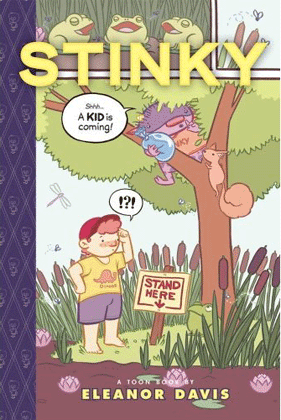
Stinky Comics Gets Reviewed
Eva Volin has this review of eleanor Davis' "toon" Stinky, which appears to be a kid-friendly title. ICV2 shares Volin's thoughts here.
Monday, August 25, 2008
Graphic Classics Available Once Again: Tales of Ambrose Bierce
SATIRE AND THE SUPERNATURAL!
Eureka Productions is pleased to announce the publication of revised second edition of the long-out-of-print GRAPHIC CLASSICS: AMBROSE BIERCE, the sixth volume in
GRAPHIC CLASSICS: AMBROSE BIERCE is revised, with 70 new pages, including new comics adaptations of "Moxon's Master," "The Damned Thing" and "The Monk and the Hangman's Daughter." Returning from the first edition are "TheStranger" and three other tales, plus a collection of 20 short fables illustrated by Dan O'Neill, Shary Flenniken, Florence Cestac, Johnny Ryan, and more great artists. With an amazing cover and new illustrations for "TheDevil's Dictionary" by Steven Cerio.
GRAPHIC CLASSICS are available in bookstores, comics shops, or direct from the publisher at http: http://www.graphicclassics.com/.
"This edition succeeds on many levels, providing awesome illustrations as well as a fabulous introduction to the strange, satirical, and horrific writings of an almost forgotten American author. Ambrose Bierce stands out as one of the best titles in an already strong series, sure to appeal to readers looking for insight into a most unusual mind." -- Booklist
______________________
GRAPHIC CLASSICS: AMBROSE BIERCE(Second Edition)Edited by Tom PomplunPublished August 2008, Eureka ProductionsDistributed by Diamond Book Distributors(ISBN 978-0-9787919-5-7)144 pgs, 7 x 10", paperback, b&w, 4c cover, $11.95
__________________
The Graphic Classics series:GRAPHIC CLASSICS: EDGAR ALLAN POE (978-0-9746648-7-3)
______________________
GRAPHIC CLASSICS: AMBROSE BIERCE(Second Edition)Edited by Tom PomplunPublished August 2008, Eureka ProductionsDistributed by Diamond Book Distributors(ISBN 978-0-9787919-5-7)144 pgs, 7 x 10", paperback, b&w, 4c cover, $11.95
__________________
The Graphic Classics series:GRAPHIC CLASSICS: EDGAR ALLAN POE (978-0-9746648-7-3)
GRAPHIC CLASSICS: ARTHUR CONAN DOYLE (978-0-9746648-5-9)
GRAPHIC CLASSICS: H.G. WELLS (978-0-9746648-3-5)
GRAPHIC CLASSICS: H.P. LOVECRAFT (978-0-9746648-9-7)
GRAPHIC CLASSICS: JACK LONDON (978-0-9746648-8-0)
GRAPHIC CLASSICS: AMBROSE BIERCE (978-0-9787919-5-7)
GRAPHIC CLASSICS: BRAM STOKER (978-0-9787919-1-9)
GRAPHIC CLASSICS: MARK TWAIN (978-0-9787919-2-6)
GRAPHIC CLASSICS: ROBERT LOUIS STEVENSON (978-0-9746648-0-4)
HORROR CLASSICS: Graphic Classics Volume Ten (978-0-9746648-1-1)
GRAPHIC CLASSICS: O. HENRY (978-0-9746648-2-8)
ADVENTURE CLASSICS: Graphic Classics Volume Twelve (978-0-9746648-4-2)
GRAPHIC CLASSICS: RAFAEL SABATINI (978-0-9746648-6-6)
GOTHIC CLASSICS: Graphic Classics Volume Fourteen (978-0-9787919-0-2)
FANTASY CLASSICS: Graphic Classics Volume Fifteen (978-0-9787919-3-3)
Check out these Lynd Ward Images
Proto-graphic novelist and woodcut artist Lynd Ward is slowly gaining more attention than ever, but was relatively unheralded for much of the 20th century. Nick Mullins shares some scans of the artist's take on Frankenstein and Dr.F's famous monster. Apparently out-of-print, the scans are gorgeous. And if you're teaching Frankenstein, it's almost silly not to look at different artists' takes on the Creature.
Ward's dynamism and expressionism; always fluid, stretched, almost metallic-feeling yet always organic forms; combination of brillow-pad0scuffed roughness and precision shading; and deliberate sense of utility when it comes to maximizing and distorting space make the artist's work a must-see. And, since he not only illustrated print novels but produced "wordless novels," he's an important historical figure in sequential art.
Friday, August 22, 2008
Another Award for Graphic Novel Excellence on its Way
Thursday, August 21, 2008
Great Interview with Lynda Barry
It's not every day I get to follow a link to an interview with the field's top female author with a link to an interview with whom I consider to be the close second, but Tom Spurgeon has a very nice interview posted with the very popular, very of-the-moment cartoonist Lynda Barry. I'm thinking of adding some Barry to my syllabus next time I teach a comics class. Satrapi will be on there for sure, and probably Bechdel's Fun Home. Besides that, it'll be another sausage fest, except for the articles written by women, the women theorists mentioned and studied, and all the neat female characters in the males' books. And the female students.. And the female flies on the the wall....
Wednesday, August 20, 2008
You've Got Veil
Great article on the Persepolis film and graphic novel available here. I recently taugh Persepolis for the nth time, but this time I had a couple of Muslim students who had strong and varied reactions to it. I wish I'd had access to this article in which Satrapi talks about humor, accuracy, and biography.
Tuesday, August 19, 2008
Who needs a sequal to 9/11?
Or, a sequel to the comic book adaptation of the 9/11 Report, anyway? That's what Jacobson and Colon gave us a few years back, and it's a great read for adults and students. ICV2 has a review of the second graphic novel on the topic from publishers Hill and Wang, which focuses on what we've been doing since the attacks to make sure we're safer and better-prepared if another happens. The first volume took a lot of flack, though it earned my praise and respect, and the second book seems to be getting some as well. Still, probably a good book to check out and consider, especially if one teachers current events, recent history, History, or integrated English Language Arts.
Comics as an Educational Tool (for smuggling drugs) :(
The Beat picked up on this story about a comic book which gives tips for how to smuggle drugs. It almost seems too sensational to be true, but comics have been used to help teach the craft of people smuggling (see the comic on how to cross into the American border safely but illegally, and what to do if one gets caught, produced by the Mexican government a few years back), landmine safety, safe sex -- any number of things. So, I'm not surprised to see a book like this. Heck, the counter-culture comics on the 70s might as well have been guides on taking drugs.
Here's hoping that SANE naysayers don't get a hold of this story and run with it, but if they do, what will still be clear is comics' potential for teaching. In this case, it's the material, not the medium, that is controversial. This concept sometimes escapes those who don't care for comics in the classroom. Like saying all novels are corrupt because they once read a dirty romance, some folks still see comics as "funnies," all superheroes, or hippie drivel. But, they come in all shapes and sizes and varieties, just like traditional-print books, and sadly, just like drugs that someone thinks need smuggling.
I have to admit, the story is enough to make me want a Prozac. Thank goodness I'm already addicted to Lipton Diet Green Tea......
Here's hoping that SANE naysayers don't get a hold of this story and run with it, but if they do, what will still be clear is comics' potential for teaching. In this case, it's the material, not the medium, that is controversial. This concept sometimes escapes those who don't care for comics in the classroom. Like saying all novels are corrupt because they once read a dirty romance, some folks still see comics as "funnies," all superheroes, or hippie drivel. But, they come in all shapes and sizes and varieties, just like traditional-print books, and sadly, just like drugs that someone thinks need smuggling.
I have to admit, the story is enough to make me want a Prozac. Thank goodness I'm already addicted to Lipton Diet Green Tea......
Thursday, August 14, 2008
Nickelodeon to Announce Kids' Graphic Novels "Best of" Awards in '09
Great affirmation of sequential art's place in the lives of young people! Some like to talk about how the comics fan base just keeps getting older, how the medium isn't invincible, but perhaps there are more young readers out there than we know? Why would the behemoth that is Nickelodeon be acknowledging comics and graphic novels otherwise?
Monday, August 11, 2008
Another Comics and Education Program
Thanks to D. Duffy for sharing this link, which appears to lead to another program designed to get kids creating and writing via the comic book format. I'd never heard of 12comics before, but the site has a neat interface. It's also based out of comics mecca New York City. No word on whether the people responsible for it know about the Comic Book Project or the other way around.
Wednesday, August 06, 2008
Want a Puff from My SIG?
For a few years now I've been pondering starting up a SANE SIG with NCTE. That would be a "Sequential Art Narratives in Education" Special Interest Group associated with the National Council of Teachers of English. I chose the "SANE" acronym, which I also use on my blog, to be intentionally subversive. "Some people might think it's crazy to use comics in the classroom, but it's actually quite SANE" (yes, I am a corn dog).
I've gotten some info from NCTE about how to start one up. Basically, they need a certain number of folks (NCTE members or potential members) who would be interested. Then some official documents are drawn up about the mission of the SIG (to examine issues associated with literacy and sequential art narratives; to propagate and inform others about scholarship on the subject; to offer support to existing and potential literacy/comics scholars and educators, etc), officers are named, etc. Dues are collected and the amount is based on membership numbers. Members of the SIG meet at the national conference and host SANE-related sessions.
There are currently other SIG's in NCTE that could make a claim to include SANE work, but I feel strongly that it can support its own group.
So, my question to you is, would you have interest in this? If so, maybe leave a comment saying so with your name and institution or a way to get in touch with you, and/or drop me an e-mail at jbcarter2 [at] utep.edu.
If there's sincere interest, maybe I'll start organizing something for us!
I've gotten some info from NCTE about how to start one up. Basically, they need a certain number of folks (NCTE members or potential members) who would be interested. Then some official documents are drawn up about the mission of the SIG (to examine issues associated with literacy and sequential art narratives; to propagate and inform others about scholarship on the subject; to offer support to existing and potential literacy/comics scholars and educators, etc), officers are named, etc. Dues are collected and the amount is based on membership numbers. Members of the SIG meet at the national conference and host SANE-related sessions.
There are currently other SIG's in NCTE that could make a claim to include SANE work, but I feel strongly that it can support its own group.
So, my question to you is, would you have interest in this? If so, maybe leave a comment saying so with your name and institution or a way to get in touch with you, and/or drop me an e-mail at jbcarter2 [at] utep.edu.
If there's sincere interest, maybe I'll start organizing something for us!
Join Me for a Web Seminar on Teaching Comics and Graphic Novels!
This September I'll be joining the illustrious literacy scholars Nancy Frey and Douglas Fisher to present web seminar hosted by the National Council of Teachers of English. Entitled "Mapping Words and Images: Writing Graphic Novels with Adolescents," the seminar is aimed at middle and high school teachers who may want to learn more about how the sequential art format can get students thinking about various stages of the writing process. I'll even be sharing reflections and samples from some pre-service teachers whom I asked to engage in the process so they could share it with their students.
When it comes to currently active SANE scholars (that's sequential art narratives in education), it doesn't get much better than Nancy and Doug -- and I'm not too shabby myself. So, I encourage you to consider attending the web seminar for your personal professional development, that of your school or district, and for the students in your classroom whom you might see excel at story-telling, revising, and composing for the very first time!
Learn how to register here.
Tuesday, August 05, 2008
The University of Stupid Mississippi
One of my favorite comics scholars, Jeet Heer, has posted an interview with the former director of the University Press of Mississippi, hands down THE academic press for comics scholarship. There's been some talk about his interview with Seetha Srinivasan over on the comics scholars list serve, and Heidi at the Beat has covered it as well.
I've got a different take than most, though, because I used to teach at the University of Southern Mississippi, one of the schools associated with the press. Srinivasan talks about the hurdles comics scholarship has had to overcome and gives some good examples of would-be comics scholars having to fight a mountain of an uphill battle to have their interests taken seriously.
While I was on faculty in the English department at USM, I was told that my interest in comics was holding me back from the respect of other members of the department, especially since I was also an English Educator.
I was also informed that a member of the department had told students in other classes that it made his blood boil that USM offered courses on graphic novels. Those were many of the courses I taught, of course.
As well, when I tried to advertise what might have been the very first "Graphic novels as Young Adult Literature" course in the United States, which I taught in the summer of 2007, my fliers repeatedly disappeared from the English Department hallways -- both inside the main offices and in the commons areas. They even disappeared when I put them up during times that I knew only faculty would have access to the building. I ended up advertising the course in the school newspaper and had a nice enrollment for the course; this remains a rare instance in my life where money trumped evil.
The thing is, I did have students who were very interested in comics studies. One even ended up going to the University of Florida for her MA, where she may be enjoying a completely different culture when it comes to comics scholarship. I even had another young faculty member remark how well-prepared students from my comics class were when they came to her Literary Theory class later in the day.
The kicker, though, is that one of my required texts was a book published by the University Press of Mississippi, and often students read others as a free choice text for other assignments, so every time I taught a graphic novels course with a literary angle, I was asking students to put money back into the university press's coffers, and thereby offering a little bit of help to USM as well.
My guess is that many in the English Department at USM were ignorant of their press's reputation among comics scholars or that the press has been doing well in part because of its prestige as the best publisher of comics-related scholarship and the sales generated from comics-related titles. I wonder, though, now that a Harvard-affiliated scholar has published an article on comics in a recent PMLA, if any of the faculty are looking back, making connections, and thinking maybe it wasn't such a bad thing to have a comics scholar in the department after all. I have serious doubts about it. This is U.S.M. we're talking about, after all (see post title).
P.S. While I'm at it, I was recently informed that a google search for my name turns up my faculty profile at USM as the very first hit. I left the university in May and was told the profile would be removed by July. My hope is that the fraudulence will be resolved shortly. I'm at UTEP now and will be teaching graphic novels in various English, English Education, and graduate-level courses starting fall 2008. Actually, I just taught Persepolis and American Born Chinese in a summer session YA Lit class. Alas, it was not all graphic novels this time around, but who knows what the future may hold?
I've got a different take than most, though, because I used to teach at the University of Southern Mississippi, one of the schools associated with the press. Srinivasan talks about the hurdles comics scholarship has had to overcome and gives some good examples of would-be comics scholars having to fight a mountain of an uphill battle to have their interests taken seriously.
While I was on faculty in the English department at USM, I was told that my interest in comics was holding me back from the respect of other members of the department, especially since I was also an English Educator.
I was also informed that a member of the department had told students in other classes that it made his blood boil that USM offered courses on graphic novels. Those were many of the courses I taught, of course.
As well, when I tried to advertise what might have been the very first "Graphic novels as Young Adult Literature" course in the United States, which I taught in the summer of 2007, my fliers repeatedly disappeared from the English Department hallways -- both inside the main offices and in the commons areas. They even disappeared when I put them up during times that I knew only faculty would have access to the building. I ended up advertising the course in the school newspaper and had a nice enrollment for the course; this remains a rare instance in my life where money trumped evil.
The thing is, I did have students who were very interested in comics studies. One even ended up going to the University of Florida for her MA, where she may be enjoying a completely different culture when it comes to comics scholarship. I even had another young faculty member remark how well-prepared students from my comics class were when they came to her Literary Theory class later in the day.
The kicker, though, is that one of my required texts was a book published by the University Press of Mississippi, and often students read others as a free choice text for other assignments, so every time I taught a graphic novels course with a literary angle, I was asking students to put money back into the university press's coffers, and thereby offering a little bit of help to USM as well.
My guess is that many in the English Department at USM were ignorant of their press's reputation among comics scholars or that the press has been doing well in part because of its prestige as the best publisher of comics-related scholarship and the sales generated from comics-related titles. I wonder, though, now that a Harvard-affiliated scholar has published an article on comics in a recent PMLA, if any of the faculty are looking back, making connections, and thinking maybe it wasn't such a bad thing to have a comics scholar in the department after all. I have serious doubts about it. This is U.S.M. we're talking about, after all (see post title).
P.S. While I'm at it, I was recently informed that a google search for my name turns up my faculty profile at USM as the very first hit. I left the university in May and was told the profile would be removed by July. My hope is that the fraudulence will be resolved shortly. I'm at UTEP now and will be teaching graphic novels in various English, English Education, and graduate-level courses starting fall 2008. Actually, I just taught Persepolis and American Born Chinese in a summer session YA Lit class. Alas, it was not all graphic novels this time around, but who knows what the future may hold?
NCTE Inbox and NPR
The NCTE Inbox just keeps the stories coming when it comes to graphic novels. I gotta get those folks to let me know how they mine for these gems! This time it's a story from NPR they're sharing, one about librarians using Comic-Con as a means to stock their shelves with new Manga titles! There's a 3-minute audio story to go along with it. They even pronounce Manga ("mahn-gah") rather than "mainga," which I even still have a tendency to do. And, there's mention of the library statistics about how Manga series attract female readers and increase circulation figures. It's a fun story, very tight, informative, and well-produced. Give it a read/listen.
Wednesday, July 30, 2008
Comics and Education Survey
I did and, upon completion, developed the super-human abilities to fly and type 300 words per minute. Nah, not really, but it was easy, painless, quick, and fun. Please help out Don by participating so he can inform more great S.equential A.rt N.arratives in E.ducation-related work.
Tuesday, July 29, 2008
Recent Christian Science Monitor articles on Comics/Literacy
Thanks to Mike Rhode, who drew my attention to this article on the growing acceptance of comics as worthy of study. A Duke graduate student is quoted. Throw in the Harvard scholar from a recent PMLA article and it seems that we've got a case of the prestige going on. Despite the fact that other universities have offered courses on comics for years, there's just something about it that makes it "exciting and new" when we can attach an "Ivy" or "Ivyesque" to it. Frankly, I don't think comics need scholars from elite private schools to lend them legitimacy, but I suppose we take what we can get in the larger scheme of things. I'm certainly not knocking any current or future comics scholars from good universities (or bad ones either), I'm just saying the "news" here isn't as new as the story might lead one to believe.
Further, this "perpetual novelty" does hurt the field a bit, I think. What happens when this line of thinking spins circles without advancing is that young scholars repeatedly feel like they've "discovered" comics scholarship for the first time, and that they're among the early academics to be in on the hot, new secret. I've been there myself. This can work as a negative, despite the excitement and enthusiasm it engenders, because it has the potential to block collaboration and sharing among scholars. Too many young comics scholars seem to feel a sense of ownership over the realm of comics scholarship, like they're hoarding a secret and must keep it to themselves so that they may eventually enlighten academia with their comic book scholarship discoveries. "Thanks, Captain Columbus, but the continent was already there and known to many before you mistook it for India."
Thank goodness there are groups and conferences out there that can help comics scholars realize they're part of something with history and legacy -- but if one is so closed off in his/her excitement and feelings of ownership, one may never seek out such entities. I've seen it happen with many undergraduates and graduate students. They come to me seeking advice and resources, only to really want their own narrowed list of weblinks, etc., that make up their knowledge base affirmed. Acknowledging that other people have been studying comics for years, afterall, means that that sense of belonging must move to a sense of sharing. Like I said, I've been there myself, so I'm sympathetic, if not a little weary of the phenomena.
And then there's this story about "tweens" (worst word ever. When I was growing up, a tween was the fleshy space between one's asshole and his/her genitalia. "Tween" and "Tweener" will always hold that ass-ociation for me. Why not just call pre-teens "The Walking Taint" or "Yon Newly Stubbly Choded Ones"?) flocking to graphic novels. Scott McCloud is quoted and the whole "comics vs. novel" thing is rehashed.
Oh man. I just read over this post. Am I becoming a curmudgeon already?? At the ripe age of 30-something? "Gasp!" he said, as he felt a cold, desperate sense of his own wizened, hoary morality creep up his spine, from deep down in his twee -- Nah, too easy. ;)
Further, this "perpetual novelty" does hurt the field a bit, I think. What happens when this line of thinking spins circles without advancing is that young scholars repeatedly feel like they've "discovered" comics scholarship for the first time, and that they're among the early academics to be in on the hot, new secret. I've been there myself. This can work as a negative, despite the excitement and enthusiasm it engenders, because it has the potential to block collaboration and sharing among scholars. Too many young comics scholars seem to feel a sense of ownership over the realm of comics scholarship, like they're hoarding a secret and must keep it to themselves so that they may eventually enlighten academia with their comic book scholarship discoveries. "Thanks, Captain Columbus, but the continent was already there and known to many before you mistook it for India."
Thank goodness there are groups and conferences out there that can help comics scholars realize they're part of something with history and legacy -- but if one is so closed off in his/her excitement and feelings of ownership, one may never seek out such entities. I've seen it happen with many undergraduates and graduate students. They come to me seeking advice and resources, only to really want their own narrowed list of weblinks, etc., that make up their knowledge base affirmed. Acknowledging that other people have been studying comics for years, afterall, means that that sense of belonging must move to a sense of sharing. Like I said, I've been there myself, so I'm sympathetic, if not a little weary of the phenomena.
And then there's this story about "tweens" (worst word ever. When I was growing up, a tween was the fleshy space between one's asshole and his/her genitalia. "Tween" and "Tweener" will always hold that ass-ociation for me. Why not just call pre-teens "The Walking Taint" or "Yon Newly Stubbly Choded Ones"?) flocking to graphic novels. Scott McCloud is quoted and the whole "comics vs. novel" thing is rehashed.
Oh man. I just read over this post. Am I becoming a curmudgeon already?? At the ripe age of 30-something? "Gasp!" he said, as he felt a cold, desperate sense of his own wizened, hoary morality creep up his spine, from deep down in his twee -- Nah, too easy. ;)
Comic-Con Reaches 125,00 for 2nd year in a row.
The largest comic book convention in the nation had 125,000 visitors this past week, equalling last year's attendance numbers simply because capacity was reached and the event holders couldn't let anyone else in. Read more here. 125,000. Let that sink in for a moment.
Wednesday, July 23, 2008
Comics and Politics 2008
ICV2 reports that a comic book publisher will be selling books based on the two presidential candidates this October. They can be purchased separately for partisan audiences, or as a 2-in-1 flip book for those seeking real fair and balanced representation.
I haven't seen any previews besides the cover images that ICV2 has shared, but what a great idea, assuming it comes to fruition. And, certainly, this would be a nice way to introduce students to the candidates and even extend studies into visual/critical literacy terrain directly by asking questions like "What does the artist's interpretation of this character possibly suggest, if anything?" and "Based on our own research on the candidates now that we've read the books, are they informative enough to be useful to an undecided voter?" or "Do you think the candidates will support these comics now that they're readily available? Why or why not?"
I for one, think the cover image of McCain shows a somewhat scary grin. Not sure if that's intentional or not....
Sunday, July 20, 2008
Teachers and Writers Magazine covers Comics in the Classroom!
The Summer 2008 edition of Teachers & Writers (39.4) is all about using comics in the classroom to get students composing and thinking about literature, from authentic biography to poetry.
With a cover from Josh Neufeld that I hope is autobiographical detailing a young man crafting a comic on Frederick Douglas as his teacher tells the class about the 19th century leader, getting "caught" doing so by said teacher, and then praised by her once she sees his work, this nonprofit publication out of NYC would be irresponsible not to showcase the work of Columbia University Teacher's College senior researcher, Michael Bitz, famous for The Comic Book Project. Bitz uses straight-up English Language Arts terminology in his lead article,"A Rare Bridge," and also gives pointers for how to start a comics club in your school.
Francoise Mouly,Art Spiegelman's wife, who has been doing quite a bit of publishing in kids comics, is interviewed, and there are articles on teaching poetry comics from Dave Morice and other articles -- some even in sequential art format -- from Susan Karwoska, Youme Landrowe, Sara Wilson, and more. As seems a requirement for these sort of themed issues, the last few pages share some excellent, if not rather choosy, resources for further consideration.
My only real complaint is that I didn't get any love in the pub! But my ego aside (though it does get aggravating to see that so many of us are starting to say the same things, but we don't seem as aware of each other as we ought to be), for $5, this is an excellent, current resource that shows more and more k-12 educators are (re)discovering the pedagogical potential of sequential art narratives!
For more information of Teachers & Writers, including contact information so you can order a copy of volume 39.4, click here.
Tuesday, July 15, 2008
The Graphic Life of Nelson Mandela
ICV2 reports the former polital prisoner is getting the sequential art treatment in an upcoming graphic novel! Excellent!!
I Heart (The) NY(er)
So there's no reason for me to explicate the now infamous Obamas The New Yorker cover. The editor in charge of making the call to run it has explained it perfectly in the CNN link I've inserted in the title of this post.
I'm embarrassed that too many Americans are too stupid to see the cover for what it is (satire) and that uber-liberals and the self-rightious are crying foul over the image even when they recognize it as satire. Not that the cover pokes fun of the Obamas -- it pokes fun of many Americans' fears about what they seem to represent (but do not) -- but do we want a president we can't poke fun of? I don't. Satire goes too far when it examines African American presidential candidates? Is that the real issue here? Feh! Once again we have folks too quick to point fingers. Cartooning and lampooning have a rich history of making social and political statements via satire, and the day the USA imposes too much restriction over satire will be the day Democracy died (again).
I haven't expressed my political leaning in this blog, but I will say I was pretty excited about that Alex Ross painting that was making the rounds a few weeks ago. And, with that being said, I have no problem with the cover and am proud of the magazine for running it. Controversy and satire should lead to intelligent discussion, and intelligent discussion should lead to better insight and understanding, and better insight and understanding is just another way of looking at being better educated.
So that's more a rant than an explication.
I'm embarrassed that too many Americans are too stupid to see the cover for what it is (satire) and that uber-liberals and the self-rightious are crying foul over the image even when they recognize it as satire. Not that the cover pokes fun of the Obamas -- it pokes fun of many Americans' fears about what they seem to represent (but do not) -- but do we want a president we can't poke fun of? I don't. Satire goes too far when it examines African American presidential candidates? Is that the real issue here? Feh! Once again we have folks too quick to point fingers. Cartooning and lampooning have a rich history of making social and political statements via satire, and the day the USA imposes too much restriction over satire will be the day Democracy died (again).
I haven't expressed my political leaning in this blog, but I will say I was pretty excited about that Alex Ross painting that was making the rounds a few weeks ago. And, with that being said, I have no problem with the cover and am proud of the magazine for running it. Controversy and satire should lead to intelligent discussion, and intelligent discussion should lead to better insight and understanding, and better insight and understanding is just another way of looking at being better educated.
So that's more a rant than an explication.
Saturday, July 12, 2008
Reading Comics Makes You Violent -- and Gay!...
....At least that's what some thought in the 1940s and 50s, spurred by Freddy Wertham's case "research" with kids and the worries of librarians, some educators, and parents. As the recent novel The Ten Cent Plague has informed the public at large and reminded comics historians, the senate even got involved once the media helped turn the comic book scare into something akin to Big Tobacco (except tobacco really can make you violent and gay. OK, OK, I made that up. The last part. Ever been around someone going through nicotine withdrawals, though?).
Jamie Coville has put together a website dedicated to sharing some of the testimony from the hearings, the subsequent self-regulating code that comics publishers created, and more.
Visit http://www.thecomicbooks.com/ to read through some very interesting testimony from some of the leaders in comics of the 1950s. Who sold out whom? What were the senate's summary remarks once all was said and done? Which pilgrim was ultimately sentenced to a death by crushing via large stone? Find out most of that information at Coville's site.
It's worth noting that many educators and education scholars had been working to disprove Wertham's claims as early as the 1940s. As I've said elsewhere, though, their work was published in academic journals, whereas the popular media got wind of the comics scare and helped publicize it via popular magazines and newspapers. Which writings do you think the public accessed the most and were most influenced by?
(Thanks to Lou N. for bringing this website to my attention!)
Jamie Coville has put together a website dedicated to sharing some of the testimony from the hearings, the subsequent self-regulating code that comics publishers created, and more.
Visit http://www.thecomicbooks.com/ to read through some very interesting testimony from some of the leaders in comics of the 1950s. Who sold out whom? What were the senate's summary remarks once all was said and done? Which pilgrim was ultimately sentenced to a death by crushing via large stone? Find out most of that information at Coville's site.
It's worth noting that many educators and education scholars had been working to disprove Wertham's claims as early as the 1940s. As I've said elsewhere, though, their work was published in academic journals, whereas the popular media got wind of the comics scare and helped publicize it via popular magazines and newspapers. Which writings do you think the public accessed the most and were most influenced by?
(Thanks to Lou N. for bringing this website to my attention!)
Wednesday, July 09, 2008
Representation, Race, The Border, Comics and Education
A popular Mexican cartoon character is drawing the ire of some American residents who have seen his countenance on comic books in their local stores, due to his appearance. CNN covers the story here. Some are saying the stories of the character taught them life lessons. Others feel the exaggerated features of the character -- reminiscent of old-timey depictions of African Americans (though the character is Cuban and Mexican in heritage) -- present images of insensitivity. Memin Pinguin, as he is known, is one in a long line of lovable scamp characters that have often inhabited comic strips and comic books and usually have represented stereotypical qualities based on notions of race, class or gender.
His appearance in U.S. stores is a contact zone engaging, border-crossing hot button topic to be sure!
Thursday, June 26, 2008
Operation G-THOOM a Success!!

Today I crossed the Mississippi River into Louisiana on my way to Texas, and the wife followed a few hours later, meaning we now have no obligation to EVER return to Mississippi. About a year and a half ago, once I ascertained that USM was not a good place for me to be, I named my desire to leave and goal to do so "GTHOOM," for "Get the hell out of Mississippi!" After traveling the northern part of the state and Jackson today, maybe I was too harsh on the state and not hard enough on USM, but "GTHOOUSM&H" is pretty awkward. At any rate, it'll take a few days for the family and I to make it to El Paso, where Operation Successful Career at University with Excellent Colleagues and Good Understanding of English Education" is underway already. :)
Wish us well, and I'll be back to posting and commenting on SANE issues soon!
Best,
JBC
Wish us well, and I'll be back to posting and commenting on SANE issues soon!
Best,
JBC
Tuesday, June 24, 2008
Monday, June 23, 2008
Comics in Mainstream Mags
June has been a big month for comics and graphic novels in regards to major mainstream press. Both Time and Playboy have done recent articles on how Hollywood is looking to sequential art more and more for marketable films, and then there's this must-read story from Sports Illustrated, which recently featured an issue with a comic book-style "Bizarro world" cover. According to the SI.com story, custom-made comics helped several top football recruits choose Oregon as their academic institution (and football home) of choice. Comics, persuasion, football and college -- all working together in effective, if not a little dubious (just ask the NCAA!) manner.
Wednesday, June 18, 2008
Two Recent Articles on Education and Comics
Both these articles were mentioned in this week's NCTE inbox, but I found them cruising other blogs as well. Good to see NCTE keeping SANE fresh in members' minds, though! This one is yet another article on the comics being used in Maryland's public schools. This one from the UK considers comics as a conduit to more reading, especially for boys. Note Nick Seaton's oversimplification of graphic novels as mere "picture books." It's always great when the opposing viewpoint speaks out of ignorance, isn't it?
From Baltimore to Britain, educators are taking note of the transformative power of sequential art when it comes to their students' literacy development!
Saturday, June 14, 2008
Wednesday, June 11, 2008
Super Heroes and the Koran
The Washington Post has a great feature on a Muslim comic book creator's attempts to model new super heroes after attributes of God. Just goes to show that the religion-sequential art connection isn't only intertwined with Christianity. Details about the project, entitled The 99, can be seen here. The site offers character details and some pretty cool free downloads.
Subscribe to:
Posts (Atom)