Stickermule

A Public Service Announcement! ;)

Showing posts with label girls. Show all posts
Showing posts with label girls. Show all posts
Tuesday, May 08, 2012


Wednesday, September 14, 2011
Women YA Lit Graphic Novelists
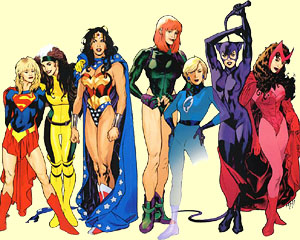 Tracy White, Raina Telgemeier, Hope Larson, Audrey Niffenegger, Vera Brosgol, Jessica Abel, and Danica Novgorodoff, Marjane Satrapi, just to name a few.
"So many women 'toonists/ Are in the YA GN biz!/ Tom Cruise's wife isn't./ But I heard her agent is!"
Forgive my placeholder, yo!
Friday, September 03, 2010
School Library Journal Article Tackles Ways to Make Libraries More Boy-Friendly
Another article mentioning comics as a means of getting boys interested in reading and hanging out in places full of books.
It's interesting to note that there is a "boy crisis" in terms of literacy and libraries that some feel comics can help resolve, whereas in the industry, especially in the comics shop, there is a "girl crisis" regarding how to get female readers to feel comfortable in places full of comic books.
An analysis of the two arguments and their nuances would be highly intriguing and enlightening, in my opinion. That'd make one hell of a thesis or dissertation or article or book.
Partly so, I think, because there would be evidence to suggest "it really has come to this," i.e. the gender perceptions are that high-brow reading and places that support literacy have become girly and female-centric and places considered, even if wrongly, to be bastions of low brow reading have become equated with boys or an adolescent version of masculinity.
What are the ramifications for such gender-intwined notions of reading and literature and literacy?
Sunday, March 28, 2010
Sequential Tart Interviews Author of _Road To God Knows_

Von Allan is interviewed regarding her new graphic novel featuring a teenage girl coping with being an adolescent while also having a mother struggling with schizophrenia.
Originally published as a webcomic at http://www.girlamatic.com/, Road to God Knows is now available in print.
I'm glad Sequential Tart covered this text, which seems to be flying under the radar but could become an important book in young adult literature circles.
Monday, December 21, 2009
Just Read: _Cancer Vixen_
Comics and graphic novels have a penchant for being excellent vehicles through which to tell difficult stories or through which to handle delicate topics.
Certainly this holds true when it comes to disease, and cancer seems to be a particularly notable source of inspiration for graphic novelists. Consider Pekar's Our Cancer Year, Fies' Mom's Cancer, Engelberg's Cancer Made Me a Shallower Person: A Memoir in Comics.
I even considered chronicling my own experience dealing with cancer via comics form. As a new member of the "missing lefty" tribe in 2004 (by which I reference the fact that a few months prior to entering my doctoral program I had a testicle removed because it was cancerous), I was in talks with the American Cancer Society about doing an information comic book on the subject. I even IM-ed with Marvel's Joe Quesada about putting a small informational comic about self-examination in Marvel's comics on month, my rationale being that the age ranges for comic book readers and those who are most likely to be diagnosed with testicular cancer overlap greatly (it didn't go over well).
So, when I saw Marisa Acocella Marchetto's graphic novel Cancer Vixen at an excellent airport bookstore in Dallas, I had to add it to my collection. Pink and purple cover be damned; Big "V" in "Cancer Vixen" right where the vagina of the skinny girl on the cover should be? No problem. I proudly made my purchase and began reading immediately.
The book, which started out as a serial, details the author's experience with breast cancer, which she discovers right before her marriage to a dreamy, well-off Italian restaurateur. Marchetto, a high-society type caught up in the glamor and glitz of New York fashion and "in" society, suddenly comes to terms with mortality and modern medicine while examining spirituality, a reality without children, and anxiety about her worth as a woman and mate with an intensity and range she never knew she had.
While my cancer was less aggressive than Marchetto's, I could easily relate to scenes where she visualizes what she thought would be the spirit forms of her future children dissipating, never to be realities. I also revisited my own psychoses regarding my gendered identity as she did the same. I knew her pain when she considered how in the world she'd pay all those bills.
I was not, however, able to relate to Marchetto's "Sex and the City meets Carsinoma" vibe, though my hunch is that many readers, especially female readers, could and would. I left the text thinking that it could possibly be considered, among other things, "a graphic novel for girls that don't usually read graphic novels," an accessible and "hip" book that could help other cancer patients and their young relatives or friends understand what might be coming once they or someone they know is diagnosed. Sort of "what if Elle Woods was a cartoonist and wanted to talk about breast cancer?" In a good way.
I should also say that Marchetto's cancer was much more aggresive than my own, so when I mention being able to connect with the text, there are caveats. Caveats exist with the elements that distanced me as well. Though she's depicted as a struggling cartoonist, Marchetto's base of family and friends come through for her such that she never really seems threatened with bankruptcy (medical exigencies being a major reason many Americans go broke) or too far removed from her previous lifestyle. She adds depth to what she comes to see as shallow aspects of herself, but she never really has to give up the rides in great European cars, the nice shoes, the vacations permanently. There is a lot of anxiety that these things and even more important things will be lost, but in the end, Marchetto retains almost everything she had before, including her breasts.
That's not to envy her, just to say that the book illustrates that every cancer case has similarities and differences in regards to every other. I had to sell my Pontiac GTO, a present from my dad for being the first in our family to graduate college, to offset medical bills (and this was with insurance!), but I've sired two healthy boys since my operation. I didn't do any chemo; Marchetto goes through that gruel and acknowledges that not everyone in the patients waiting rooms she visited handled it as well as she was able to -- or even survived it.
So, for me, the book is one rife with text-to-self connections while also constituting a study in contrasts. Overall, I'm glad to have read the book and recommend it to others. I hope that educators or school councilors might consider it as a book to recommend to those who are experiencing cancer or those young people who might have relatives who are. In the end it is a survivor's story, which means some readers will experience different endgames in their own cancer experiences, but the text is informative, emotional, feminine, and, dare I say it, tres chique.
Certainly this holds true when it comes to disease, and cancer seems to be a particularly notable source of inspiration for graphic novelists. Consider Pekar's Our Cancer Year, Fies' Mom's Cancer, Engelberg's Cancer Made Me a Shallower Person: A Memoir in Comics.
I even considered chronicling my own experience dealing with cancer via comics form. As a new member of the "missing lefty" tribe in 2004 (by which I reference the fact that a few months prior to entering my doctoral program I had a testicle removed because it was cancerous), I was in talks with the American Cancer Society about doing an information comic book on the subject. I even IM-ed with Marvel's Joe Quesada about putting a small informational comic about self-examination in Marvel's comics on month, my rationale being that the age ranges for comic book readers and those who are most likely to be diagnosed with testicular cancer overlap greatly (it didn't go over well).

So, when I saw Marisa Acocella Marchetto's graphic novel Cancer Vixen at an excellent airport bookstore in Dallas, I had to add it to my collection. Pink and purple cover be damned; Big "V" in "Cancer Vixen" right where the vagina of the skinny girl on the cover should be? No problem. I proudly made my purchase and began reading immediately.
The book, which started out as a serial, details the author's experience with breast cancer, which she discovers right before her marriage to a dreamy, well-off Italian restaurateur. Marchetto, a high-society type caught up in the glamor and glitz of New York fashion and "in" society, suddenly comes to terms with mortality and modern medicine while examining spirituality, a reality without children, and anxiety about her worth as a woman and mate with an intensity and range she never knew she had.
While my cancer was less aggressive than Marchetto's, I could easily relate to scenes where she visualizes what she thought would be the spirit forms of her future children dissipating, never to be realities. I also revisited my own psychoses regarding my gendered identity as she did the same. I knew her pain when she considered how in the world she'd pay all those bills.
I was not, however, able to relate to Marchetto's "Sex and the City meets Carsinoma" vibe, though my hunch is that many readers, especially female readers, could and would. I left the text thinking that it could possibly be considered, among other things, "a graphic novel for girls that don't usually read graphic novels," an accessible and "hip" book that could help other cancer patients and their young relatives or friends understand what might be coming once they or someone they know is diagnosed. Sort of "what if Elle Woods was a cartoonist and wanted to talk about breast cancer?" In a good way.
I should also say that Marchetto's cancer was much more aggresive than my own, so when I mention being able to connect with the text, there are caveats. Caveats exist with the elements that distanced me as well. Though she's depicted as a struggling cartoonist, Marchetto's base of family and friends come through for her such that she never really seems threatened with bankruptcy (medical exigencies being a major reason many Americans go broke) or too far removed from her previous lifestyle. She adds depth to what she comes to see as shallow aspects of herself, but she never really has to give up the rides in great European cars, the nice shoes, the vacations permanently. There is a lot of anxiety that these things and even more important things will be lost, but in the end, Marchetto retains almost everything she had before, including her breasts.
That's not to envy her, just to say that the book illustrates that every cancer case has similarities and differences in regards to every other. I had to sell my Pontiac GTO, a present from my dad for being the first in our family to graduate college, to offset medical bills (and this was with insurance!), but I've sired two healthy boys since my operation. I didn't do any chemo; Marchetto goes through that gruel and acknowledges that not everyone in the patients waiting rooms she visited handled it as well as she was able to -- or even survived it.
So, for me, the book is one rife with text-to-self connections while also constituting a study in contrasts. Overall, I'm glad to have read the book and recommend it to others. I hope that educators or school councilors might consider it as a book to recommend to those who are experiencing cancer or those young people who might have relatives who are. In the end it is a survivor's story, which means some readers will experience different endgames in their own cancer experiences, but the text is informative, emotional, feminine, and,
 dare I say it, tres chique.
p.s. I totally prefer this image to the right, which I assume is an alternate or previous cover for the book (?). This one has more attitude and is taken from a scene where the author/character is kicking death in the face! From "Sex and the City" to "You go, girl!" :)
Friday, September 18, 2009
Lisi Harrison's _The Clique_ YA Novels to get GN Treatment
Yen Press to adapt multimillion dollar-maker.
Subscribe to:
Posts (Atom)