Stickermule

A Public Service Announcement! ;)

Monday, March 23, 2009


2009 Hugo Awards Include Graphic Texts for First Time
Once limp-formed award trophy very excited about the news (*giggle*):
Friday, March 13, 2009
Quotes on Comics
Introducing a blog/site that is exactly what its name implies: quotes on comics. Very cool stuff.
Jews and American Comics
Thanks to MH for informing me about the book Jews and American Comics, which is reviewed at Graphic Novel Reporter. It is hard to overestimate the impact Jewish Americans have had on the American comics industry.
Wednesday, March 11, 2009
#20,265
That's the current Amazon.com sales a rank for a little ol' book you may have heard of: The King James version of The Bible. Watchmen? Still #1. Jesus retains a huge edge in overall sales, though.
If all things are through God, Watchmen really has turned out to be one heck of a collaboration.
Shaggy-haired bearded men unite!


If all things are through God, Watchmen really has turned out to be one heck of a collaboration.
Shaggy-haired bearded men unite!


Tuesday, March 10, 2009
High School Teacher Talks about Teaching Watchmen
I've heard rumors of high school teachers using Watchmen. I even got close to meeting one fellow who discussed it in Charlottesville, Va, at my comic shop while I was engrossed in taking thick description notes of the place for a qualitative research class. Now, Graphic Novel Reporter has some testimony from a high school teacher who is teaching the GN for all to see! Yay!!!
Monday, March 09, 2009
Historic Day!
Publisher's Weekly reports that for sometime today, Watchmen was the #1 seller on Amazon.com. I heard Teri Lesense talk about some of her upcoming research that suggests that seeing a movie before reading the book actually helps students' motivations to do the reading. Looks like there might be a little bit of that going on here?
A graphic novel selling better than any other book on Amazon. And it is my favorite graphic novel, to boot. It might be time to dance naked in the streets, faithful readers. Maybe I'll suggest that to my "Teaching the Graphic Novel" class tonight, as we conclude our study of Watchmen, lol....
A graphic novel selling better than any other book on Amazon. And it is my favorite graphic novel, to boot. It might be time to dance naked in the streets, faithful readers. Maybe I'll suggest that to my "Teaching the Graphic Novel" class tonight, as we conclude our study of Watchmen, lol....
Sunday, March 08, 2009
Yeah, I saw it: Watchmen Movie Talk
An admirable but flawed attempt at bringing the classic graphic novel to the big screen, Zack Snyder's Watchmen shows the director was probably right to repeatedly tell sources that if anyone got the chance to screw up the source material, he wanted it to be him.
The film is not terrible. It won't be mentioned in the same breath as The Spirit, I don't think. The first hour is pretty atrocious, but once the action gears up, and once Dan and Laurie are thick into their budding relationship, things get good.
The fight scenes are great. Blake's struggle for survival against Veidt is probably the singular element that supersedes the comic. We see a fighter going out in warrior fashion, yet his beatdown is still brutal enough for one to have sympathy for him. The multiple images of Sally Jupiter in his apartment also help the audience form some sympathy for the otherwise difficult-to-love Comedian (assuming they know the backstory, that is). The moments where one feels he got what he deserved don't come until later in the film.
And Night Owl finally looked like a bad-ass, maybe too much so. He and Laurie don't just immobilize, they apparently kill many of their attackers, even before they put on the capes and cowls again.
Even the final confrontation with Ozymandias is adrenalin-pumping fun. Veidt's superior strength and speed are made obvious. And I enjoyed the moment where Adrian "embraced" a final barrage of punches from Dan in a moment that was clearly changed such that the "everyman" could make the endpoint, regain some street cred, and give the audience some sense of power.
The love story between Dan and Laurie is what sells the film. But it is in what the film does not adapt concerning this story, paired with too much exposition from Laurie to explain Dr. Manhattan's powers and history, that weakens the movie.
"Do that thing you do," a perfect example of Laurie preempting the godhead of the graphic novel for the sake of advancing story, may become the "jump the shark, Fonzie!" plot faux pas of super-hero movies.
There were many moments where the violence was more excessive than it needed to be; Dr. Manhattan should have been given more weight/authority, or at least the ability to speak for himself more often, and Rorschach needn't have handled that cleaver the way he did (thanks Saw films!).
As for the acting, it was adequate. Dan and the Edward were probably best acted, then Rorschach and Manhattan. Laurie was great to look at, and the chemistry between her and Dan was probably enough to excuse otherwise deadpan delivery. Laurie's best-acted scenes were her most "emotional" ones, I guess I'll say, to be modest.
Having read the book multiple times, enjoyed the motion comic, and viewed the film, I'm happy to say that the source material hasn't been touched in terms of quality. I am worried,though, that the film will become the default accepted interpretation of the book's many subtleties and tensions, which would be a tremendous error of judgement.
Some critics like to score films with stars or thumbs. I think the symbol for Watchmen sums this one up pretty well: One smiley face, stained.
The film is not terrible. It won't be mentioned in the same breath as The Spirit, I don't think. The first hour is pretty atrocious, but once the action gears up, and once Dan and Laurie are thick into their budding relationship, things get good.
The fight scenes are great. Blake's struggle for survival against Veidt is probably the singular element that supersedes the comic. We see a fighter going out in warrior fashion, yet his beatdown is still brutal enough for one to have sympathy for him. The multiple images of Sally Jupiter in his apartment also help the audience form some sympathy for the otherwise difficult-to-love Comedian (assuming they know the backstory, that is). The moments where one feels he got what he deserved don't come until later in the film.
And Night Owl finally looked like a bad-ass, maybe too much so. He and Laurie don't just immobilize, they apparently kill many of their attackers, even before they put on the capes and cowls again.
Even the final confrontation with Ozymandias is adrenalin-pumping fun. Veidt's superior strength and speed are made obvious. And I enjoyed the moment where Adrian "embraced" a final barrage of punches from Dan in a moment that was clearly changed such that the "everyman" could make the endpoint, regain some street cred, and give the audience some sense of power.
The love story between Dan and Laurie is what sells the film. But it is in what the film does not adapt concerning this story, paired with too much exposition from Laurie to explain Dr. Manhattan's powers and history, that weakens the movie.
"Do that thing you do," a perfect example of Laurie preempting the godhead of the graphic novel for the sake of advancing story, may become the "jump the shark, Fonzie!" plot faux pas of super-hero movies.
There were many moments where the violence was more excessive than it needed to be; Dr. Manhattan should have been given more weight/authority, or at least the ability to speak for himself more often, and Rorschach needn't have handled that cleaver the way he did (thanks Saw films!).
As for the acting, it was adequate. Dan and the Edward were probably best acted, then Rorschach and Manhattan. Laurie was great to look at, and the chemistry between her and Dan was probably enough to excuse otherwise deadpan delivery. Laurie's best-acted scenes were her most "emotional" ones, I guess I'll say, to be modest.
Having read the book multiple times, enjoyed the motion comic, and viewed the film, I'm happy to say that the source material hasn't been touched in terms of quality. I am worried,though, that the film will become the default accepted interpretation of the book's many subtleties and tensions, which would be a tremendous error of judgement.
Some critics like to score films with stars or thumbs. I think the symbol for Watchmen sums this one up pretty well: One smiley face, stained.
Friday, March 06, 2009
More Press from El Paso times
Some of the students in my graduate-level "Teaching the Graphic Novel" course are quoted in this article on Watchmen the movie. Both the local paper and The New york Daily News interviewed me about the film. It's a fun time to be a Watchmen scholar. :)
Stanford Graphic Novel Project Enters Year 2
Now, if students at Stanford are learning that crafting and composing in the sequential art form is challenging and rewarding and certainly rigorous, it's gotta be a good idea for the rest of us, right?
From a Graphic Novel Reports article on this exciting project:
This is the second year of the Stanford Graphic Novel Project, an endeavor to teach narrative through graphic storytelling. Our goal is to treat the graphic novel as a collective, collaborative project and as a team create a book during the winter term of each year. With co-instructor Tom Kealey, our 2008 class wrote, storyboarded, illustrated, designed, and published a 224-page graphic novel called Shake Girl. Fifteen students drew the 700 illustrations for Shake Girl in six weeks. This year, our students are currently at work on a 256-page graphic novel set in the Democratic Republic of Congo.
Visit the link to Graphic Novel Reporter to get the full story. And remember, the next time an administrator, teacher, or parent questions who you are trying to use comics to teach writing and composing, tell them the uber-intelligent students at Stanford are actually leading the way. Go Cardinal!
The truth of the matter is that creating sequential art is no easy task. It is fun, engaging, exhausting, and intellectually stimulating, but it is no cake walk. My graduate students in "Teaching the Graphic Novel" turn in an 8-pager mini-comic for their midterms in a few weeks, along with a process paper. I'm excited to see if they'll admit the amount of thought that went into their projects while also allowing themselves to admit that they earned a new respect for the form. As I tell teachers, the best way to understand the comics-making process is to try it yourself.
From a Graphic Novel Reports article on this exciting project:
This is the second year of the Stanford Graphic Novel Project, an endeavor to teach narrative through graphic storytelling. Our goal is to treat the graphic novel as a collective, collaborative project and as a team create a book during the winter term of each year. With co-instructor Tom Kealey, our 2008 class wrote, storyboarded, illustrated, designed, and published a 224-page graphic novel called Shake Girl. Fifteen students drew the 700 illustrations for Shake Girl in six weeks. This year, our students are currently at work on a 256-page graphic novel set in the Democratic Republic of Congo.
Visit the link to Graphic Novel Reporter to get the full story. And remember, the next time an administrator, teacher, or parent questions who you are trying to use comics to teach writing and composing, tell them the uber-intelligent students at Stanford are actually leading the way. Go Cardinal!
The truth of the matter is that creating sequential art is no easy task. It is fun, engaging, exhausting, and intellectually stimulating, but it is no cake walk. My graduate students in "Teaching the Graphic Novel" turn in an 8-pager mini-comic for their midterms in a few weeks, along with a process paper. I'm excited to see if they'll admit the amount of thought that went into their projects while also allowing themselves to admit that they earned a new respect for the form. As I tell teachers, the best way to understand the comics-making process is to try it yourself.
Thursday, March 05, 2009

The New York Times Graphic Novels Best Sellers List?
Hard to ignore the medium when a major source like this is giving it such attention.
Wednesday, March 04, 2009
21st Century Skills Backlash?
According to Education Week, there may be a backlash against notions of 21st century literacies and those, like me, who promote them.
How soon before some high-fallooting Ph.d.-waving asshole stands up and says, "Now we got folks tryin' to teach em' comics in school instead o' Shagspert!"? The countdown is on....
As the Stephen Sawchuck penned article "Backers of '21st-Century Skills' Take Flak" suggests, though, the backlash is not really a backlash, it is just continued resistance that Education Week and Cultural Literacy purists are drawing more attention to. As is stated by a very wise Linda Darling-Hammond, the curriculum debates inherent in new vs. traditional literacies, etc. have been going on for at least the entirety of the 20th century.
There is a good analogue here to comics and literacy scholarship. Even though my work and the recent work of others has folks thinking about comics and graphic novels, many other scholars and teachers have been writing on the subject for as long as there have been comic strips and comic books in America. Think late 1930s as a starting point. There's a reason I quote Dewey and Vygostsky in the intro to Building Literacy Connections with Graphic Novels....
As well, the analogue also extends to notions of "either/or." It shouldn't be "instead of" but "in conjunction with." We can't have critical literacy-based curricula because we need to focus on functional literacy skills? Cultural literacy needs to trump all literacy? Only Shakespeare plays and no Shakespeare podcasts or Manga to supplement them?
It's not an either/or proposition. Literacy is a continuum. That's why I am so keen on focusing on how comics can help students develop functional literacies, cultural literacies, critical literacies, and certainly New/Multimodal/21st century literacies. Getting at one literacy skill doesn't and shouldn't mean ignoring others.
We all want all students to read (functional literacy). We all agree that factual knowledge provides (cultural literacy) a good base for being considered educated. Why can't we all agree that considerations of power, justice, and point of view (critical literacy) as they relate to factual knowledge help students develop greater understandings and also help them develop inquiring, curious minds? Well, some might not want others to have those types of minds, of course.
And that's the tension between those who seem to have a beef with new literacies and those who want to focus on other types at the exclusion of critical literacies: The functional/cultural camp is afraid that the critical camp is trying to subversively overthrow American values -- and there may be some truth to that -- and the critical camp is afraid the functional/cultural camp is sneakily, subversively trying to keep underprivileged populations "in their proper place" -- and there may be some truth to that too.
But we are living in the 21st century -- even here in Texas -- so the term "21st century skills" generally applies to the skills students will need to live well in the world they'll inherent for the next 91 years. Knowing how to read print is a necessity. Knowing how to read non-print is a necessity. Knowing history and basic math, science, and language arts skills is essential. Knowing how to think critically about who makes decisions in the world and how they get formed is important. Knowing how to navigate new spaces while understanding their precedents -- important, important, important. 21st century skills are all -literacy skills.
So, if Spider-Man helps an ESL student gain functional literacy, while a Manga Shakespeare helps build the comprehension of a 10th grader while he reads it along with a viewing or reading of the play, and examining Joe Sacco's Palestine helps a World History class understand the tensions in Israel, while American Born Chinese helps a class understand identity and ethnicity and a group of senoirs are deconstructing Watchmen as an example of 1980s nuclear hysteria/pre-millinium hysterics in relation, let it be.
Our kids live in the 21st century. Any skill they need from school, whether they get it there or not, is a 21st century skill.
How soon before some high-fallooting Ph.d.-waving asshole stands up and says, "Now we got folks tryin' to teach em' comics in school instead o' Shagspert!"? The countdown is on....
As the Stephen Sawchuck penned article "Backers of '21st-Century Skills' Take Flak" suggests, though, the backlash is not really a backlash, it is just continued resistance that Education Week and Cultural Literacy purists are drawing more attention to. As is stated by a very wise Linda Darling-Hammond, the curriculum debates inherent in new vs. traditional literacies, etc. have been going on for at least the entirety of the 20th century.
There is a good analogue here to comics and literacy scholarship. Even though my work and the recent work of others has folks thinking about comics and graphic novels, many other scholars and teachers have been writing on the subject for as long as there have been comic strips and comic books in America. Think late 1930s as a starting point. There's a reason I quote Dewey and Vygostsky in the intro to Building Literacy Connections with Graphic Novels....
As well, the analogue also extends to notions of "either/or." It shouldn't be "instead of" but "in conjunction with." We can't have critical literacy-based curricula because we need to focus on functional literacy skills? Cultural literacy needs to trump all literacy? Only Shakespeare plays and no Shakespeare podcasts or Manga to supplement them?
It's not an either/or proposition. Literacy is a continuum. That's why I am so keen on focusing on how comics can help students develop functional literacies, cultural literacies, critical literacies, and certainly New/Multimodal/21st century literacies. Getting at one literacy skill doesn't and shouldn't mean ignoring others.
We all want all students to read (functional literacy). We all agree that factual knowledge provides (cultural literacy) a good base for being considered educated. Why can't we all agree that considerations of power, justice, and point of view (critical literacy) as they relate to factual knowledge help students develop greater understandings and also help them develop inquiring, curious minds? Well, some might not want others to have those types of minds, of course.
And that's the tension between those who seem to have a beef with new literacies and those who want to focus on other types at the exclusion of critical literacies: The functional/cultural camp is afraid that the critical camp is trying to subversively overthrow American values -- and there may be some truth to that -- and the critical camp is afraid the functional/cultural camp is sneakily, subversively trying to keep underprivileged populations "in their proper place" -- and there may be some truth to that too.
But we are living in the 21st century -- even here in Texas -- so the term "21st century skills" generally applies to the skills students will need to live well in the world they'll inherent for the next 91 years. Knowing how to read print is a necessity. Knowing how to read non-print is a necessity. Knowing history and basic math, science, and language arts skills is essential. Knowing how to think critically about who makes decisions in the world and how they get formed is important. Knowing how to navigate new spaces while understanding their precedents -- important, important, important. 21st century skills are all -literacy skills.
So, if Spider-Man helps an ESL student gain functional literacy, while a Manga Shakespeare helps build the comprehension of a 10th grader while he reads it along with a viewing or reading of the play, and examining Joe Sacco's Palestine helps a World History class understand the tensions in Israel, while American Born Chinese helps a class understand identity and ethnicity and a group of senoirs are deconstructing Watchmen as an example of 1980s nuclear hysteria/pre-millinium hysterics in relation, let it be.
Our kids live in the 21st century. Any skill they need from school, whether they get it there or not, is a 21st century skill.
Smithsonian Webcomic on Forensic Anthropology
"Written in Bone" follows some scientists through a dig and find in Maryland. A fun attempt to make sifting through dirt seem interesting, it is an admirable effort, if not a little dry. Not bone dry, mind you, but not earth-shattering.
Still, I love it when something with as much clout as the Smithsonian Institute uses comic art to educate!
Still, I love it when something with as much clout as the Smithsonian Institute uses comic art to educate!
Tuesday, March 03, 2009
Watchmen Motion Comic DVD Coming Soon
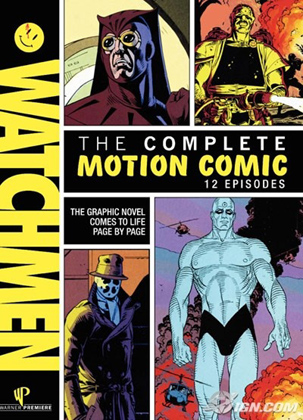 ICV2 reports that the motion comic version of Watchmen, sort of a comic book on tape, with video reminiscent of those 1960s Spider-Man cartoons, is set for DVD release soon.
I have the motion comics downloaded to my ipod and find them fascinating. They're well-done, my only criticism is that there is one narrator for all parts, even the women, but the guy is good.
However, they don't stand up to the original text. I had the opportunity to compare some scenes from the book to their equivalents in the motion comic with students in my "Teaching the Graphic Novel" course, and it was clear this format can't capture the intricate intertextuality of the source material.
An excellent example of this comes in Chapter I, after Dan leaves Hollis. The "Obsolete Models" sign gets a lot of attention as a signifier in the comic, but even though it sways back and forth in the wind in the motion comic, one can't read the entirety of its text, meaning that unless one has already read the graphic novel, one is probably not going to catch on to this layer of meaning.
Also, none of the print sections at the end of each chapter are reproduced in the motion comic, so those nuances are lost as well.
The dissonance between these two texts has me a little more anxious about the movie, of course. But, I'm very happy to have these multiple textual iterations of Watchmen coming available soon. I do not know if I'll buy the motion comics DVD, since I've already got them, but I will get the DVD of the film so I can compare and contrast the various forms on my own and with my students.
Praise and award Nod for YA GN _Swallow Me Whole_
 The Beat reports that Swallow Me Whole, a graphic novel by Nate Powell, is the first GN since Maus to be honored for the LA Times Book Prize.
From a quoted source: "The book follows two teenage stepsiblings, Ruth and Perry, through the ups and downs of school, family, and suburban restlessness — all complicated by the insect armies, swirling visions, and haunting voices that no one else can perceive..."
For the full story, click the title to this post.
As for me, looks like I got a book to add to my reading list!
Monday, March 02, 2009
Quoted on Watchmen Movie in New York Daily News
Another one of those instances where a 30 minute conversation comes down to one line, but it's cool to be mentioned in the New York Daily News, especially about a text that I love sooooo much! For the record, I did express to the reporter that I think the Watchmen movie will rock.
Subscribe to:
Posts (Atom)