I did and, upon completion, developed the super-human abilities to fly and type 300 words per minute. Nah, not really, but it was easy, painless, quick, and fun. Please help out Don by participating so he can inform more great S.equential A.rt N.arratives in E.ducation-related work.
EN/SANE World is James Bucky Carter's enclave of English Education (EN) resources as well as a haven for those looking for information on Sequential Art Narratives in Education (SANE).
A Public Service Announcement! ;)
Wednesday, July 30, 2008
Comics and Education Survey
I did and, upon completion, developed the super-human abilities to fly and type 300 words per minute. Nah, not really, but it was easy, painless, quick, and fun. Please help out Don by participating so he can inform more great S.equential A.rt N.arratives in E.ducation-related work.
Tuesday, July 29, 2008
Recent Christian Science Monitor articles on Comics/Literacy
Thanks to Mike Rhode, who drew my attention to this article on the growing acceptance of comics as worthy of study. A Duke graduate student is quoted. Throw in the Harvard scholar from a recent PMLA article and it seems that we've got a case of the prestige going on. Despite the fact that other universities have offered courses on comics for years, there's just something about it that makes it "exciting and new" when we can attach an "Ivy" or "Ivyesque" to it. Frankly, I don't think comics need scholars from elite private schools to lend them legitimacy, but I suppose we take what we can get in the larger scheme of things. I'm certainly not knocking any current or future comics scholars from good universities (or bad ones either), I'm just saying the "news" here isn't as new as the story might lead one to believe.
Further, this "perpetual novelty" does hurt the field a bit, I think. What happens when this line of thinking spins circles without advancing is that young scholars repeatedly feel like they've "discovered" comics scholarship for the first time, and that they're among the early academics to be in on the hot, new secret. I've been there myself. This can work as a negative, despite the excitement and enthusiasm it engenders, because it has the potential to block collaboration and sharing among scholars. Too many young comics scholars seem to feel a sense of ownership over the realm of comics scholarship, like they're hoarding a secret and must keep it to themselves so that they may eventually enlighten academia with their comic book scholarship discoveries. "Thanks, Captain Columbus, but the continent was already there and known to many before you mistook it for India."
Thank goodness there are groups and conferences out there that can help comics scholars realize they're part of something with history and legacy -- but if one is so closed off in his/her excitement and feelings of ownership, one may never seek out such entities. I've seen it happen with many undergraduates and graduate students. They come to me seeking advice and resources, only to really want their own narrowed list of weblinks, etc., that make up their knowledge base affirmed. Acknowledging that other people have been studying comics for years, afterall, means that that sense of belonging must move to a sense of sharing. Like I said, I've been there myself, so I'm sympathetic, if not a little weary of the phenomena.
And then there's this story about "tweens" (worst word ever. When I was growing up, a tween was the fleshy space between one's asshole and his/her genitalia. "Tween" and "Tweener" will always hold that ass-ociation for me. Why not just call pre-teens "The Walking Taint" or "Yon Newly Stubbly Choded Ones"?) flocking to graphic novels. Scott McCloud is quoted and the whole "comics vs. novel" thing is rehashed.
Oh man. I just read over this post. Am I becoming a curmudgeon already?? At the ripe age of 30-something? "Gasp!" he said, as he felt a cold, desperate sense of his own wizened, hoary morality creep up his spine, from deep down in his twee -- Nah, too easy. ;)
Further, this "perpetual novelty" does hurt the field a bit, I think. What happens when this line of thinking spins circles without advancing is that young scholars repeatedly feel like they've "discovered" comics scholarship for the first time, and that they're among the early academics to be in on the hot, new secret. I've been there myself. This can work as a negative, despite the excitement and enthusiasm it engenders, because it has the potential to block collaboration and sharing among scholars. Too many young comics scholars seem to feel a sense of ownership over the realm of comics scholarship, like they're hoarding a secret and must keep it to themselves so that they may eventually enlighten academia with their comic book scholarship discoveries. "Thanks, Captain Columbus, but the continent was already there and known to many before you mistook it for India."
Thank goodness there are groups and conferences out there that can help comics scholars realize they're part of something with history and legacy -- but if one is so closed off in his/her excitement and feelings of ownership, one may never seek out such entities. I've seen it happen with many undergraduates and graduate students. They come to me seeking advice and resources, only to really want their own narrowed list of weblinks, etc., that make up their knowledge base affirmed. Acknowledging that other people have been studying comics for years, afterall, means that that sense of belonging must move to a sense of sharing. Like I said, I've been there myself, so I'm sympathetic, if not a little weary of the phenomena.
And then there's this story about "tweens" (worst word ever. When I was growing up, a tween was the fleshy space between one's asshole and his/her genitalia. "Tween" and "Tweener" will always hold that ass-ociation for me. Why not just call pre-teens "The Walking Taint" or "Yon Newly Stubbly Choded Ones"?) flocking to graphic novels. Scott McCloud is quoted and the whole "comics vs. novel" thing is rehashed.
Oh man. I just read over this post. Am I becoming a curmudgeon already?? At the ripe age of 30-something? "Gasp!" he said, as he felt a cold, desperate sense of his own wizened, hoary morality creep up his spine, from deep down in his twee -- Nah, too easy. ;)
Comic-Con Reaches 125,00 for 2nd year in a row.
The largest comic book convention in the nation had 125,000 visitors this past week, equalling last year's attendance numbers simply because capacity was reached and the event holders couldn't let anyone else in. Read more here. 125,000. Let that sink in for a moment.
Wednesday, July 23, 2008
Comics and Politics 2008
ICV2 reports that a comic book publisher will be selling books based on the two presidential candidates this October. They can be purchased separately for partisan audiences, or as a 2-in-1 flip book for those seeking real fair and balanced representation.
I haven't seen any previews besides the cover images that ICV2 has shared, but what a great idea, assuming it comes to fruition. And, certainly, this would be a nice way to introduce students to the candidates and even extend studies into visual/critical literacy terrain directly by asking questions like "What does the artist's interpretation of this character possibly suggest, if anything?" and "Based on our own research on the candidates now that we've read the books, are they informative enough to be useful to an undecided voter?" or "Do you think the candidates will support these comics now that they're readily available? Why or why not?"
I for one, think the cover image of McCain shows a somewhat scary grin. Not sure if that's intentional or not....
Sunday, July 20, 2008
Teachers and Writers Magazine covers Comics in the Classroom!
The Summer 2008 edition of Teachers & Writers (39.4) is all about using comics in the classroom to get students composing and thinking about literature, from authentic biography to poetry.
With a cover from Josh Neufeld that I hope is autobiographical detailing a young man crafting a comic on Frederick Douglas as his teacher tells the class about the 19th century leader, getting "caught" doing so by said teacher, and then praised by her once she sees his work, this nonprofit publication out of NYC would be irresponsible not to showcase the work of Columbia University Teacher's College senior researcher, Michael Bitz, famous for The Comic Book Project. Bitz uses straight-up English Language Arts terminology in his lead article,"A Rare Bridge," and also gives pointers for how to start a comics club in your school.
Francoise Mouly,Art Spiegelman's wife, who has been doing quite a bit of publishing in kids comics, is interviewed, and there are articles on teaching poetry comics from Dave Morice and other articles -- some even in sequential art format -- from Susan Karwoska, Youme Landrowe, Sara Wilson, and more. As seems a requirement for these sort of themed issues, the last few pages share some excellent, if not rather choosy, resources for further consideration.
My only real complaint is that I didn't get any love in the pub! But my ego aside (though it does get aggravating to see that so many of us are starting to say the same things, but we don't seem as aware of each other as we ought to be), for $5, this is an excellent, current resource that shows more and more k-12 educators are (re)discovering the pedagogical potential of sequential art narratives!
For more information of Teachers & Writers, including contact information so you can order a copy of volume 39.4, click here.
Tuesday, July 15, 2008
The Graphic Life of Nelson Mandela
ICV2 reports the former polital prisoner is getting the sequential art treatment in an upcoming graphic novel! Excellent!!
I Heart (The) NY(er)
So there's no reason for me to explicate the now infamous Obamas The New Yorker cover. The editor in charge of making the call to run it has explained it perfectly in the CNN link I've inserted in the title of this post.
I'm embarrassed that too many Americans are too stupid to see the cover for what it is (satire) and that uber-liberals and the self-rightious are crying foul over the image even when they recognize it as satire. Not that the cover pokes fun of the Obamas -- it pokes fun of many Americans' fears about what they seem to represent (but do not) -- but do we want a president we can't poke fun of? I don't. Satire goes too far when it examines African American presidential candidates? Is that the real issue here? Feh! Once again we have folks too quick to point fingers. Cartooning and lampooning have a rich history of making social and political statements via satire, and the day the USA imposes too much restriction over satire will be the day Democracy died (again).
I haven't expressed my political leaning in this blog, but I will say I was pretty excited about that Alex Ross painting that was making the rounds a few weeks ago. And, with that being said, I have no problem with the cover and am proud of the magazine for running it. Controversy and satire should lead to intelligent discussion, and intelligent discussion should lead to better insight and understanding, and better insight and understanding is just another way of looking at being better educated.
So that's more a rant than an explication.
I'm embarrassed that too many Americans are too stupid to see the cover for what it is (satire) and that uber-liberals and the self-rightious are crying foul over the image even when they recognize it as satire. Not that the cover pokes fun of the Obamas -- it pokes fun of many Americans' fears about what they seem to represent (but do not) -- but do we want a president we can't poke fun of? I don't. Satire goes too far when it examines African American presidential candidates? Is that the real issue here? Feh! Once again we have folks too quick to point fingers. Cartooning and lampooning have a rich history of making social and political statements via satire, and the day the USA imposes too much restriction over satire will be the day Democracy died (again).
I haven't expressed my political leaning in this blog, but I will say I was pretty excited about that Alex Ross painting that was making the rounds a few weeks ago. And, with that being said, I have no problem with the cover and am proud of the magazine for running it. Controversy and satire should lead to intelligent discussion, and intelligent discussion should lead to better insight and understanding, and better insight and understanding is just another way of looking at being better educated.
So that's more a rant than an explication.
Saturday, July 12, 2008
Reading Comics Makes You Violent -- and Gay!...
....At least that's what some thought in the 1940s and 50s, spurred by Freddy Wertham's case "research" with kids and the worries of librarians, some educators, and parents. As the recent novel The Ten Cent Plague has informed the public at large and reminded comics historians, the senate even got involved once the media helped turn the comic book scare into something akin to Big Tobacco (except tobacco really can make you violent and gay. OK, OK, I made that up. The last part. Ever been around someone going through nicotine withdrawals, though?).
Jamie Coville has put together a website dedicated to sharing some of the testimony from the hearings, the subsequent self-regulating code that comics publishers created, and more.
Visit http://www.thecomicbooks.com/ to read through some very interesting testimony from some of the leaders in comics of the 1950s. Who sold out whom? What were the senate's summary remarks once all was said and done? Which pilgrim was ultimately sentenced to a death by crushing via large stone? Find out most of that information at Coville's site.
It's worth noting that many educators and education scholars had been working to disprove Wertham's claims as early as the 1940s. As I've said elsewhere, though, their work was published in academic journals, whereas the popular media got wind of the comics scare and helped publicize it via popular magazines and newspapers. Which writings do you think the public accessed the most and were most influenced by?
(Thanks to Lou N. for bringing this website to my attention!)
Jamie Coville has put together a website dedicated to sharing some of the testimony from the hearings, the subsequent self-regulating code that comics publishers created, and more.
Visit http://www.thecomicbooks.com/ to read through some very interesting testimony from some of the leaders in comics of the 1950s. Who sold out whom? What were the senate's summary remarks once all was said and done? Which pilgrim was ultimately sentenced to a death by crushing via large stone? Find out most of that information at Coville's site.
It's worth noting that many educators and education scholars had been working to disprove Wertham's claims as early as the 1940s. As I've said elsewhere, though, their work was published in academic journals, whereas the popular media got wind of the comics scare and helped publicize it via popular magazines and newspapers. Which writings do you think the public accessed the most and were most influenced by?
(Thanks to Lou N. for bringing this website to my attention!)
Wednesday, July 09, 2008
Representation, Race, The Border, Comics and Education
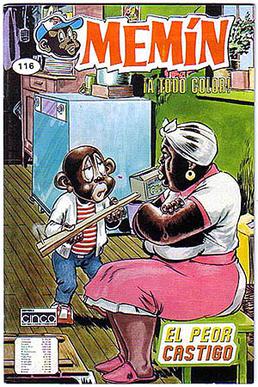
A popular Mexican cartoon character is drawing the ire of some American residents who have seen his countenance on comic books in their local stores, due to his appearance. CNN covers the story here. Some are saying the stories of the character taught them life lessons. Others feel the exaggerated features of the character -- reminiscent of old-timey depictions of African Americans (though the character is Cuban and Mexican in heritage) -- present images of insensitivity. Memin Pinguin, as he is known, is one in a long line of lovable scamp characters that have often inhabited comic strips and comic books and usually have represented stereotypical qualities based on notions of race, class or gender.
His appearance in U.S. stores is a contact zone engaging, border-crossing hot button topic to be sure!
Thursday, June 26, 2008
Operation G-THOOM a Success!!

Today I crossed the Mississippi River into Louisiana on my way to Texas, and the wife followed a few hours later, meaning we now have no obligation to EVER return to Mississippi. About a year and a half ago, once I ascertained that USM was not a good place for me to be, I named my desire to leave and goal to do so "GTHOOM," for "Get the hell out of Mississippi!" After traveling the northern part of the state and Jackson today, maybe I was too harsh on the state and not hard enough on USM, but "GTHOOUSM&H" is pretty awkward. At any rate, it'll take a few days for the family and I to make it to El Paso, where Operation Successful Career at University with Excellent Colleagues and Good Understanding of English Education" is underway already. :)
Wish us well, and I'll be back to posting and commenting on SANE issues soon!
Best,
JBC
Wish us well, and I'll be back to posting and commenting on SANE issues soon!
Best,
JBC
Tuesday, June 24, 2008
Monday, June 23, 2008
Comics in Mainstream Mags
June has been a big month for comics and graphic novels in regards to major mainstream press. Both Time and Playboy have done recent articles on how Hollywood is looking to sequential art more and more for marketable films, and then there's this must-read story from Sports Illustrated, which recently featured an issue with a comic book-style "Bizarro world" cover. According to the SI.com story, custom-made comics helped several top football recruits choose Oregon as their academic institution (and football home) of choice. Comics, persuasion, football and college -- all working together in effective, if not a little dubious (just ask the NCAA!) manner.
Wednesday, June 18, 2008
Two Recent Articles on Education and Comics
Both these articles were mentioned in this week's NCTE inbox, but I found them cruising other blogs as well. Good to see NCTE keeping SANE fresh in members' minds, though! This one is yet another article on the comics being used in Maryland's public schools. This one from the UK considers comics as a conduit to more reading, especially for boys. Note Nick Seaton's oversimplification of graphic novels as mere "picture books." It's always great when the opposing viewpoint speaks out of ignorance, isn't it?
From Baltimore to Britain, educators are taking note of the transformative power of sequential art when it comes to their students' literacy development!
Saturday, June 14, 2008
Wednesday, June 11, 2008
Super Heroes and the Koran
The Washington Post has a great feature on a Muslim comic book creator's attempts to model new super heroes after attributes of God. Just goes to show that the religion-sequential art connection isn't only intertwined with Christianity. Details about the project, entitled The 99, can be seen here. The site offers character details and some pretty cool free downloads.
Why George Washington Went to Japan
Thanks to Mike Rhode for bringing this to my attention:
Manga CVN 73 USS George Washington (2008) has been released by the US Navy. The 204-page graphic novel is available for download and tells the story of the USS George Washington's stationing in Japan. A forward from RADM James D. Kelly, USN, the commander of naval forces in Japan, extols the beauty of Japan and seems to read like a rationale for the vessel's presence. Available in both Japanese and English, the Manga is free to whomever cares to download and is published by the Public Affairs Office of the Navy.
So, it appears to be a work that offers a rationale, educates, and informs. And probably persuades, or attempts to, anyway. The ship's history and services are detailed via the experiences of a new soldier named Jack, a Japanese America, who is walking its floors for the first time. The USS Cole and terrorist attacks are mentioned, and the work of men and women on the ship is portrayed as honorable and impressive. The soldiers work as a team, look out for one another, and drill constantly so they're prepared for any dangerous situations. They attend seminars on Japanese culture and language. Upon entiring the port at Yokosuka, they are reminded by their commander to be good neighbors.
A hero on the ship after putting out a dangerous fire, Jack immerses himself in Japanese culture with awe and respect, especially mindful that this is where his grandparents live. "Japanese blood definitely runs through my veins," he says. After meeting up with his grandparents, Jack asks his grandpa if he'll ever visit the states. His reply comprises the last pages of the story before the ship's stats are given. "I can go anytime. We're neighbors across the ocean, right?"
The military has a long history of using sequential art to help train and educate its troops, and other governments have used the format as well, one notable example being the guide to immigrating to the states that the Mexican government published a few years ago. This seems geared towards wary citizens of Japan and is a very interesting piece of proactive public relations work.
Manga CVN 73 USS George Washington (2008) has been released by the US Navy. The 204-page graphic novel is available for download and tells the story of the USS George Washington's stationing in Japan. A forward from RADM James D. Kelly, USN, the commander of naval forces in Japan, extols the beauty of Japan and seems to read like a rationale for the vessel's presence. Available in both Japanese and English, the Manga is free to whomever cares to download and is published by the Public Affairs Office of the Navy.
So, it appears to be a work that offers a rationale, educates, and informs. And probably persuades, or attempts to, anyway. The ship's history and services are detailed via the experiences of a new soldier named Jack, a Japanese America, who is walking its floors for the first time. The USS Cole and terrorist attacks are mentioned, and the work of men and women on the ship is portrayed as honorable and impressive. The soldiers work as a team, look out for one another, and drill constantly so they're prepared for any dangerous situations. They attend seminars on Japanese culture and language. Upon entiring the port at Yokosuka, they are reminded by their commander to be good neighbors.
A hero on the ship after putting out a dangerous fire, Jack immerses himself in Japanese culture with awe and respect, especially mindful that this is where his grandparents live. "Japanese blood definitely runs through my veins," he says. After meeting up with his grandparents, Jack asks his grandpa if he'll ever visit the states. His reply comprises the last pages of the story before the ship's stats are given. "I can go anytime. We're neighbors across the ocean, right?"
The military has a long history of using sequential art to help train and educate its troops, and other governments have used the format as well, one notable example being the guide to immigrating to the states that the Mexican government published a few years ago. This seems geared towards wary citizens of Japan and is a very interesting piece of proactive public relations work.
Tuesday, June 10, 2008
I Didn't Teach You THAT!!
Perhaps you've heard about the Japanese man who went on a murderous rampage in Tokyo. The man is being described as a "disturbed young auto worker" but also as a comics and video games fan. His stabbings did take place in the part of town that caters to those with those interests, and his slow unveiling of his master plans via his cell phone do seem the stuff of movies, comic, and games.
But, there was a time when the idea of collapsing buildings with jets seemed the stuff of Hollywood imagination or super-hero comics as well. After 9/11, some comic book creators were asked by the government to help think of ways terrorists might attack the USA. Our technology, our politics and our environs simply aren't so far removed from what people think of when they hear the word "comic books" anymore. To focus on this man's affinity for comics and games without acknowledging the violence and scariness of the real world seems irresponsible to me. But, we often try to look for any possible link to help us make sense of senseless crimes. Here, it seems to me the emphasis needs to be on mental illness, first and foremost.
Yet apparently some media are making much of the young man's comics fandom. I dislike hearing stories like this because detractors do not need much to spin their dislike for comics as teaching tools into a crisis of illiteracy, dumbing down, and danger. I remember an anecdote from Wright's Comic Book Nation in which he details how to two young boys stole an airplane and piloted it cross-country. When finally caught by authorities, they asked the two where they learned to do stuff like that. "In the comic books!" the boys replied. Now that's delinquency, sure (theft), but it's also education!! (assuming there's any truth to the story, of course. Wouldn't it be great to learn how to fly a plane from a comic book?)
Let's focus more on this man being disturbed first than on his being a comics reader. Young people and adults can get ideas to do all sorts of horrible things from any number of sources, their parents, teachers, history and humanity in general, but it takes a specific mindset to actually carry out random acts of violence. I think it would reveal a pretty weak faith in the intelligence of mankind to assume that a previously mentally stable adult sees such acts in the media he consumes and then copies it without there being other issues at play beyond and prior to the media stimulation.
Kids are more impressionable, sure. I certainly pile-drove and clothes-lined my brothers more than once after watching WWF (as it was called back then) and NWA wrestling on the television. And, my oldest son never wanted to pull our cat's tail until he saw kids do it to their cats in children's books No No Yes Yes and Mittens. Kids often try out what they see or want to do so -- in any and all facets of their lives -- which is why they need adults to help them make sense of possible influences.
My prayers to the victims, the families, and the young man with the hopes that the future surrounding him and those he harmed will hold a focus on justice, aid, and healing rather than on an interest in comics and gaming. Though, let us not forget that justice, aid, and healing are concepts found in many comics and video games as well...........
But, there was a time when the idea of collapsing buildings with jets seemed the stuff of Hollywood imagination or super-hero comics as well. After 9/11, some comic book creators were asked by the government to help think of ways terrorists might attack the USA. Our technology, our politics and our environs simply aren't so far removed from what people think of when they hear the word "comic books" anymore. To focus on this man's affinity for comics and games without acknowledging the violence and scariness of the real world seems irresponsible to me. But, we often try to look for any possible link to help us make sense of senseless crimes. Here, it seems to me the emphasis needs to be on mental illness, first and foremost.
Yet apparently some media are making much of the young man's comics fandom. I dislike hearing stories like this because detractors do not need much to spin their dislike for comics as teaching tools into a crisis of illiteracy, dumbing down, and danger. I remember an anecdote from Wright's Comic Book Nation in which he details how to two young boys stole an airplane and piloted it cross-country. When finally caught by authorities, they asked the two where they learned to do stuff like that. "In the comic books!" the boys replied. Now that's delinquency, sure (theft), but it's also education!! (assuming there's any truth to the story, of course. Wouldn't it be great to learn how to fly a plane from a comic book?)
Let's focus more on this man being disturbed first than on his being a comics reader. Young people and adults can get ideas to do all sorts of horrible things from any number of sources, their parents, teachers, history and humanity in general, but it takes a specific mindset to actually carry out random acts of violence. I think it would reveal a pretty weak faith in the intelligence of mankind to assume that a previously mentally stable adult sees such acts in the media he consumes and then copies it without there being other issues at play beyond and prior to the media stimulation.
Kids are more impressionable, sure. I certainly pile-drove and clothes-lined my brothers more than once after watching WWF (as it was called back then) and NWA wrestling on the television. And, my oldest son never wanted to pull our cat's tail until he saw kids do it to their cats in children's books No No Yes Yes and Mittens. Kids often try out what they see or want to do so -- in any and all facets of their lives -- which is why they need adults to help them make sense of possible influences.
My prayers to the victims, the families, and the young man with the hopes that the future surrounding him and those he harmed will hold a focus on justice, aid, and healing rather than on an interest in comics and gaming. Though, let us not forget that justice, aid, and healing are concepts found in many comics and video games as well...........
Monday, June 09, 2008
Nadda Genre
In a future publication scheduled for fall release, I'm going to explain why the term "genre" is inadequate and somewhat inaccurate when applied to graphic novels. On the heel's of yesterday's post about markets and GN's, here's another tidbit where thinking about markets can help us understand terminology. Though "graphic novel" is a marketing term, it is not a genre term within the markets. As ICV2 points out in another article on sales, graphic novels make up their own publishing category and can be compared to "genre" categories like horror, mystery, and sci-fi. Compared to them, but not considered one of them.
In her recent article "Comics as Literature? Reading Graphic Narrative" (in PMLA 123.2) Hillary Chute treats "comics as a medium - not as a lowbrow genre" (p.452) I think terms like medium and format are better used to describe comics and graphic novels.
I'll publicize the article more once it gets closer to its release date, but these two recent pieces deserved some attention, even if the article was submitted before I could add them to my reference page!
In her recent article "Comics as Literature? Reading Graphic Narrative" (in PMLA 123.2) Hillary Chute treats "comics as a medium - not as a lowbrow genre" (p.452) I think terms like medium and format are better used to describe comics and graphic novels.
I'll publicize the article more once it gets closer to its release date, but these two recent pieces deserved some attention, even if the article was submitted before I could add them to my reference page!
Friday, June 06, 2008
NCTE Lows and Highs
Today I received an e-mail from NCTE telling me I did not garner enough votes to be elected to the Secondary Nominating Committee. To make the news more official, a letter restating this failure is on the way to me via parcel post.
It did require freeing up some time at the national convention in November. Though I'm saddened not to have gotten the nomination, it might work out for the best anyway. Currently, I'm scheduled to be at 3 different NCTE sessions as a presenter or group leader of some kind, so garnering the nomination might have meant dropping out of something. I'll be busy enough in San Antonio, it looks like, so no need to be too sad.
As well, in addition to being a speaker at NHCTE in Manchester this past April, I'm on tap to speak at NCTE state affiliate conferences in Iowa (which I've previously announced), Oregon, and my homestate of North Carolina. I'm excited about all three of these engage
ments, though being the keynote speaker for the NC branch, in the state where I was born, raised, and taught middle and high school and community college, is a special delight.
On top of that, I've got an article forthcoming in a volume of The ALAN Review that I'm excited about, and apparently so are the editors, who have told me the piece is of "feature article" quality. On top of all this, I just sent a project proposal to NCTE that may turn into something very major, and I've got another NCTE-related big event being planned sometime in September, but I probably can't speak too much about that now, except to say it will be web-based.

So, all in all, it always stings a little to be rejected, but in the karmic scheme of things, if I have to accept a small bit of negative news so that I can focus on and maybe see to fruition other future successes with NCTE, I guess that's fine by me. I'm sure the person nominated will do a great job. I wish him or her success.
I didn't exactly campaign for the nomination -- I don't think I even mentioned it on ENSANEWORLD -- and though I was honored that someone thought enough of me to at least nominate me for consideration, I admit I was always a little nebulous on what the responsibilities of the position would entail.
As well, in addition to being a speaker at NHCTE in Manchester this past April, I'm on tap to speak at NCTE state affiliate conferences in Iowa (which I've previously announced), Oregon, and my homestate of North Carolina. I'm excited about all three of these engage
So, all in all, it always stings a little to be rejected, but in the karmic scheme of things, if I have to accept a small bit of negative news so that I can focus on and maybe see to fruition other future successes with NCTE, I guess that's fine by me. I'm sure the person nominated will do a great job. I wish him or her success.
Subscribe to:
Posts (Atom)