Stickermule

Custom Stickers, Die Cut Stickers, Bumper Stickers - Sticker Mule

A Public Service Announcement! ;)

A Public Service Announcement! ;)

Friday, May 29, 2009

Neil Cohn and Visual Language

Neil Cohn of Tufts University's Psychology Department recently gave a public lecture at U Toronto. Cohn, who often self-publishes his essays via emaki press (visit http://www.emaki.net/), considers comics a visual language. I've called him the Todorov of comics scholarship, but I'm starting to think that label is too restrictive.


If you really want to call yourself informed about comics scholarship -- and have the educator's interest in psychology or linguistics -- you need to know Cohn's work. I'm not sure it represents the best or most thorough theories of comics, but his ideas are very important and respected among comics scholars.

Hear and see his lecture "What is 'Visual Language'? What 'Comics' Can Tell Us About The Mind" by clicking on the title of this post.
~~~~
Here are my rough running notes as I viewed his presentation (emphasis on rough):

*He begins talking about definitions of "visual language," many of which sounds fairly similar to WJT Mitchell's imagetext, but he is very discriminating in what qualifies as "visual language" for him.

*Cohn's definition of the term moves away from the reliance on metaphor that is found in many others. He does not assume that communication = language, rather, language is part of communication, but not all of it.
*On cognition, Cohn states that humans convey concepts via three modalities, and only three modalities: auditory, manual/facial, and visual-graphic.
* Cohn says each modality can take on rules or structured sequences (sentences [spoken languages], hand motions in [sign languages], and comics [visual languages]).
*Comics use the verbal and written modalities, of course. He calls writing a synethesia in that it turns a verbal language into a written language understood graphically.
* I like his phrasing here in that he is overtly stating that writing is a form of graphics. Remember, the Greeks only had one word for both writing and drawing: graphein. As I have mentioned several times in print, letters are just signified graphemes.
*He makes a distinction between comics and other forms of sequential art and illustrated books. Comics do not = visual language. "Rather, comics are to visual language what novels are to English," he says. "Comics are the sociocultural contexts in which the biological capacity, or the cognitive capacity, is used. Comics are written in visual language and maybe written language."
*I'm not sure here. I worry that he is not tackling the larger term/category of sequential art.
*His overall claim is that there is a visual language on par with written language. Nothing particularly new here to the comics theory reader. This is a revolutionary or radical statement only to those who haven't heard it before.
*He discusses Charles Sanders Peirce as a semiotician who says meaning gets made in three different ways: iconic, indexical, and symbolic reference. Iconic reference suggests resemblance or similarity (he gives examples of a smiley face and the Mona Lisa); Indexicality refers to causality or indication (the example here is a finger pointing to the moon; the finger does not equal the moon but points us towards it); Symbolic reference suggests conventionality or systematicity alone (he offers a peace sign, an American flag, a heart, etc.) Conventionality is a variable in the first two. Not so much in the third.
*I'm a Derrida man myself.
*Traditional thoughts on drawing are from perception and from memory. Memory is the stand-in for perception. Cohn thinks this is short-sighted. A better view would deal with patterns in the mind. An object is "scanned" through what he calls "graphemic properties" such as lines and curves and dots; the mind sees this as tree, then articulates it.
*His ideas do seem to match with concepts from brain research, which tell us that we do not remember things in one specific place in the brain, but, rather, different aspects of things are stored in different areas, and when we access memories or schema or what have you, the different ganglions and neurons in different places fire together to bring all elements of the "thingliness" to our consciousness.
*He says drawing from memory, then, has nothing to do with perception, but rather accessing those visual patterns. Sort of sounds a little round-robin to me. Isn't the visual pattern somehow based on remembering the object? Do we just remember the abstract elements, which then come together when we metacognitively remember? It seems a chicken-egg issue that I'm not sure he resolves. Basically, he seems to say that drawing via visual memory is simply one more step removed from the thing itself than what others have articulated. Patterns are remembered more so than details.
*All languages, even visual ones, have patterns and grammars (within particular sequenced systems -- here he sounds like Thierry Groensteen a bit). Visual languages are more like sign languages than spoken languages, he claims.
*From here, he gets to his older ideas of visual grammars in comics. Lots of parsing out sequences and labeling them as clauses, etc. This is why I call him the Todorov of comics scholarship. The critique of Todorov's literary algebraic labeling, of course, is that is has been considered to be of limited utility. When I see his diagrams essentially turning a comic strip into a sentence diagram, I have real trouble thinking about practical applications as well.
*In basic terms, though, it does show us how innately complex a process reading comics can be. His thoughts remind me of a quote from a recent article on graphic novels by Johanna Drucker in which she says (perhaps without knowing it) that reading and creating comics is essentially the equivalent of running through the higher order levels of Bloom's taxonomy.
*Communication happens via "mutual intelligibility," those with "mutual intelligibility" are in communities. Some communities overlap; some do not, based on mutual intelligibility.
*So, is this a psycho-linguistic appreciation of fanboys and fangirls? Sounds good to me, lol. ;)
*Wow, he actually does go on to discuss elements of the comics reading community.
*His thoughts on human development:
* There must be some level of innateness in drawing. Other species do not learn to draw like humans do. His dotting over a 7 year old's sequenced drawings remind me of one of Kress's articles from the New London Group book.
* There must be a learning period. He says there is a drop off in ability to draw around puberty. The ability stagnates in many cultures, but not Japanese culture, where the development keeps going, because everyone continues to draw sequential images due to a widespread love of Manga.
Hmmm... but what about motivation? What about the person in American culture who returns to art late in life?
*Language consists of:
*Concepts conveyed through a modality by a sequential grammar that is governed by hierarchical rules, that is infinitely creative, that is used for communicative purposes by a community of speakers, that is diverse for that community, that gives them identity; it is processed unconsciously; it might be relativistic; some aspect of that is innate, some is learned.
PHEW!!
*Not Language:
Communication = concepts and modality.
Language adds the grammar.
*OK, I get it.
*Computer language is not language; paintings are not language; music is not language;dancing is not language; diagrams and charts are not language.
*I feel he is probably most wrong in these points. He doesn't adequately parse out various types of paintings, for example. What about a sequence of paintings or art works, like Hogarth's? Another critique: for someone who seems to be bringing thought from different disciplines together, he sure seems to miss a lot from current comics theory, literary theory, and education. That's a lot to ask of a person, to be sure, though.
*Well, there are grammars in these forms, but not language. Huh? didn't he just say that language adds the grammar? Again, he gets a little round-robin in his thinking at times.
*Some things don't use concepts but do use a grammar and a modality. That's how he's resolving this issue. But, I'm not sure I agree here. Is he forgetting that dance, painting, art -- all have visual and abstract mental iconography of their own? That the people who create them and enjoy them and know about them bring schema based on history, knowledge of form, composition, etc?
*Next step: How does our culture treat graphic communication? He says "as art." But, visual language and the capacity to draw are not the same as art to him. "Art is the sociocultural context in which we use thus biological capacity."
*Interesting....
*He says that art and language are competing paradigms. Any proponent of comics art in classrooms or in conservative college English departments knows this, or at least knows that art and language have traditionally been bisected, whether they should be or not.
* He believes the language view is what we are primed for, our biological, cognitive orientation. The art view, or individualistic view, is oppressing that. HUH???
*To sum: communication is not language. Why is this important? In education, visual representation is in the "art box." We can move it to the "language box," he says. It can be seen as core and integral to our ability to communicate rather than frivolous.
*Of course, education is already there/not already there. NCTE/IRA define the English Language Arts as reading, writing, listening, speaking, visualizing and visually representing. New Literacy and Multimodal literacy scholars such as myself already advocate for arts integration in the ELA classroom. Yet, we still have teachers who resist these progresses based on the "schism thinking" that Cohn is referencing.
* Cohn says that "comics," as a term, with acceptance of the split notion rather than the schism notion, can "do its thing," keep its sociocultural context, but expand. I think he needs to consider notions of genre and form here. Actually considering literary theory/comics theory would help him a bit. He hasn't referenced a single other comics scholar beyond Scott McCloud.
*To the audience's questions/points made from there:
* Eye tracking studies don't show much, no systematic patterns.
*Someone asks about panels. Cohn references a system, but not Groensteen. He has mentioned "linear" a couple of times. Wonder if he would buy my "it is but it isn't" thoughts on comics as a non-linear narrative.....
*"What do comics do that written and spoken languages don't?": Great question from the audience. [This, to me(as in Bucky), is another "it is but it isn't but it is" thing. Comics can do things differently, or via a meshing of modes or paradigms, as Cohn touches on, than traditional print texts or spoken languages, but they do things similarly as well.
We shouldn't focus on one point over the other. In education, this means we can't just try to focus on what graphic novels do that other narratives don't. We miss important opportunities to help students learn and to advocate for the form when we do so.
We don't have to stop using current best practices to teach graphic novels. This fact should help teachers want to use them/be less afraid of integrating them. This is a point that many, many people -- including scholars and editors -- seem to be missing when we consider using graphic novels or comics in the classroom. Do comics do things that are unique to comics? They do but thy don't but they do.
Actually, comics, like all other texts, don't do a damn thing until a reader engages them.... That's another point we shouldn't forget. There may be comics about magic, and students may respond to them with mystical fervor, but comics aren't magic in and of themselves. Waving a copy of American Born Chinese around three times and saying "Read!" won't automatically cure what ails us]

Thursday, May 28, 2009

San Diego Comicon Sold Out!

Even in this economy, the comics trade show leviathan does well. I'll post the attendance numbers once they become available. If this year tops 120K, I will proclaim that comics readers rule the universe.

NCTE Inbox Graphic Novel-Heavy This Week

This week's NCTE inbox featured several links to graphic novels-related materials. From the inbox:


Graphic novels are an increasingly popular format for stories told in a range of genres. While learning to read graphic novels takes practice, their artistic and literary merit makes the effort more than worthwhile.

In this month's episode of ReadWriteThink.org's Text Message podcast, host Jennifer Buehler offers An Introduction to Graphic Novels (M-S). Tune in to hear an introduction to the graphic novel form, including discussion of key works such as Maus and American Born Chinese. Then listen for specific recommendations of nine graphic novels, including fantasy epics, memoirs, biographies, and adventure thriller stories.

Interested in finding out more about graphic novels and their potential for enriching your students' literacy learning? These resources from NCTE and ReadWriteThink.org provide a place to start.Using Comics and Graphic Novels in the Classroom (G)This article from the NCTE Council Chronicle offers an overview of the comic and graphic novel forms and suggests a wide range of applications in the classroom.

Graphic Novels in the Classroom (E-M)In this Language Arts article, in what is one of the first-ever journal articles in graphic novel format, educator and author of American Born Chinese Gene Yang makes a case for using graphic novels in classrooms.

Comics in the Classroom as an Introduction to Genre Study (E)The combination of the image and text (and relative brevity) of comic strips and comic books make them an excellent source of teaching material, as they explore language and meaning in a creative way. In this ReadWriteThink.org lesson, students will be examining the genre and subgenres of comics, their uses, and purposes.

Book Report Alternative: Comic Strips and Cartoon Squares (M)This ReadWriteThink.org lesson offers a new way to think about and respond to a work of literature. By creating comic strips or cartoon squares featuring characters in books, students are encouraged to think analytically about a work they've explored in ways that expand their critical thinking by focusing on the significant points of the book in a few short scenes.

Expanding Literacies through Graphic Novels (S)This article from English Journal offers a rationale, based on the need for current students to learn multiple literacies, for the use of graphic novels in the high school English class. The author highlights several titles, suggests possible classroom strategies, and discusses some of the obstacles teachers may face in adding graphic novels to their curriculum.

Gaining Background for the Graphic Novel Persepolis: A WebQuest on Iran (S)To prepare students for reading the graphic novel Persepolis, this ReadWriteThink.org lesson uses a WebQuest to focus students' research efforts on finding reliable information about Iran before and during the Islamic Revolution. In groups, students research and then present information on aspects of Iran such as politics, religion, and culture.

Building Literacy Connections with Graphic Novels: Page by Page, Panel by Panel (M-S)Each chapter of this book presents practical suggestions for the classroom as it pairs a graphic novel with a more traditional text or examines connections between multiple sources. The sample chapter includes teaching suggestions for pairing Spider-Man comics with Freak the Mighty and comments on teaching Maus I and Maus II.

Mapping Words and Images: Writing Graphic Novels with Adolescents (M-S)Presenters in this on-demand archived Web seminar describe how they use the graphic novel to get their students writing authentic, personal, and creative texts. Participants learn about excellent practical and classroom-tested ideas for using the graphic novel format to get students writing in new and exciting ways.

Taking (and Teaching) the Shoah Personally (C)Including discussion of Art Speigelman's Maus, this College English article describes the issues raised in a course on the Shoah that aimed to incorporate familial, historical, and rhetorical perspectives. The author is led to wonder whether the stories of those who underwent such experiences stand utterly outside critique and appropriation and may demand of us instead only that we never forget.

Tuesday, May 26, 2009

On My To-Read List

Emmanuel Gilbert is getting tons of well-deserved publicity for his new book from First Second, The Photographer, which I will be purchasing as soon as I see it at an area bookstore (or online if that doesn't pan out). I still need to read his first critically-acclaimed graphic novel Alan's War.

Another title on my reading list? Jaime Hernandez's Locas II, which I've pre-ordered and which should be here by mid-July.

I'm excited about reading all three titles. I recently read Gene Yang and D. Kim's latest triptych, The Eternal Smile. Not as good as American Born Chinese. Interesting and just as metaphysical. Fun, just not as instant a classic as Yang's first book. Still, I recommend checking it out. There's more critique of Western and American popular culture in there for those who loved that with ABC. And who doesn't enjoy a jab at Walt Disney?

Sunday, May 24, 2009

Most Famous HS Teacher to Ever Teach _Watchmen_ Reflects

High School English teacher John C. Weaver revisits Graphic Novel Reporter.com to talk about teaching Watchmen, now that he can do so in retrospect.

Donald and the Hoff: Big Deals in Germany

Great article about the popularity of Donald Duck in Germany. Dude sells a lot of comics over there.

Thursday, May 21, 2009

10,000 Hits!

Today we reached a milestone at EN/Sane World. Though I've hosted this blog since November of 2006, I only added a counter last year on June 10. As of today, less than a year later, we have officially passed 10,000 hits! Of course, we truly passed this number months ago since we were sans counter for so long, but we'll let today be the celebration date. :)

Onward to 20,000! Thanks to all my readers, worldwide!

New Book on Teaching Graphic Novels Forthcoming!

I'm happy to share with you the news that Maupin House has begun advertising for Katie Monnin's new book on teaching graphic novels. Aptly entitled Teaching Graphic Novels: Practical Strategies for the Secondary ELA Classroom, the book will be available in the fall of 2009 and is described as "the only resource to offer secondary ELA teachers classroom-based, standards-aligned strategies they can apply today" (though some may argue that "only").

Maupin has set up a blog to help get the word out about the book. I'm hoping they'll send me an advance copy so I can sing its praises -- maybe they'll even let me do a back cover blurb! Visit the promotional blog here.

The book should establish Katie as an important scholar in the comics-and-literacy field. She and I have been doing some collaborative work lately, and I hope to get to work with her more in the future. Please keep an eye and an ear out for more information on this title as it becomes available.

I'll certainly let you know my thoughts on it here when I can!

Go Read: _Manga High_ by Michael Bitz

Michal Bitz's new book Manga High: Literacy, Identity, and Coming of Age in an Urban High School details the educational successes and amazing students associated with the Comic Book Project. Bitz' s four year longitudinal, qualitative study of the first CBP site, Martin Luther King, Jr. High School in New York City, is represented via crisp, informed, accessible writing and via compelling testimonial and art work from students and staff.

Bitz's goal is to illustrate how creating comic art gets at every major literacy skill. The examples culled from the MLKHS account for superb evidence of his points. Bitz also seeks to remind educators about the power of students' internal motivation and the authenticity of student-directed research and composition. Furthermore, Bitz hopes his research will speak to school world/real world schisms about literature, literacy, creating, and learning. Whereas traditional schooling often failed students in the project, their once-weekly Manga jam sessions opened pathways to higher-level literacy and learning from one another in fulfilling, inspiring ways.

Though there is little statistical data illustrating students' individual growth in specific subjects, Bitz shows how the project helped students overcome myriad obstacles in their personal- and school lives. It is clear that, if not for participating in the project, many students would have been lost in a crumbling bureaucracy of a failed education system and/or complicated family dynamics. Many would have most probably failed to earn a diploma.

Strong, moving accounts of several students and their artwork, Manga-style comics, help drive home his points.

If readers aren't driven to consider use of comics and Manga in their own classrooms or in after school programs after reading Manga High, I don't know what it will take.

I highly recommend reading Manga High: Literacy, Identity, and Coming of Age in an Urban High School, available now from Harvard Education Press.

More Positive NCTE-Related News

It looks like I may be visiting the Idaho Council of Teachers of English this coming October as a featured speaker on comics and literacy. The conference will be held outside of Boise. I've never been to Idaho but am excited about the possibility. Also, buying a touristy-style t-shirt for my wife that phonetically reads "I da ho" and seeing if she will wear it or curse at me intrigues me greatly. ;)

Rassin-Frassin'!: More NCTE Woes

After over 2 years of development, NCTE has informed me that they will not be publishing my next edited collection, which was about comics and contact zone theory. Code-named the Meet, Clash, and Grapple project, it just never garnered enough love from folks other than its general editor, namely me.

We did have several nice reviews and pieces of feedback, but in the end, a nasty negative review that will surely doom its writer to a special place in hell (wink!) and the less -positive other comments were the ones the NCTE contact sided with. Rather than spend more time looking for another publisher and waiting more months for more peer reviews,etc., I decided to disband the project. Too much time was wasted in waiting this go-'round, and I felt it more advantageous to cut losses and focus on potential wins.

So, despite the fact that my first book sold several thousand copies and is still selling, despite the fact that I am now an award-winning graphic novels educator, despite the fact that I am regarded well enough as an expert on the subject, despite the fact that NCTE awarded us a preliminary contract for MCG, despite the fact that Harvard Educational Press just released a book in which some of the ideas of our collection are alluded to (perfectly set up for us, actually), despite my previous publications also setting up ideas for the collection, and despite some very nice comments, the project is dead.

Or at least it is dead in its current form. For any of you readers who are involved in academia or might eventually want to consider publishing, let me share some advice via the actions I took after learning this news.

The advice stems from a seminar on academic publishing I attended while I was getting my Masters at the University of Tennessee. A very influential professor told the audience to publish fearlessly and to never let rejection hold one back. She mentioned having the envelope for the next publication possibility ready by the time the rejection letter came. I've taken the advice to heart.

So, immediately after receiving the news, I drove to my office and reworked my two chapters to the book, both of which were reviewed favorably overall, and submitted them to journals. Within five hours of a rejection, I had already sent out two other possibilities for future success.

The rest of the day was spent contacting contributors and suggesting outlets they might consider for their chapters as well. I might not be able to help their tenure files via a book, but at least I did offer peer review, peer editing, and suggestions for individual success. It wasn't fun work, but I made it a situation where I could still do what I loved so much about being a general editor in the first place: offer help and opportunities to other academics.

I urge those interested in academic publishing to adapt a similar attitude. I know there are those who want publishing to be an anxiety-ridden process, who will tell you that if you send out a sub-par article, the editor will remember you forever and it will ruin your reputation. While not impossible, and while one should always attempt to send out work as polished as one could get it, if an editor at a journal is so petty as to actually try to remember a work that wasn't deemed publication worthy, that editor 1. is not adequately serving the authors of articles that were accepted and 2. probably doesn't have enough work to do; otherwise, they'd know to forget what isn't directly relevant to the success of their journals in progress.

Now, I was able to use reviewer comments to tweak my drafts. I was also able to share reviewer praise for the articles when informing journal editors of its previous attempted life. Based on the positive comments in peer review, I have no reason not to think that both of these articles will eventually find publication. I may be wrong, of course, but I'll keep at it until I'm satisfied, until my attention is on other projects, or until I self-publish the work on my blog, which is always an option, though not necessarily the best one for my tenure file.

Frankly, success in academic publishing means following the "where there's a will, there's a way" mantra. If one can at least pretend (acting, my friend! It's all in the performance!) to conquer their fears and anxieties, if one can realize that there's always the next opportunity, and if one tries to capitalize on feedback in a quick, responsive manner -- even letting the immediate emotional anger or frustration be what provides the drive to take reasoned, responsible action --, one can have success. If you have something important to say and work to say it well, eventually, two out of three reviewers or however many it takes will help you find a place to say it.

Am I disappointed? Yes. Do I feel like I failed my contributors? To some extent. But am I defeated? Pshhht!!

Tuesday, May 19, 2009

Fellow North Carolinian Uses Comics in his 4th Grade Classroom

Chris Mason, a fourth grade teacher in Durham, NC (my home state, though now I'm a Texan), uses comics with his students to get them synthesizing data and composing projects at Durham Academy's Lower School. Mason's also getting students involved in other forms of multimedia composition and publication.

Keep up the good work, Mr. Mason and kids! :)


p.s. Thanks to S.K. for sending me this info!

I Sooo Called This!

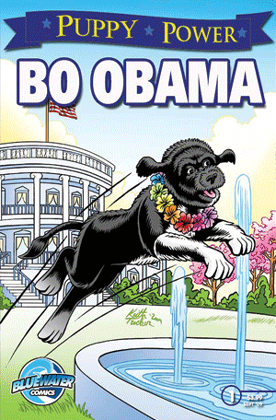
Bo Obama, the president's dog, will soon star in his own comic book. Back when I commented on the Obama Conan spoof, I commented that I thought the dog would get his own title once the Obamas actually owned a dog. Looks like I was right. Bluewater is publishing Puppy Power: Bo Obama along with Political Power: Barrack Obama and Political Power: Joe Biden. These titles join their other politician-themed books.

I'm at a loss as to what to predict next. Maybe Bo gets a tapeworm, and Bluewater publishes Parasite Power: Bo-wel Obama?

Visions of the Future, Illustrated!

Press release:

Eureka Productions is pleased to announce the publication of SCIENCE FICTION CLASSICS: Graphic Classics Volume Seventeen. This is the first full-color volume in the GRAPHIC CLASSICS® series of comics adaptations of great literature.

SCIENCE FICTION CLASSICS presents comics adaptations of stories from the original creators of science fiction including "The War of the Worlds" by H.G. Wells and "A Martian Odyssey" by Stanley G. Weinbaum. Also featured are "In the Year 2889" a rare short story by Jules Verne, and "The Disintegration Machine", starring Arthur Conan Doyle's Professor Challenger. Plus E.M. Forster's only SF tale, the poignant "The Machine Stops", and shorts by Lord Dunsany and Hans Christian Anderson.


GRAPHIC CLASSICS are available in bookstores, comics shops, or direct from the publisher at http: ⁄ ⁄ http://www.graphicclassics.com/.


“These are handsomely-crafted books presenting terrific stories.’”— Tony Isabella, Comics Buyer's Guide


“A splendidly inventive series.” — Malcolm Jones, Newsweek


“In short, every volume is highly recommended.’”— Paul Buhle, Rain Taxi


SCIENCE FICTION CLASSICS: Graphic Classics Volume Seventeen Edited by Tom Pomplun Published May 2009, Eureka Productions Distributed by Diamond Book Distributors(ISBN 978-0-9787919-7-1)

Saturday, May 16, 2009

Camelot in Four Colors

Just learned about this excellent resource surveying the Arthurian legend as it appears in comics. The site is informative, well-illustrated, and has multiple character- and series information. It would make a great resource for illustrating how ingrained Arthurian mythos is in literature and popular culture or for showing different creative folks' twist on timeless tales.

Friday, May 15, 2009

Hill & Wang Expans Non-Fiction Line of GN's

The publishers responsible for The 9/11 Report Graphic Adaptation and other good non-fiction titles is going to be offering you more in the coming years.

So, be on the lookout for some new Wangs. Hill and Wangs, that is. ;)

Thursday, May 14, 2009

Dark Horse Dabbling in Motion Comics

More web comic/ipod comic/new interface-for-the-medium goodness from the Milwaukee-based brand.

Wednesday, May 13, 2009

Heed My Words, My Friends and Readers!

Today I talked via e-mail with a respected figure in the field of YA Lit/Teacher education about these stories that have been popping up featuring prominent figureheads talking about canons and reading quality literature.

The person told me that even they feel we're starting to focus less on literature and more on reading.

I was dumbfounded, but also happy to have the case so easily qualified for me. For the life of me, I can't figure out any good reason (I know plenty of bad ones) why educated people who have made a life of letters or who enjoy teaching literature can't understand that literaCY is the prerequisite to truly engaging in and understanding literatURE.

Focusing on literature without considerations of reading, simply for the sake of preservation of a field or any other reason, is like teaching a portrait painting class without asking the students to take figure drawing or asking them to learn basic elements of shape and design. It's like assuming that students don't need to know how to multiply to do Calculus.

If the issue at hand really can be traced to worry about moving away from literature and towards reading, the solution to the "problem" is simple:

Stop viewing reading and literature as separate constructs. Instead, favoring the logical, sensible -- dare I even say it "common sense' -- notion that literature and literacy, great books and reading proficiency, are always intricately intermeshed, and our pedagogy concerning teaching all types of literature and media ought always to be based in this premise.

More with the Crisis Rhetoric!: "Death to the Classics!" Lead story in this week's NCTE Inbox

I am starting to believe that there is a segment of professors and English educators out there associated with a certain council with members of a certain demographic who have spent too much time looking at their shrunken retirement portfolios and have gone out of their heads.

This article, "Death to the Classics!", which was the headliner for today's NCTE Inbox, isn't quite as sensationalist as it sounds. Though it mentions multiculturalism and adding women and minority voices to traditional canons as though it was/is a "fad" and seems to downplay the importance of media texts like film, it does offer a variety of perspectives on canons and acceptable reading in k-12 classroom.

The rhetoric from some of those quoted, however, gives the piece an ominous, reactionary tone. NCTE president-elect/ Maker-of-the-members-to-be-saying "Can I take Back My Vote, Please" Carol Jago is at it again, claiming teachers have just given up on teaching canonical texts.

It's as if she's asserting, "If they would just try harder, they could get those kids reading at the second grade level in those 12th grade classrooms to read and understand every word of Moby Dick." Got no fluency? Take you ten minutes to read a 100 word paragraph? Buck up; there's magic somewhere that'll fix it all: teachers just gotta scrounge around for it.

One of the first lessons I learned as a classroom teacher in a class full of struggling readers is that there is no magic wand that makes it all better. Effort and motivation are important, yes. But the "you just gotta try harder and that's it" argument is meeting one form of ignorance (not knowing, as in not knowing how to read successfully) with another (blind, stupid stubbornness).

I am beginning to know what it would feel like if Sara Palin was ever sworn in to office.

Anyone know if Jago can see Russia from her house?

Some sort of researcher (it is never clarified what she researches) Sandra Stotsky is "horrified" of the "disaster" of kids reading popular texts instead of canonical texts. Again, the idiot "either/or" dichotomy. Like there's no way for them to do both!!! An English professor (not an education professor, or even an English education professor) from Emory complains that students need a core experience, another Cultural Literacy reference that is diminutive in its focus (why is it that so often these days Cultural Literacy arguments are reductive? It's as if speakers want us to see them as idiots. MEMO: Critical literacy and Cultural literacy can and should interact/intersect. Again, it's not an either/or proposition. Multiple texts and experiences can coexist. Even E.D. Hirsch knows that, deep down!).

Thank goodness for Kylene Beers and Robert Probst and an actual practicing k-12 teacher bringing another side to the story, talking about how students need and want to read texts beyond the fiction-heavy titles on most reading lists and/or featuring characters to whom they can more easily relate than are featured in many "classics." Beers experienced for herself the same feelings of "magic effort will be the cure" that I did when she taught struggling reader conglomerant figure George (see her book What to Do When Kids Can't Read) to understand what I mean); Probst is keen enough to even talk about how some of his best readers were poor students who might not have been able to read a novel on grade-level but were excellent social decoders and had a street fluency beyond his own abilities.

It's scary: one can read this article and almost see sides forming. If the alarmists keep with their tone, the rest of us may have to pull together to make sure the last vestiges of sense aren't ran out of education studies. Nationally, we were just plunged back to the 1890s in almost every aspect of American life. Now, folks who should know better seem intent on having us revisit pedagogies associated with the turn of the wrong century as well.
_______________

Random notes:

"Sides" often equates to "bifurcation." As frustrated as I am to read some of the alarmism, and as much as it alarms me, I know it is important not to go too far in creating alarmist text in reaction to them. That will just push apart and lose too much of what we need for common ground. If those of us who are against the rhetoric that is popping up concerning a return to a stolid Cultural Literacy don't keep our cool, we'll fall on far "other side" of the "either/or" spectrum. Let's critique these statements when they are made. Let's discuss their absurdity and danger, but let us not push against them so hard that we lose the sense of commonality that will keep outsiders from looking at us and wondering what a bunch of idiots we are.

Hmmm... perhaps that's the overall goal: a larger force wants us to eat ourselves from the inside so they can take over with the support of the masses; swoop in and fix the mess it instigated/created. That can't happen with a Democrat in office, can it? Hmmm... I'll just consider "conspiracy theories" to be too much of an extreme possibility.... for now..... But it would be awfully opportune to declare education broken at a time when teachers and teacher educators are squabbling amongst themselves. It'd be easy to "shake things up" after shaking things up...... Yeesh, and I thought things were getting scary before I started to extrapolate! ;)


Tuesday, May 12, 2009

Want a Hit List of my Hottest Topics?

Just realized this, but if you want to see me talking about things with a particularly fiery passion on this site, you should use the search bar at the top left of the blog interface and type in keywords "either/or" and/ or "mythbusting." It's a veritable hit list -- or is that a s*it list? -- of Bucky bluster. ;)

Fightin' Fallacies: More Mythbusting with Bucky

I'm working on a co-authored article on graphic novels with another professor and a graduate student. Recently, one of the co-authors wanted to talk about the "uniqueness" of the graphic novel form and mentioned notions of narrative, linearity, and simultaneity. Having been reading a lot of comics theory and literacy theory, having published some, and certainly having kept my finger on the pulse of academics' (especially education professors') growing intrigue with comics, I was compelled to reply to [some] comments via sharing my own thoughts on what might be called "developing fallacies of fascination" concerning the uniqueness of sequential art narrative.

Here is what I wrote in my response to my the co-author, with their original text not included for the sake of privacy:

I have strong thoughts on how people are viewing narrative, comics, and linearity that might surprise [folks]...

People talk about graphic novels as nonlinear texts and think that this nonlinearity is an important "special" feature of the form that helps inform thought about narrative and sets the form apart. I do not agree completely because of how the arguments are often framed (i.e. incompletely and in "either/or" talk). The problem is that comics are linear and are read linearly, and I and others would argue that narrative will always be linear. Even formed thought, and especially formed thought put to paper, has a progression to it in that there are points of beginning-middle-and end. Fuzzy sometimes, sure, but they're there.

The simultaneity issue [----] is key to the understanding/misunderstanding comics as nonlinear texts: It's not that they aren't linear; it is that they are linear while simultaneously being nonlinear. :)

If by no other frame than that a person starts reading at one moment in time, progresses through measurable time in his/her reading, and then stops, a linear narrative is formed.

Even if they stop, go back, and re-read. Even if the comic is beset with flashbacks and flash forwards and cut screens. These flash forwards and flashbacks and cut screens still have their specific places in the overall narrative. The reading can be measured with a clear beginning and ending.

Now, within the linearity of the reading of the comic, there may be any number of splinters and breaks and fusions, via a re-reading or simply due to the nature of the form, what Thierry Groensteen calls the iconic solidarity of the form, the space-place of the panels and pages, which are always framed by narrative frames, even if they are cognitive. As is often the case with theories of reading that come from outside literacy studies but somehow end up influencing them, many are forgetting that there is an actual social interaction with the text, something that Rosenblatt still doesn't get her proper kudos among contemporary theorists for pointing out (but let us all drool over Barthes, who is saying similar things).

.... I can tell you that education folks are starting to get interested in that notion of the "specialness" of the graphic novels, but I have to admit that even as a proponent of the form, I think people have jumped the gun too early on thoughts of "uniqueness" tied to narrative and linearity because they want to see something that is there but don't want to acknowledge that something can be there and not be there simultaneously.

All in all, the most rational argument for anything high-end theory dealing with comics that I feel can be made today is this: "It is but it isn't but it is."

.....I've been thinking for a long time on these issues of narrative, linearity, simultaneity, and what we might call the growing "fascination with fallacies" concerning comic art that have yet to be named as such.

OK, so maybe you heard it here first: "it is but it isn't but it is." Educators are wanting to focus on what the graphic novel can do that other forms can't. Well, that's all fine and good, but let's get it right before we start labeling things and let us not continually fall victim to our simplistic either/or thinking, which permeates even language and theory that sounds high-end but is just as susceptible to wrongheadedness.

It's just as important that sequential art can do things that other forms can do while doing things that maybe they can't as it is to try to highlight what makes the form unique. Not noting this important aspect leaves us vulnerable to making statements that are ill-formed and incomplete and may lead to the development of "fallacies of fascination" concerning forms that education folks might see as "new" but that in actuality have been emerging for centuries.


Monday, May 11, 2009

The 1976 Project

University of Windsor Professor and comics scholar Dale Jacobs is undertaking a project in which he examines all of Marvel's comics published during 1976, which is when he was ten and is when he read his first comics. The project sounds exciting, and I wish him luck in his studies!

Another Article on a Study on Arts in the Curriculum

Proof the World is Round: TSA Finds Scary Comic

Directly after 9/11, there were talks about the government hiring creative people, including comic book writers, to come up with possible terrorist attack ideas. The thinking seemed to be that the planes being hijacked was such left-field thinking, that to thwart future attacks, left-field brains needed to be deployed; the events were so out of a comic book, comic book writers needed to be employed.

Now, in a bit of round robin, the TSA has found a script of the comic Unthinkable to be a scary item. TSA detained writer Mark Sable when they found the script in his bag. What is Unthinkable about? The Beat's Heidi McDonald describes its premise as such: " a government think tank spends its time thinking up possible terrorist scenarios."

Sunday, May 10, 2009

Christ-Like Powers in Comics Series

Comixology's Karen Green talks curriculum, super-hero comics, and the interesting "Christ's Second Coming" comics series Chosen, now available in trade.

Sequential Tart Danielle Henderson Talks About Loving Literature/Comics

Nice, short essay here on how a young woman came to love reading and love reading comics. For her, reading traditional print-based texts came before the love of comics, but love of the medium is still strong in this one.

Wednesday, May 06, 2009

Best. Super-Hero.Musical. Ever?

NJ High School Teachers, Cartooning Club Host Con

The Beat was full of comics-and-educationy type stories today. Here's another one: A high school in New Jersey is what appears to be a pretty hosting a major comics convention. According to the website for the Hawthorne High School Comic Convention:

Run by Hawthorne High art teachers Allan Rosenberg and Da nielle Russo and the wonderful students of the Cartooning Club,the convention is held as a fundraiser to supplement the art department’s budget, thus making it possible do even greater things for the art students of the high school.

Awesome thinking, Teachers and kids!

Bucky + EE = Buckeye

If I ever decide to apply for a position in English Education (EE) at Ohio State, that's how I'm going to begin or end my application. And with money pouring into their Cartooning Library and Collection, it might be a great fit (not that I'm not completely happy with my UTEP gig. In fact, I'd like to start a Cartooning library/museum there of our own). Jean Schulz just gave 1 million bucks to the collection, with the possibility of more monies to come:

The Ohio State University received a gift of $1 million from Jean Schulz, the widow of Peanuts creator Charles M. Schulz to support the renovation of Sullivant Hall, the future home of the world’s most comprehensive academic research facility dedicated to documenting printed cartoon art.

Along with her generous gift, Mrs. Schulz issued a challenge: She will provide an additional matching gift of $2.5 million if Ohio State raises the same amount from other sources, making the total impact of her gift $6 million....

Get the full scoop here.

Did you Know Marjane Satrapi Wrote a Children's Book?

Me neither, but following the link embedded in the title to this post will take you to a review of 2006's Mosters Are Afraid of the Moon, a straight-up illustrated kid's book.


Math Lessons with Gene Yang!

You heard right. The Beat has a link to a series of factoring lessons from the award-winning graphic novelist and California K-12 teacher Gene Yang.

Monday, May 04, 2009

Southern States Urged to Do More About Literacy in Secondary Education

More in the "what good is literature if students can't read it?" category, this time from an ASCD daily e-brief.

Chris Wilson's MA Thesis on Comics Available On-Line

Give Chris a visit at Graphic Classroom and read his MA thesis on comics and a 5th grade classroom. Tell 'em Bucky sent ya! :)

Thursday, April 30, 2009

And Just When I was Getting Over Being Embarrased By My President....

Vague, couched in tired, reactionary "crisis" rhetoric, and seemingly narrow in focus, scope, and informed resources, NCTE president-elect Carol Jago's recent NCTE-published white sheet "Crash! The Currency Crisis in American Culture" just arrived in my inbox. The PDF is available by clicking the title of this post, in which I have intentionally used wording I believe to be equivalent to the absurdist rhetorical punch of her title and piece.

I knew to expect a growth in Cultural Literacy-heavy writings once the economy went sour and the 21st Century had settled in. Recent MLA statements seem to have more than a tinge of fear in them about the changing nature of reading and literature in the U.S., and I even read a quote from a representative from Harvard recently talking about how we're getting too far away from education for education's sake. Jago's white sheet reads similarly to these statements.

In all those examples, I find it hard not to note banal reactionary concern from individuals and institutions free to engage in elitist, privileged perspectives: I worry that the reemergence of the "learning for learning's sake" argument is too closely linked with economic downturns that have left many universities reeling. I read these arguments as saying, "Come back to school. Your tuition dollars will help save the Extra-Sensory Studies program." As well, as the new century situates itself, its problems, potentials, and strains become more apparent, making it easier for those grounded in ideas of the previous century to beckon back to good old days that never were, to notions of living and literacy that may grow less and less relevant with each passing tweet.

I can't tell you for sure if Jago's position statement is supposed to be read as such. Perhaps she's dabbling in savvy subversion, but her main point is that students need to read and write about literature.

I am not sure anyone would argue with this, though she seems to think there are many. She says, "They [whom, I don't know] see the study of Harper Lee's To Kill a Mockingbird, for example, as superfluous to helping students make a living. But making a living isn't enough." She says later, "Part of our responsibility as teachers is to help students discover that the pursuit of happiness does not begin and end with the purchase of a new car."

I'm not a proponent of state standards by any means, but I've never read one -- in teaching in North Carolina, Tennessee, Virginia, Mississippi, and Texas -- all standards-ravenous states -- about making sure students are able to purchase a Mazda. Jago may be trying to warn readers to be wary of students' own sense of capitalism, but in a document laced with terms like "currency" and scare-tactic mentions of ambiguous "theys," she comes off as pointing fingers.

At whom? Considering that she never overtly defines "literature" but defends its use in practice via mentioning Harper Lee, Janie Crawford, Huck Finn, Paul Laurence Dunbar, Maya Angelou, Countee Cullen, William Wordsworth, Maxine Hong Kingston, Romeo and Juliet, The Great Gatsby, Moby Dick, Crime and Punishment, Henry V, and Emily Dickenson, it may be at those who have a broader sense of literature than Jago. She doesn't mention canons specifically, but she does use the other C-word:

"I worry in our determination to provide students with literature they can relate to, we end up teaching works that students actually don't need much help with at the expense of teaching the classics that they most certainly do need assistance negotiating."

So, literature is defined as the classics. At a time when many of the top names in education, literary studies and other fields are talking about how new forms such as graphic novels inform, expand, and transform the very meaning and nature of literature, Jago wants us to return to a narrowed definition of what is literature and what it isn't? Again, it is hard to say as her definitions of solidified quantities revolve around the use of "literature" and "classics," but the alternatives that she may or may not consider "literature" are as vaguely defined as those others she invokes.

I worry that she is speaking of those who advocate for Young Adult literature, for using digital forms in the classroom, for bringing in contemporary (to her credit, she does make the distinction between "classic" and "contemporary" literature, but in no detail beyond using the two terms) song lyrics. Of those who advocate for using graphic novels in the classroom. Of those who even advocate using non-fiction in the classroom, since most of her examples are poetry, drama, or fiction.

I also worry that her phrasing sets up another useless "either/or" trap that educators so easily fall into these days. She mentions how crucial it is for students to experience scenes like Atticus Finch putting his children at risk to stand up for the rights of the under-represented. If she thinks it is tough being Atticus, she should try being Vladek or Anja Spiegelman. Indeed, "literature reflects the human condition," as Jago points out, and it "requires deep reading and analytical thinking." Do I give up analytical though, deep reading, and the ability to integrate and ingrain terms like clarify, motif, and device by teaching a text that is not in the canon? That is not in what appears to be a very winnowed view of literature? Are they necessarily "banished" simply because I'm not teaching fiction, or traditional print-based text? Can not the zone of proximal development be reached in texts other than canonical ones? So many graphic novels reflect so many facets of the human condition. So do good YA titles.

Indeed, many who advocate for the integration of "newer" types of texts do so with the understanding that these texts can help build connections to the more traditional literature, not with the intent to replace it for all students. Jago does not make any mention of these educators, though, focusing on "caring teachers" who "defend the use of alternative, simplified reading selections for nonhonors students in the belief that their students don't have the vocabulary background knowledge, or reading stamina to follow complex syntax." She argues the only way to get them to develop those skills is through the reading of complex works. "Complex," of course, is a complicated term. I might even argue that the structure of a graphic novel, with its spaces and closures, boundaries and borders, images in repetition and sequence, make up a complex complex. :)

There are many teachers and teacher educators who want to teach literature. In my experience, many of them ask questions like "where is the quantitative data to show graphic novels work?" while accepting the fact that there is little-to-know quantitative data that any one text that Jago mentions or that might be on their current syllabi "works." When it comes down to it, it is the teacher and the strategy that are most important, not the text. An excellent teacher can make a rock interesting, which, if I may hazard a guess, is why some people go on to become geologists. This point also seems lost at times in "Crash!"

There is also the reality that Reading research has identified levels of reading success such as the frustration level, the instructional level, and the independent level. Jago states of a text that students can read on their own, "it probably isn't the best choice for classroom study." She also mentions that when help is available, students who "never expected to be able to read challenging literature find that...the book isn't as daunting as they first thought." Agreed, but by not couching her phrasing in specific terminology from Reading research, Jago undermines her positions and comes off as one apparently hoping that "saying it simply makes it so." This isn't the case, of course.

We know that asking students to read works at their frustration level, for example, is asking them to read at their failing level. Scaffolding -- visual, textual, auditory, or otherwise -- can help students understand elements of these texts, but if the selections are too far above the students' reading level, "exposure" or base understandings are the best teachers can expect. There is the zone of proximal development, then there is the zone beyond. This point needed to be made, and there are mryiad Reading and literacy scholars Jago could have cited to make it.

Surely there are good strategies for teaching complex literature, writing and joining with other types of texts included within them, but there is also the reality that not all students in English language arts classrooms will be able to read certain traditional texts with fluency and comprehension. By ignoring basic Reading knowledge, Jago appears to be missing a very important "in between" positioning.

This happens again when she juxtaposes ideas on Critical Literacy in this very obviously Cultural Literacy-laced work. She asserts, "Once we disdain to teach works that need to be taught to be understood, we not only debase the coinage of literature but also bring into question our own function....all we need to do is to question the value of literature itself, and, abracadabra, we have eliminated the need to teach it."

But in the following paragraphs, she says that students need to be able to critique "a brave new world in which reading is reduced to skimming and scanning websites." If they don't, they'll be "unprepared for everything that this great nation holds dear -- independence, freethinking, and the pursuit of happiness." Besides for a severe lack of understanding of reading in the 21st century (students are reading beyond simply skimming and scanning, just in ways that they might not define as "school" reading) inherent in the statement, Jago also has in this argument a glaring paradox: We shouldn't question the value of literature, but we should question habits in which we do find ourselves actively reading?

"Why" is at the heart of Critical Literacy. Not questioning why we might read from "classics"-heavy curricula seems to me to be regressing in its own way, to a point where very specific sociocultural points of view are privileged without question. As I mentioned above, leading figures in multiple fields are now discussing how new or recently recognized forms are altering and informing notions of literacy and reading. The New London Group mentions that this will move us towards a need for transformational design over critique. I do not argue here against the notion that critique is necessary. Critical Literacy in every aspect is necessary. That we should ever stop questioning why we teach literature (-- why we teach anything --), that our students should be robbed of the opportunities to transform themselves via critique and questioning of the texts and forms they encounter and why they are there for them to encounter -- for the sake of keeping literature from falling into chaos -- seems beyond absurd.

Quoting Louise Rosenblatt, Jago asserts that, “The problem that a teacher faces first of all, then, is the creation of a situation favorable to a vital experience of literature. Unfortunately, many of the practices and much of the tone of literature teaching have precisely the opposite
effect” (61). To me, this statement gets at strategy, not at text. To how a teacher teaches, not what. Jago ends her essay by commenting, "As we move through the twenty-first century, let's be careful not to lose in the name of progress and preparedness the texts and habits of mind that have brought us this far." Are these "habits of mind" those strategies to which Rosenblatt might allude, or notions of what is acceptable literature and what isn't? I worry Jago means the latter.

Those habits of mind are always already changing. This call comes too late, vague as it is, paradoxical as it is, and via its use of "either/or," capital and crisis rhetoric, to be given serious consideration as it is currently phrased. Yet, I fear it will be heeded and interpreted as a call not towards the future, but to a past that we can't relive, and since the past that was, was beset with inequities and narrowed views of worth and value judgements from every angle, including from the privileged elite and privileged intellectuals, to a past we shouldn't want to relive.

The argument is old; the rhetoric of crisis and fear is stale, and terms are vaguely defined. I know that as a young academic, I might be placing myself precariously for writing this. I'm not so naive as to not realize that even in the academy there is bread-buttering and the need to tread cautiously at times. But I can't shake feeling that though I'm not sure Jago is saying what she wants to be saying, I'm certainly afraid she is.

Mythbusting Experiment: "I'm Not a Visual Learner"

I admit it, I have seen more than my fair share of practicing teachers turn ghost-white at my mention of using art -- especially teacher-drawn -- art in their classrooms and in my workshops. I hear cries of, "What if you can't draw?" and "What about students who aren't artistic" and "I'm just not a visual learner" more often than I'd like.

I don't get frustrated with the teachers themselves, though I readily admit to you in every exercise that I have used with students and with teachers, a larger majority of students have bought in and enjoyed it more than some of the teachers have, most likely because I make kids feel comfortable by being comfortable enough to model my own drawing skills, which are slight. I do get frustrated as I look into those teachers' eyes and see a 4th grade teacher tell her child-self "No more books with pictures. It's time for real reading" or see a play role out before me featuring said teacher's child-self and another presence --sometimes adult, sometimes child -- ridicule the person's attempt at visual expression.


Yes, I am convinced that my inner eye is seeing psychological trauma associated with drawing and art and its connection to reading when I deal with many reluctant teachers, who sometimes seem to completely shut down upon knowing I might be asking them to draw.


Contemporary education, with its belittling of the arts and linguistic/logical emphasis, seems to further embed the psychological scars. I know that many believe there is a such thing as a person who isn't a visual learner.


I disagree, excepting the caveat of blindness as it is defined as a medical condition. There may be some of us who are better visual learners than others, and certainly this plays a part in reading because many who have reading issues have trouble visualizing what they read, but every sighted person is a visual learner and a visual reader to some degree.


Don't believe me? Try this experiment:


You'll need:

a desk and chair

a friend

a book you haven't memorized. Preferably one you haven't read.


Steps:

1. Posit the book in your friend's hands. Better yet, let the friend pick a book from a shelf or bring one with him/her.

2. Sit in the chair, then close your eyes.

3. Ask the friend to place the book in front of you on the desk, then ask her open it to a random page, making sure the book's pages lay flat.

4. Keeping your eyes closed, begin reading the book.


Didn't work, did it? Isn't it a strange phenomenon that we often seem to forget that when we read, we're actually using our eyes? We get so caught up in the cognitive aspect of reading we forget the basic sensory aspect and how the sensory-cognitive aspects are actually working together to help us form comprehension. It's like we think the words go straight to our brain, bypassing our corneas and rods and cones all together.


If you can read, you're a visual learner. You might not be as good at learning through visual stimulus as others are, but -- especially if you've ever uttered the phrase "I'm just not a visual learner" -- you're probably better at it than you think.

Recommended Reading: English Language Notes 46.2: "Graphia: The Graphic Novel and Literary Criticism"

University of Colorado, Boulder professor (and my former chair at USM) William Kuskin edits this issue of English Language Notes, which deals specifically with the graphic novel and how its best home may be situated in the realm of Literature Studies.

Kuskin joins Charles Hatfield, Johanna Drucker, Jan Baetens, and other talented intellectuals from the U.S. and abroad to illustrate how the hardbound (or at least compared to its soft-pamphlet brethren) graphic novel is literally/literarily bound to the histories, legacies, and theories of the book. Each essay positions graphic novels in or around the ethos of the book and literary theory while also touching on other notions that have posited the graphic novel elsewhere/elsewheres (film, art, media studies) and while making sure to expressing the unique values of the medium. The limits of narrative, linearity, and form of traditional print-based texts, other types of visuo-verbal discourse emanating from the page, and the graphic novel medium inform each other, comment on one another, and in many ways, transform one another as the authors place them in proper relationships.

I enjoyed the issue very much and recommend it to anyone interested in comics studies. I happen to be reading it alongside the new Comics Studies Reader and Theirry Groensteen's The System of Comics, and I find this joining to make for an even more satisfying intellectual endeavor, especially when I compare Groensteen's thoughts (in both the Reader and in Systems) on how comics, or the 9th art, as they call it in France, needs to be considered as its own, unique system, with its scholarship drawing from but not concreted in any number of studies, to ELN's situating graphic novels and its scholarship in literary traditions and thought. Both make compelling arguments on their own, of course, but they're particularly intriguing when paired.

You can order your copy of the "Graphia" issue of ELN by visiting here. It's worth at least twice what you'll pay for it and will make for many exciting conversations among those interested in comics and with those more traditionally literary-minded folks whom may not yet know what to make of them.

Tuesday, April 28, 2009

Get Your Daily Dose of God or Goddess

My good friend and very talented comics artist (and artist in general) Erik A. Evensen has started a blog where he posts sketches of one deity per day. All culture's mythologies are on the table at Daily Deity. Evensen's graphic novel Gods of Asgard won a Xeric grant to help it see completion, and it is definitely a text I recommend for libraries and classrooms. It is well-researched and well-rendered.

I think visualization of interesting characters like gods and fairies and other creatures from mythology can help make ancient texts come alive for students. I used to ask my students to draw various pilgrims from Chaucer's Canterbury Tales or to do a sketch of what the Beowulf monsters looked like to them. I also used to integrate fine art in my k-12 classes, letting students see how painters, etchers and sculptors had interpreted scenes from Shakespeare plays, The Rhyme of the Ancient Mariner, etc.

I recommend bookmarking Daily Deity. It's a high-interest site for kids and adults and will always have a connection to multiple studies: religion, mythology, literature, history, to name a few. Even if the site eventually stops updating (the last entry as of this posting is April 17), it's a worthwhile resource.

Classics Illustrated Series hit Hard By New Policies

A press release to make a person cry, "Why, Diamond? Why?":

TORONTO, April 28, 2009 — In early April 2009, Diamond Comic Distributors notified Jack Lake Productions Inc., publisher of Classics Illustrated comics, that due to “new operating guidelines and benchmarks,” they are dropping solicitation and distribution of the full Classics Illustrated series.

President of Jack Lake Productions Inc., Jaak Jarve, commented, “That this is another example of a knee-jerk reaction to the tough economic environment everybody is struggling with to get through.”

He also added, “Ironically, here we have an American intellectual property (consisting of 325 classical literature titles) which are being dumped in favor of spandex-super-hero titles. Oddly enough the American-owned and -produced Classics Illustrated series is being welcomed more by foreign publishers than our own North American publishing community.

Maybe those foreigners are investing in the knowledge that classical literature will help teach our children to cope with the realities of the real world much better than these caped-crusaders who like jumping off high buildings. Splat! That’s all I have to say.”

Jaak further mentioned, “Given these new circumstances, we ask all our loyal customers and retailers to continue to order these new republished Classics Illustrated titles directly from Jack Lake Productions Inc. at our website http://www.jacklakeproductions.com or call us at our toll-free number 1-800-269-9206.”

Classics Illustrated titles will continue to be sold and distributed by independent distributors, book stores, BudsArtBooks.com and Amazon.com.

Jack Lake Productions Inc. is proud to announce that since September 2008, Classics Comic Store Ltd. out of the UK, managed by Jeff Brooks, has been selling and distributing Classics Illustrated titles into the UK, Republic of Ireland, Australia, New Zealand and South Africa.
The company is also proud to announce that in March of this year, !Editions, a publisher out of France, picked up the worldwide French rights for the 1990 First/Berkley Classics Illustrated titles.

In 2007, Papercutz picked up the worldwide English rights for the Classics Illustrated First/Berkley series as well as their own deluxe 144-page adaptations of classic literature. Since 2006, Egmont has been re-issuing 4-title Classics Illustrated volumes in Scandinavia. Since 2005, Modern Times S.A. has been selling and distributing Classics Illustrated Juniors in Greece and Cyprus.

-----
Check us out on the Internet at http://www.jacklakeproductions.com

Free Comic Book Day is Almost Upon Us!

Get free comics this weekend just by stopping by your local comics shop. It's a great time to explore different genres. And, hey, maybe you can finagle a class set of something if you ask the store owners nicely.

Sunday, April 26, 2009

Borderland Comics Studios to Represent on Free Comic Book Day: May 2, 2009

More comics goodness -- this time for Free Comic Book Day, coming up May 2,2009 -- from comics creators in the El Paso/Juarez region via this press release:

Free Comic Book Day: The Christmas of Comics, to promote literacy and art through the medium of comics and to inspire thousands, nay, millions to get out and visit their local shops is upon us, MAY 2nd 2009!


This year, Adversary Comix and 656 Comics is doing something unheard of, unprecedented, and just really kick ass and cool! Nothing like this has ever been done before, so we’ve gotta set the trend and hopefully this will become the norm. with the recession in full effect it’s tough to get your books for a low price, but how does free sound, well we’re gonna sweeten the deal even more as we present the first COMIC BOOK CD made in EL PASO, TX and CD.JUAREZ CHIH!!!!!


The digital age is upon us, we download music and movies like mad, and comics are headed in the digital direction, major companies are seeing the trend and striking while the iron is hot, and since we at Adversary and 656 enjoy breaking borders, we’re throwing our hat in the ring as well!


We are giving away a CD with over 25 comics and previews in it.Yes you heard right! Why only get one or two free comics on FCBD, when you can get over 25!


We are mixing media and technology to bring to you just a sample of all the work that 656 Comics and Adversary Comics has put out!Here is a sampling of what we’ll be handling out on FCBD!:

El Valiente vs La Momia Robotica

Los Meksmen vs Zombi Kid part 1

Zombi RiderEl Comiquero #1

El Comiquero Verano

Mar de Locura

Dusk

8x8 Short Stories

Terror infonavit, a 24 hour comic

Las Chicas Clave 1-4


And the premiere of:

A Year Without a Summer

Double Edge


And previews of

BATTERY ACID: Tales of the Strange Sort

INFESTACION: Hell’s Pass 1-3INFESTACION 1-4

JAGGED FRAGMENT

KARMESI

DARK LIZZY

GUARDIAN

LOS MEKSMEN

EL COMIQUERO


The FCBD CD will be given away at our signing @ Dave’s Comics located at 5360 N. Mesa St.
El Paso, TX 79912(915) 875-8600 Soon to be renamed Asylum Comics.


And on top of that, the CD will have a free sketch on the label! But wait that’s not the best part, the best part is that even if you can’t make it to El Paso to our signing to receive a CD, you can email us at adversarycomix@gmail.com and WE WILL SEND YOU A COPY FOR FREE!


And did I mention that the whole stable of Adversary and 656 artists will be there AND that BATTERY ACID: TALES OF THE STRANGE SORT WILL BE ON SALE?!And on top of that! ADVERSARY COMIX: AGENTS OF THE PARANORMAL will be on hand to answer your paranormal questions and read your future, there will be Pinup Models and a LIVE ART JAM and free giveaways and trivia, and direct from Los Angeles, P.H.A.T.M Death squad will be belting out the tunes till the cops shut us down!


So join us if you can and see what FREE COMIC BOOK DAY should be like, the ADVERSARY/656 way!Whew! And then the after party afterwards? We are going to keep going till the break of dawn!


-- YOUR IMAGINATION IS NOT THE ENEMY!

Thursday, April 23, 2009

Salt Water Taffy

Salt Water Taffy, a favorite comic among many and one suitable for general audiences, is going to have a web comic version as well as its popular print version, according to The Beat.

ViziPress Gets Busy with Multimodal Comics

Press release:


(New York, April 22) The first visual storytelling site that combines Graphic Novel and music that will define a new genre of literacy, launches today. Over 20,000 viewers have already previewed its opening collection of titles on ViziPress.com

ViziPress.com combines the elements of infographics, visual narrative and music to deliver fiction and non-fiction narratives online and soon, on iPhones and other smart mobile devices.

"We have learned from the Graphic Novel/Manga World that a new generation of readers needs a high level of visuality with their literacy," says founder, Alan Brody. "The magic in the online version is the music which brings it all together in a compelling way."

ViziPress is launching with 3 titles:
Cigarette Seduction - a non-fiction book on the history and psychology of smoking
Broad on Wall - a racy romp about Wall Street
White Shaka Boy - the story about a New York teen who discovers his inner Zulu and the empire he owns in Africa.

ViziPress will be serializing all these books in "Webisodes" that can be viewed online and by iPhones and other smart phones as well as delivering them in print and digital format.

Business Books
ViziPress will be offering visual renderings of non-fiction business books, complex texts, graphic novels and music storybooks.

About the Music
Each webisode comes with original music from top performers like Jennie Walker and great producers like Tommy Faragher. White Shaka Boy features music by Draztik from the top selling African album, Imbube.

About the Platform
ViziPress is powered by Empressr - an innovative presentation technology platfom that supports full mutimedia features.About the AuthorAlan Brody is a technology impresario and producer of multimedia Graphic Novels.

About ViziPress
ViziPress is the innovative publisher of cutting edge Graphic Novels in print and digital formats. It is also produces the annual Graphica in Education https://www.webmail.utep.edu/exchweb/bin/redir.asp?URL=http://www.graph-ed/.

Tuesday, April 21, 2009

SpiralMind: A New Hero from El Paso Comics Creators!

Press release:

COMIC FANS FIND A NEW HERO IN SPIRALMIND


Series zooming forward with big plans for military, Spanish speakers, Comic-Con


Since its debut in January, the Spiralmind comic book series has picked up steam and a devoted fan base around the country. Hugely popular entertainment website Ain’t It Cool News gives Spiralmind a big thumbs-up, saying “Not [in] a style you see often in this post-Image era of cross-hatches and sketches, and that’s what made reading this first issue so refreshing. The story aims high with a conflict of biblical proportions, but boiled down to its basics, it’s got an @$$-kicking rabbi, a spandex clad superhero, and werewolves...


Issue one also has a full article on Ancient Judaic Exorcism. This is definitely unlike any comic I’ve read before…and a hell of a lot of fun to read… SPIRALMIND is definitely a comic book reading experience you won’t forget.”

Created by two natives of the world’s largest border metropolis, BenPerez and Matt Rothblatt dot the fantastical city of Ninevah where Spiralmind battles to save humanity from mystical demons with details of their truly unique hometown. Their background in military service also contributes to the story as well as plans for spreading the comic around the world. Plans are in the works with local military base Fort Bliss to provide free copies of Spiralmind for soldiers being deployed overseas. “Our soldiers deserve a little bit of fun and a little bit of home,” says Perez. “We’re happy to work hard and do what we can in return for all they do.”


In acknowledgement of their bicultural, bilingual environment, Perez and Rothblatt always intended for Spiralmind to be available in two languages and the Spanish version of Issue #1, Rabbi’s Lament, hits stores May 1.


“Our plan since starting this venture was to make Spiralmind accessible to everyone in El Paso and Spanish speakers around the world,” says Rothblatt.Perez adds, “Living in El Paso—where Spanish is primarily a first language for residents—we realize the importance that ‘En Español’ holds for people. This goes for the rest of the country too! As of 2008, Hispanics made up 15% of the U.S. population and are projected to make up 30% by 2050. From a business standpoint, it’s a no-brainer. DC Comics did a Spanish language issue of Blue Beetle, a Hispanic character living in El Paso. The writer Jai Nitz—who lives in Lawrence, Kansas but has family in Laredo, Texas—was able to pull off the issue beautifully while representing Spanish and the 'Spanglish' spoken here on the border. Thanks to guys like Jai and some of his predecessors, Spanish comics are considered an important part of a shifting paradigm in the comic book industry.”


“If things go well, we’ll be able to translate it into other languages in the future,” Rothblatt explains. “But having Spiralmind available in Spanish was not just a business decision; it was a decision of the heart. We know there are many kids and young adults living in El Paso,Ciudad Juarez [Mexico] across our border, or even in Omaha, Boston,and Raleigh who speak Spanish. These books are for them. We want them to be able to embrace our stories just as an English speaker would our English version.”


Jahaziel Rodriquez, who assisted Perez and Rothblatt in translating Rabbi’s Lament, says, “When I first heard about Spiralmind from Ben and Matt, I was excited for them. When they mentioned a Spanish translation, I was excited for me. As a fan of comics and a fluid Spanish speaker, I had not seen many good comics in Spanish, but Spiralmind had the chance to be exactly that. So I jumped at the opportunity to bring something to life that had not previously been seen. Hispanic-American fans of the genre were not being given the privilege to enjoy strong comic stories in their native language and I wanted to be involved in the process of making that possible.”


Spiralmind can be ordered online from www.comixpress.com orwww.indyplanet.com. Updates about the series and its creative umbrella, Phi3 Comics, can be found at www.myspace.com/phi3comics.


Spiralmind will celebrate Free Comic Book Day on May 2 with an appearance by creators Perez and Rothblatt in their hometown of El Paso at Rebels Comic Vault. Upcoming plans for Spiralmind include appearances at Comic-Con in June and Issue #2 ready in time for summer.


# # # # # # # # # # # # # # # # # # # # # #The Spiralmind team is available for interviews. Review copies of Issue #1 in English and Spanish are available for review, along with hi-res art for publication. For more information, contact Lisa Y.Garibay at LARGetc. Publicity, 213-840-3517 or lisa@largetc.com

List of Web Comics

Someone asked the comics scholars list serve about recommended web comics for a college course on comics and graphic novels. The results were ... well, this is a list serve full of comics fans and scholars. So, here's a link to many that got their URLs posted in one place, and the URLs for several others. The info just kept coming, which is wonderful and what these lists are for!

Others:

Perry Bible Fellowship: http://pbfcomics.com/

Listed as someone's "Jewish faves":
Eros Inc. http://www.commonnamefilms.com/erosinc/
Hereville http://www.hereville.com
Rabbi Encounters http://rabbiencounters.smackjeeves.com/
Talmud Comics http://homepage.usask.ca/~mll934/
Comic Torah - http://afreeman.com/52portions/index.htm
Of Biblical Proportions - http://obpcomics.com/
Graphic Therapy - Notes from the Gap Years by Emily Steinberg http://www.smithmag.net/graphictherapy/2008/06/04/chapter-1/

I'm basically posting this info as a placeholder so the next time I want my own students to look into web comics, I can call their attention to this resource, which started out as a teacher's request for info. You feel free to do the same to keep the "pedagogical pass it" forward going!

Saturday, April 18, 2009

Friday, April 17, 2009

Call for Papers! Graduate Conference and Event

CFP: El Paso in the Comics II: “The Southwest in the Comics”

Graduate students in all fields of study are invited to submit 200-word abstracts to the second-annual “El Paso in the Comics” conference and event, to be held on the campus of the University of Texas at El Paso, February 23, 2010.

Papers on all aspects of comics scholarship, theory, and pedagogy will be given attention, but those that deal with issues related to artists, creators, characters and/or themes associated with the American Southwest and/or Hispanic/Chicano culture in comics will be given top priority.

Abstracts should include name, e-mail, affiliation (university and program), proposed paper title and 200-word description. Presentations should run no more than 20 minutes.

Send abstract to:
Dr. James B. Carter
Re: El Paso in the Comics Conference
113 Hudspeth Hall
UTEP English Department
500 W. University Ave.
El Paso, TX 79912

Or electronically to:
Jbcarter2@utep.edu

The deadline for abstracts is August 20, 2009.

The academic portion of the event will take place in the morning. A creators' roundtable will follow in the mid-afternoon, featuring the many local studios and creators of the El Paso/Juarez region discussing their work with members of the community. The evening will wrap up with a keynote speech by celebrated comics artist and writer Jaime Hernandez of Love and Rockets fame.

Hugh Jackman Promotes Free Comic Book Day/ Literacy

In other news, my wife rejoices as this makes the chances of me inviting him over for dinner that much more likely.

Thursday, April 16, 2009

UNL Digital Collection Debuts: Government Comics Collection

Governments have used comics to educate, indoctrinate, train and persuade for almost as long as comics have been recognized as a medium. This excellent new online collection details multiple examples from the U.S., Mexico, and other countries and also has some gems like senate reports from the 1950s.

This is one resource you'll want to remember.

Wednesday, April 15, 2009

Interview with Gene Yang, Other Asian-American Comics Creators

Great, great interview covering a range of topics over at Sequential Tart.

Chabon on Carter

Alas, it's John Carter of Mars, not James Bucky Carter of El Paso, of whom the writer who draws so much inspiration from comics speaks. Apparently, he might be helping with a script for a movie version of the classic sci-fi. Maybe next time......

Juggernaut Slowing, Still Not Stopped

ICV2 reports that comics sales were down 6% and graphic novels sales down 5% in the most recent quarter, but says that with the economy as it is, that's actually not so bad. Comics weathers the storm better than other sectors so far, and I expect this to continue, unless there is serious backlash from the cover price increases on certain comic books ($4.99 a pop!). I just wish that comic strips weren't being dropped from so much, and that editorial cartoonists were in better shape.

It'll be interesting to see how the economy and reactions to it shape the comics industry, especially since there seems to be no stop to movie studios seeing comics characters as viable commodities. DC is keeping it's second tier characters fresh by bringing back back-up stories in many of its main books. Marvel has most of its most interesting players in solo and team books, but they are being very budget-conscious of whom they pay and how much they pay out for their future movie releases.

Will the price increase finally move folks to the trade/graphic novel route as more wait to get the pamphlet stories collected? Is that the hope of the companies? Will Spidey save Madam Web?

Tuesday, April 14, 2009

Raggin' on Shaggy

I give Shakespeare a lot of grief, I admit it. Unfortunately, he often makes a good example when I talk about how not to teach English (don't spend 3 weeks discussing every detail of his life and asking students to do exact replicas of the Globe, right down to the butt imprints on the seats)and how he is often used to promote literacy practices that are becoming more and more ancient by the day.

This is sad because, I really like the guy. Or guys, if you go for the whole "Francis Bacon" multiple identity theories. I love the plays I've read, though I admit to being too rusty on too many of them, and I loves me a sonnet, Petrarchian, Spencerian, Shakespearean, or Flinstonian (a rare form with the rhyme scheme of Y-A-B-B-A/D-A-B-B-A/D-O-O. Don't tell this to college students, though, unless you want to see it written as an answer to a test question enough times to make you wish you'd majored in grocery bagging).

It's not his fault he's been so misappropriated. Indeed, he's good evidence for many of the ideas I espouse about multiple, multimodal and visual literacies, and I was glad to see this week's NCTE's Inbox mention several others who are seeing Ol' Shagstaff in those lenses as well.

To wit: In my travels, I have often encountered skeptics who ask me if students oughtn't be reading Shakespeare instead of learning this visual literacy stuff. Of course, I eat this up, because what texts could be more interactive, multimodal, and visual than the plays of Shakespeare? The very figure that so many traditionalists uphold as the pinnacle of literary quality is the same figure who might represent the pinnacle of the multimodal experience!

Shakespeare's plays aren't meant to be read dryly, but to be EXPERIENCED. Read, seen, heard, smelled, even. I recently attended a state-level conference where the new teacher of the year talked about needing no film versions or abridged texts to teach her students Shakespeare. By God, the original language was all they needed. But the language is so much stuff and nonsense on its own, as tedious as a twice-told tale without the visual and visceral experiences that were originally meant to accompany it.

What I wouldn't do to time travel with a video recorder and study not just a performance of King Lear or A Midsummer Night's Dream, but how the audience interacted with the story as they witnessed it....

We can't do that, of course, but we can at least acknowledge the visual and spatial quality of the texts without degrading their status as literature. Again, if it represents the apex of literary achievement, let us see that within the top of the form, visual elements must exist. Teach Shakespeare instead of visual literacy? It is visual literacy! Teach Shakespeare instead of comics? Why not Shakespeare-inspired plots or themes in comics, or Manga or other graphic adaptations of Shakespeare. The visual doesn't detract from the source material ,which innately was visual to begin with!

Of course, I know enough that the argument I've made herein will not make short shrift of many traditionalist's thoughts on my good friend Willy D. Shakes. But, at heart, I think Shaggy and I are on the same team, brothers never so vile, when it comes to his plays and visual literacy.

After all, if all the world's a stage, and we're merely players, and we're not supposed to enjoy seeing any of it and doing the active aspects that "playing" implies, what sort of sick joke is life? Lot of tripping over each other, I think. And a lot of not being able to see the forest (marching or otherwise. Hey, anyone else think that Macbeth should have included the line "Run, Forest, Run"?) for the trees for not being able to see the trees or anything else.

Monday, April 13, 2009

Student Review and Lesson Ideas: The Education of Hopey Glass


In The Education of Hopey Glass, Jaime Hernandez attempts to portray the lives of several Hispanic adults, paying close attention to the development of Hopey as a young woman trying to make sense out her life as she takes a teaching assistant position at an elementary school. Interestingly, the graphic novel seems to come to an abrupt break midway through, and turns it’s focus away from Hopey, her lesbian lover Maggie, and her new career as a teaching assistant; to that of a highly sexually charged relationship between the characters of Ray and Viv, and Ray’s unrequited love for Maggie. It is not clear if Hernandez intended the graphic novel to read this way, or if it is a major flaw in the plot line.

Hernandez explores issues of racial identity, racial discrimination, sexual and physical violence towards women, and homosexuality as prominent themes and underlying themes in almost every vignette of his work. He artfully combines the characters choice dialogue with highly explicit illustrations that not only set the scene for the reader, but provide background information as well. His illustrations are done with so much expertise and craft that many times dialogue is sparse or non-existent, and the story line does not seem to suffer. However, it may be this expertise that is Hernandez’s undoing as well.

I suggest that in the second half of The Education of Hopey Glass, Hernandez may lose some of the reader’s interest because of the explicit sexual relationship between Ray, Viv, and Angel. While more mature readers may be turned off by the explicit sketches, some younger readers may be turned on. Either way, the focus on the explicit sexual images may overtake a readers attention, rather than focusing on the plot line and racial themes apparent in the graphic novel.

A suggestion for a lesson plan can be geared towards twelfth-grade and college level students exploring the theme of racial identity and/or the “passing” theme. In the text, Milena Loznika passes for a young Mexican woman to land a job on television. Teaching suggestions include linking The Education of Hopey Glass with Nella Larsen’s Passing, and W.E. Bois’ The Veil. One can ask students to read all three texts, hold a class discussion, and then give students a choice of writing a comparative/contrast paper or to compose their own prose or poetry, citing their own experience of passing if applicable.

-- Cira Montoya

Student Review and Lesson Ideas: Sloth


Gilbert Hernandez’s Sloth is an imaginative graphic novel that examines the feelings of fear, frustration, uncertainty, and joy all adolescents go through during their teenage years. He does this by constructing an imaginative plot line; wherein the two main characters Miguel and Lita, escape the trauma of adolescent love by “willing themselves” into a self-induced coma. When both characters emerge from their coma, they seem to have forgotten about the most stressful moments of their past, and opt to perceive the world in a much slower, methodical way.

Hernandez artfully creates illustrations that suggest to the reader that Miguel and Lita are in a dream-like trance while existing in their self-induced comas. His illustrations also suggest the dreamy-like state of a coma is connected to a peace of mind only found with in the lemon grove that much of the plot-line takes place in. The third character Romeo, also experiences a method of escape from the stresses of teenage angst and love. Romeo succumbs to urban legend folklore and actually transforms himself into a teenage idol, with hopes of romance with Lita. When the romance between Romeo and Lita backfires, Romeo escapes inflicting any more trauma upon Lita and Miguel and “wills himself” into a coma as well.


Hernandez creatively suggests how young adults opt to escape the social and emotional pressures of growing into adulthood in the twenty-first century. Within the graphic novel, Hernandez touches on the volatile themes of abandonment, female discrimination in the workforce, love versus lust, teenage idolization, and adolescent self-esteem. Furthermore, Hernandez successfully depicts how the three main characters opt to “fade out” of society through self-induced comas, rather than the much glorified subject of teen suicide. This aspect of the graphic novel makes it a possible candidate for use in the classroom, preferably for twelfth-grade and college-level students.

A possible lesson plan for integrating Hernandez’s Sloth into the classroom includes the exploration of the themes mentioned above. For example, one may choose to create a unit plan on the theme of discrimination in America. Varied texts may include The Invisible Man by Ralph Ellison, Racism 101 by Nikki Giovanni, and Sloth by Gilbert Hernandez. After a class discussion on the re-occurring theme in all three texts, one may ask students to write a persuasive paper on discrimination in America citing all three texts, or for those students who have a more creative edge; ask students to create their own poem or comic strip incorporating the discrimination theme.
-- Cira Montoya