Stickermule

A Public Service Announcement! ;)

Sunday, May 31, 2009


Friday, May 29, 2009
Mizzou Alley Oop!
The Missouri University Special Collections and Rare Books branch of the university library is hosting "Alley Opp: 75 Years of the Comic World of V.T. Hamlin." Thanks to S. Duke for letting me know about this great online exhibit. Missouri truly is the "show me" state.
Neil Cohn and Visual Language
Neil Cohn of Tufts University's Psychology Department recently gave a public lecture at U Toronto. Cohn, who often self-publishes his essays via emaki press (visit http://www.emaki.net/), considers comics a visual language. I've called him the Todorov of comics scholarship, but I'm starting to think that label is too restrictive.

*He begins talking about definitions of "visual language," many of which sounds fairly similar to WJT Mitchell's imagetext, but he is very discriminating in what qualifies as "visual language" for him.
If you really want to call yourself informed about comics scholarship -- and have the educator's interest in psychology or linguistics -- you need to know Cohn's work. I'm not sure it represents the best or most thorough theories of comics, but his ideas are very important and respected among comics scholars.
Hear and see his lecture "What is 'Visual Language'? What 'Comics' Can Tell Us About The Mind" by clicking on the title of this post.
~~~~
Here are my rough running notes as I viewed his presentation (emphasis on rough):
*He begins talking about definitions of "visual language," many of which sounds fairly similar to WJT Mitchell's imagetext, but he is very discriminating in what qualifies as "visual language" for him.
*Cohn's definition of the term moves away from the reliance on metaphor that is found in many others. He does not assume that communication = language, rather, language is part of communication, but not all of it.
*On cognition, Cohn states that humans convey concepts via three modalities, and only three modalities: auditory, manual/facial, and visual-graphic.
* Cohn says each modality can take on rules or structured sequences (sentences [spoken languages], hand motions in [sign languages], and comics [visual languages]).
*Comics use the verbal and written modalities, of course. He calls writing a synethesia in that it turns a verbal language into a written language understood graphically.
* I like his phrasing here in that he is overtly stating that writing is a form of graphics. Remember, the Greeks only had one word for both writing and drawing: graphein. As I have mentioned several times in print, letters are just signified graphemes.
*He makes a distinction between comics and other forms of sequential art and illustrated books. Comics do not = visual language. "Rather, comics are to visual language what novels are to English," he says. "Comics are the sociocultural contexts in which the biological capacity, or the cognitive capacity, is used. Comics are written in visual language and maybe written language."
*I'm not sure here. I worry that he is not tackling the larger term/category of sequential art.
*His overall claim is that there is a visual language on par with written language. Nothing particularly new here to the comics theory reader. This is a revolutionary or radical statement only to those who haven't heard it before.
*He discusses Charles Sanders Peirce as a semiotician who says meaning gets made in three different ways: iconic, indexical, and symbolic reference. Iconic reference suggests resemblance or similarity (he gives examples of a smiley face and the Mona Lisa); Indexicality refers to causality or indication (the example here is a finger pointing to the moon; the finger does not equal the moon but points us towards it); Symbolic reference suggests conventionality or systematicity alone (he offers a peace sign, an American flag, a heart, etc.) Conventionality is a variable in the first two. Not so much in the third.
*I'm a Derrida man myself.
*Traditional thoughts on drawing are from perception and from memory. Memory is the stand-in for perception. Cohn thinks this is short-sighted. A better view would deal with patterns in the mind. An object is "scanned" through what he calls "graphemic properties" such as lines and curves and dots; the mind sees this as tree, then articulates it.
*His ideas do seem to match with concepts from brain research, which tell us that we do not remember things in one specific place in the brain, but, rather, different aspects of things are stored in different areas, and when we access memories or schema or what have you, the different ganglions and neurons in different places fire together to bring all elements of the "thingliness" to our consciousness.
*He says drawing from memory, then, has nothing to do with perception, but rather accessing those visual patterns. Sort of sounds a little round-robin to me. Isn't the visual pattern somehow based on remembering the object? Do we just remember the abstract elements, which then come together when we metacognitively remember? It seems a chicken-egg issue that I'm not sure he resolves. Basically, he seems to say that drawing via visual memory is simply one more step removed from the thing itself than what others have articulated. Patterns are remembered more so than details.
*All languages, even visual ones, have patterns and grammars (within particular sequenced systems -- here he sounds like Thierry Groensteen a bit). Visual languages are more like sign languages than spoken languages, he claims.
*From here, he gets to his older ideas of visual grammars in comics. Lots of parsing out sequences and labeling them as clauses, etc. This is why I call him the Todorov of comics scholarship. The critique of Todorov's literary algebraic labeling, of course, is that is has been considered to be of limited utility. When I see his diagrams essentially turning a comic strip into a sentence diagram, I have real trouble thinking about practical applications as well.
*In basic terms, though, it does show us how innately complex a process reading comics can be. His thoughts remind me of a quote from a recent article on graphic novels by Johanna Drucker in which she says (perhaps without knowing it) that reading and creating comics is essentially the equivalent of running through the higher order levels of Bloom's taxonomy.
*Communication happens via "mutual intelligibility," those with "mutual intelligibility" are in communities. Some communities overlap; some do not, based on mutual intelligibility.
*So, is this a psycho-linguistic appreciation of fanboys and fangirls? Sounds good to me, lol. ;)
*Wow, he actually does go on to discuss elements of the comics reading community.
*His thoughts on human development:
* There must be some level of innateness in drawing. Other species do not learn to draw like humans do. His dotting over a 7 year old's sequenced drawings remind me of one of Kress's articles from the New London Group book.
* There must be a learning period. He says there is a drop off in ability to draw around puberty. The ability stagnates in many cultures, but not Japanese culture, where the development keeps going, because everyone continues to draw sequential images due to a widespread love of Manga.
Hmmm... but what about motivation? What about the person in American culture who returns to art late in life?
*Language consists of:
*Concepts conveyed through a modality by a sequential grammar that is governed by hierarchical rules, that is infinitely creative, that is used for communicative purposes by a community of speakers, that is diverse for that community, that gives them identity; it is processed unconsciously; it might be relativistic; some aspect of that is innate, some is learned.
PHEW!!
*Not Language:
Communication = concepts and modality.
Language adds the grammar.
*OK, I get it.
*Computer language is not language; paintings are not language; music is not language;dancing is not language; diagrams and charts are not language.
*I feel he is probably most wrong in these points. He doesn't adequately parse out various types of paintings, for example. What about a sequence of paintings or art works, like Hogarth's? Another critique: for someone who seems to be bringing thought from different disciplines together, he sure seems to miss a lot from current comics theory, literary theory, and education. That's a lot to ask of a person, to be sure, though.
*Well, there are grammars in these forms, but not language. Huh? didn't he just say that language adds the grammar? Again, he gets a little round-robin in his thinking at times.
*Some things don't use concepts but do use a grammar and a modality. That's how he's resolving this issue. But, I'm not sure I agree here. Is he forgetting that dance, painting, art -- all have visual and abstract mental iconography of their own? That the people who create them and enjoy them and know about them bring schema based on history, knowledge of form, composition, etc?
*Next step: How does our culture treat graphic communication? He says "as art." But, visual language and the capacity to draw are not the same as art to him. "Art is the sociocultural context in which we use thus biological capacity."
*Interesting....
*He says that art and language are competing paradigms. Any proponent of comics art in classrooms or in conservative college English departments knows this, or at least knows that art and language have traditionally been bisected, whether they should be or not.
* He believes the language view is what we are primed for, our biological, cognitive orientation. The art view, or individualistic view, is oppressing that. HUH???
*To sum: communication is not language. Why is this important? In education, visual representation is in the "art box." We can move it to the "language box," he says. It can be seen as core and integral to our ability to communicate rather than frivolous.
*Of course, education is already there/not already there. NCTE/IRA define the English Language Arts as reading, writing, listening, speaking, visualizing and visually representing. New Literacy and Multimodal literacy scholars such as myself already advocate for arts integration in the ELA classroom. Yet, we still have teachers who resist these progresses based on the "schism thinking" that Cohn is referencing.
* Cohn says that "comics," as a term, with acceptance of the split notion rather than the schism notion, can "do its thing," keep its sociocultural context, but expand. I think he needs to consider notions of genre and form here. Actually considering literary theory/comics theory would help him a bit. He hasn't referenced a single other comics scholar beyond Scott McCloud.
*To the audience's questions/points made from there:
* Eye tracking studies don't show much, no systematic patterns.
*Someone asks about panels. Cohn references a system, but not Groensteen. He has mentioned "linear" a couple of times. Wonder if he would buy my "it is but it isn't" thoughts on comics as a non-linear narrative.....
*"What do comics do that written and spoken languages don't?": Great question from the audience. [This, to me(as in Bucky), is another "it is but it isn't but it is" thing. Comics can do things differently, or via a meshing of modes or paradigms, as Cohn touches on, than traditional print texts or spoken languages, but they do things similarly as well.
We shouldn't focus on one point over the other. In education, this means we can't just try to focus on what graphic novels do that other narratives don't. We miss important opportunities to help students learn and to advocate for the form when we do so.
We don't have to stop using current best practices to teach graphic novels. This fact should help teachers want to use them/be less afraid of integrating them. This is a point that many, many people -- including scholars and editors -- seem to be missing when we consider using graphic novels or comics in the classroom. Do comics do things that are unique to comics? They do but thy don't but they do.
Actually, comics, like all other texts, don't do a damn thing until a reader engages them.... That's another point we shouldn't forget. There may be comics about magic, and students may respond to them with mystical fervor, but comics aren't magic in and of themselves. Waving a copy of American Born Chinese around three times and saying "Read!" won't automatically cure what ails us]
Thursday, May 28, 2009
San Diego Comicon Sold Out!
Even in this economy, the comics trade show leviathan does well. I'll post the attendance numbers once they become available. If this year tops 120K, I will proclaim that comics readers rule the universe.
NCTE Inbox Graphic Novel-Heavy This Week
This week's NCTE inbox featured several links to graphic novels-related materials. From the inbox:
Graphic novels are an increasingly popular format for stories told in a range of genres. While learning to read graphic novels takes practice, their artistic and literary merit makes the effort more than worthwhile.
In this month's episode of ReadWriteThink.org's Text Message podcast, host Jennifer Buehler offers An Introduction to Graphic Novels (M-S). Tune in to hear an introduction to the graphic novel form, including discussion of key works such as Maus and American Born Chinese. Then listen for specific recommendations of nine graphic novels, including fantasy epics, memoirs, biographies, and adventure thriller stories.
Interested in finding out more about graphic novels and their potential for enriching your students' literacy learning? These resources from NCTE and ReadWriteThink.org provide a place to start.Using Comics and Graphic Novels in the Classroom (G)This article from the NCTE Council Chronicle offers an overview of the comic and graphic novel forms and suggests a wide range of applications in the classroom.
Graphic Novels in the Classroom (E-M)In this Language Arts article, in what is one of the first-ever journal articles in graphic novel format, educator and author of American Born Chinese Gene Yang makes a case for using graphic novels in classrooms.
Comics in the Classroom as an Introduction to Genre Study (E)The combination of the image and text (and relative brevity) of comic strips and comic books make them an excellent source of teaching material, as they explore language and meaning in a creative way. In this ReadWriteThink.org lesson, students will be examining the genre and subgenres of comics, their uses, and purposes.
Book Report Alternative: Comic Strips and Cartoon Squares (M)This ReadWriteThink.org lesson offers a new way to think about and respond to a work of literature. By creating comic strips or cartoon squares featuring characters in books, students are encouraged to think analytically about a work they've explored in ways that expand their critical thinking by focusing on the significant points of the book in a few short scenes.
Expanding Literacies through Graphic Novels (S)This article from English Journal offers a rationale, based on the need for current students to learn multiple literacies, for the use of graphic novels in the high school English class. The author highlights several titles, suggests possible classroom strategies, and discusses some of the obstacles teachers may face in adding graphic novels to their curriculum.
Gaining Background for the Graphic Novel Persepolis: A WebQuest on Iran (S)To prepare students for reading the graphic novel Persepolis, this ReadWriteThink.org lesson uses a WebQuest to focus students' research efforts on finding reliable information about Iran before and during the Islamic Revolution. In groups, students research and then present information on aspects of Iran such as politics, religion, and culture.
Building Literacy Connections with Graphic Novels: Page by Page, Panel by Panel (M-S)Each chapter of this book presents practical suggestions for the classroom as it pairs a graphic novel with a more traditional text or examines connections between multiple sources. The sample chapter includes teaching suggestions for pairing Spider-Man comics with Freak the Mighty and comments on teaching Maus I and Maus II.
Mapping Words and Images: Writing Graphic Novels with Adolescents (M-S)Presenters in this on-demand archived Web seminar describe how they use the graphic novel to get their students writing authentic, personal, and creative texts. Participants learn about excellent practical and classroom-tested ideas for using the graphic novel format to get students writing in new and exciting ways.
Taking (and Teaching) the Shoah Personally (C)Including discussion of Art Speigelman's Maus, this College English article describes the issues raised in a course on the Shoah that aimed to incorporate familial, historical, and rhetorical perspectives. The author is led to wonder whether the stories of those who underwent such experiences stand utterly outside critique and appropriation and may demand of us instead only that we never forget.
Tuesday, May 26, 2009
On My To-Read List
Emmanuel Gilbert is getting tons of well-deserved publicity for his new book from First Second, The Photographer, which I will be purchasing as soon as I see it at an area bookstore (or online if that doesn't pan out). I still need to read his first critically-acclaimed graphic novel Alan's War.
Another title on my reading list? Jaime Hernandez's Locas II, which I've pre-ordered and which should be here by mid-July.
I'm excited about reading all three titles. I recently read Gene Yang and D. Kim's latest triptych, The Eternal Smile. Not as good as American Born Chinese. Interesting and just as metaphysical. Fun, just not as instant a classic as Yang's first book. Still, I recommend checking it out. There's more critique of Western and American popular culture in there for those who loved that with ABC. And who doesn't enjoy a jab at Walt Disney?
Sunday, May 24, 2009
Most Famous HS Teacher to Ever Teach _Watchmen_ Reflects
High School English teacher John C. Weaver revisits Graphic Novel Reporter.com to talk about teaching Watchmen, now that he can do so in retrospect.
Donald and the Hoff: Big Deals in Germany
Great article about the popularity of Donald Duck in Germany. Dude sells a lot of comics over there.
Thursday, May 21, 2009
10,000 Hits!
Today we reached a milestone at EN/Sane World. Though I've hosted this blog since November of 2006, I only added a counter last year on June 10. As of today, less than a year later, we have officially passed 10,000 hits! Of course, we truly passed this number months ago since we were sans counter for so long, but we'll let today be the celebration date. :)
Onward to 20,000! Thanks to all my readers, worldwide!
Onward to 20,000! Thanks to all my readers, worldwide!
New Book on Teaching Graphic Novels Forthcoming!
 I'm happy to share with you the news that Maupin House has begun advertising for Katie Monnin's new book on teaching graphic novels. Aptly entitled Teaching Graphic Novels: Practical Strategies for the Secondary ELA Classroom, the book will be available in the fall of 2009 and is described as "the only resource to offer secondary ELA teachers classroom-based, standards-aligned strategies they can apply today" (though some may argue that "only").
Maupin has set up a blog to help get the word out about the book. I'm hoping they'll send me an advance copy so I can sing its praises -- maybe they'll even let me do a back cover blurb! Visit the promotional blog here.
The book should establish Katie as an important scholar in the comics-and-literacy field. She and I have been doing some collaborative work lately, and I hope to get to work with her more in the future. Please keep an eye and an ear out for more information on this title as it becomes available.
I'll certainly let you know my thoughts on it here when I can!
Go Read: _Manga High_ by Michael Bitz
 Michal Bitz's new book Manga High: Literacy, Identity, and Coming of Age in an Urban High School details the educational successes and amazing students associated with the Comic Book Project. Bitz' s four year longitudinal, qualitative study of the first CBP site, Martin Luther King, Jr. High School in New York City, is represented via crisp, informed, accessible writing and via compelling testimonial and art work from students and staff.
Bitz's goal is to illustrate how creating comic art gets at every major literacy skill. The examples culled from the MLKHS account for superb evidence of his points. Bitz also seeks to remind educators about the power of students' internal motivation and the authenticity of student-directed research and composition. Furthermore, Bitz hopes his research will speak to school world/real world schisms about literature, literacy, creating, and learning. Whereas traditional schooling often failed students in the project, their once-weekly Manga jam sessions opened pathways to higher-level literacy and learning from one another in fulfilling, inspiring ways.
Though there is little statistical data illustrating students' individual growth in specific subjects, Bitz shows how the project helped students overcome myriad obstacles in their personal- and school lives. It is clear that, if not for participating in the project, many students would have been lost in a crumbling bureaucracy of a failed education system and/or complicated family dynamics. Many would have most probably failed to earn a diploma.
Strong, moving accounts of several students and their artwork, Manga-style comics, help drive home his points.
If readers aren't driven to consider use of comics and Manga in their own classrooms or in after school programs after reading Manga High, I don't know what it will take.
I highly recommend reading Manga High: Literacy, Identity, and Coming of Age in an Urban High School, available now from Harvard Education Press.
More Positive NCTE-Related News
It looks like I may be visiting the Idaho Council of Teachers of English this coming October as a featured speaker on comics and literacy. The conference will be held outside of Boise. I've never been to Idaho but am excited about the possibility. Also, buying a touristy-style t-shirt for my wife that phonetically reads "I da ho" and seeing if she will wear it or curse at me intrigues me greatly. ;)
Rassin-Frassin'!: More NCTE Woes
After over 2 years of development, NCTE has informed me that they will not be publishing my next edited collection, which was about comics and contact zone theory. Code-named the Meet, Clash, and Grapple project, it just never garnered enough love from folks other than its general editor, namely me.
We did have several nice reviews and pieces of feedback, but in the end, a nasty negative review that will surely doom its writer to a special place in hell (wink!) and the less -positive other comments were the ones the NCTE contact sided with. Rather than spend more time looking for another publisher and waiting more months for more peer reviews,etc., I decided to disband the project. Too much time was wasted in waiting this go-'round, and I felt it more advantageous to cut losses and focus on potential wins.
So, despite the fact that my first book sold several thousand copies and is still selling, despite the fact that I am now an award-winning graphic novels educator, despite the fact that I am regarded well enough as an expert on the subject, despite the fact that NCTE awarded us a preliminary contract for MCG, despite the fact that Harvard Educational Press just released a book in which some of the ideas of our collection are alluded to (perfectly set up for us, actually), despite my previous publications also setting up ideas for the collection, and despite some very nice comments, the project is dead.
Or at least it is dead in its current form. For any of you readers who are involved in academia or might eventually want to consider publishing, let me share some advice via the actions I took after learning this news.
The advice stems from a seminar on academic publishing I attended while I was getting my Masters at the University of Tennessee. A very influential professor told the audience to publish fearlessly and to never let rejection hold one back. She mentioned having the envelope for the next publication possibility ready by the time the rejection letter came. I've taken the advice to heart.
So, immediately after receiving the news, I drove to my office and reworked my two chapters to the book, both of which were reviewed favorably overall, and submitted them to journals. Within five hours of a rejection, I had already sent out two other possibilities for future success.
The rest of the day was spent contacting contributors and suggesting outlets they might consider for their chapters as well. I might not be able to help their tenure files via a book, but at least I did offer peer review, peer editing, and suggestions for individual success. It wasn't fun work, but I made it a situation where I could still do what I loved so much about being a general editor in the first place: offer help and opportunities to other academics.
I urge those interested in academic publishing to adapt a similar attitude. I know there are those who want publishing to be an anxiety-ridden process, who will tell you that if you send out a sub-par article, the editor will remember you forever and it will ruin your reputation. While not impossible, and while one should always attempt to send out work as polished as one could get it, if an editor at a journal is so petty as to actually try to remember a work that wasn't deemed publication worthy, that editor 1. is not adequately serving the authors of articles that were accepted and 2. probably doesn't have enough work to do; otherwise, they'd know to forget what isn't directly relevant to the success of their journals in progress.
Now, I was able to use reviewer comments to tweak my drafts. I was also able to share reviewer praise for the articles when informing journal editors of its previous attempted life. Based on the positive comments in peer review, I have no reason not to think that both of these articles will eventually find publication. I may be wrong, of course, but I'll keep at it until I'm satisfied, until my attention is on other projects, or until I self-publish the work on my blog, which is always an option, though not necessarily the best one for my tenure file.
Frankly, success in academic publishing means following the "where there's a will, there's a way" mantra. If one can at least pretend (acting, my friend! It's all in the performance!) to conquer their fears and anxieties, if one can realize that there's always the next opportunity, and if one tries to capitalize on feedback in a quick, responsive manner -- even letting the immediate emotional anger or frustration be what provides the drive to take reasoned, responsible action --, one can have success. If you have something important to say and work to say it well, eventually, two out of three reviewers or however many it takes will help you find a place to say it.
Am I disappointed? Yes. Do I feel like I failed my contributors? To some extent. But am I defeated? Pshhht!!
Tuesday, May 19, 2009
Fellow North Carolinian Uses Comics in his 4th Grade Classroom
Chris Mason, a fourth grade teacher in Durham, NC (my home state, though now I'm a Texan), uses comics with his students to get them synthesizing data and composing projects at Durham Academy's Lower School. Mason's also getting students involved in other forms of multimedia composition and publication.
Keep up the good work, Mr. Mason and kids! :)
p.s. Thanks to S.K. for sending me this info!
Keep up the good work, Mr. Mason and kids! :)
p.s. Thanks to S.K. for sending me this info!
I Sooo Called This!
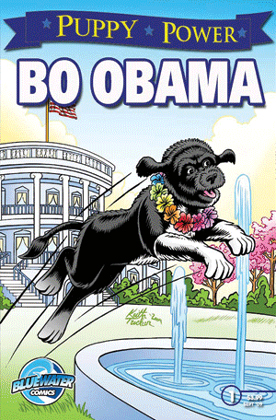 Bo Obama, the president's dog, will soon star in his own comic book. Back when I commented on the Obama Conan spoof, I commented that I thought the dog would get his own title once the Obamas actually owned a dog. Looks like I was right. Bluewater is publishing Puppy Power: Bo Obama along with Political Power: Barrack Obama and Political Power: Joe Biden. These titles join their other politician-themed books.
I'm at a loss as to what to predict next. Maybe Bo gets a tapeworm, and Bluewater publishes Parasite Power: Bo-wel Obama?
Visions of the Future, Illustrated!
 Press release:
Eureka Productions is pleased to announce the publication of SCIENCE FICTION CLASSICS: Graphic Classics Volume Seventeen. This is the first full-color volume in the GRAPHIC CLASSICS® series of comics adaptations of great literature.
SCIENCE FICTION CLASSICS presents comics adaptations of stories from the original creators of science fiction including "The War of the Worlds" by H.G. Wells and "A Martian Odyssey" by Stanley G. Weinbaum. Also featured are "In the Year 2889" a rare short story by Jules Verne, and "The Disintegration Machine", starring Arthur Conan Doyle's Professor Challenger. Plus E.M. Forster's only SF tale, the poignant "The Machine Stops", and shorts by Lord Dunsany and Hans Christian Anderson.
GRAPHIC CLASSICS are available in bookstores, comics shops, or direct from the publisher at http: ⁄ ⁄ http://www.graphicclassics.com/.
“These are handsomely-crafted books presenting terrific stories.’”— Tony Isabella, Comics Buyer's Guide
“A splendidly inventive series.” — Malcolm Jones, Newsweek
“In short, every volume is highly recommended.’”— Paul Buhle, Rain Taxi
SCIENCE FICTION CLASSICS: Graphic Classics Volume Seventeen Edited by Tom Pomplun Published May 2009, Eureka Productions Distributed by Diamond Book Distributors(ISBN 978-0-9787919-7-1)
Saturday, May 16, 2009
Camelot in Four Colors
Just learned about this excellent resource surveying the Arthurian legend as it appears in comics. The site is informative, well-illustrated, and has multiple character- and series information. It would make a great resource for illustrating how ingrained Arthurian mythos is in literature and popular culture or for showing different creative folks' twist on timeless tales.
Friday, May 15, 2009
Hill & Wang Expans Non-Fiction Line of GN's
The publishers responsible for The 9/11 Report Graphic Adaptation and other good non-fiction titles is going to be offering you more in the coming years.
So, be on the lookout for some new Wangs. Hill and Wangs, that is. ;)
So, be on the lookout for some new Wangs. Hill and Wangs, that is. ;)
Thursday, May 14, 2009
Dark Horse Dabbling in Motion Comics
More web comic/ipod comic/new interface-for-the-medium goodness from the Milwaukee-based brand.
Wednesday, May 13, 2009
Heed My Words, My Friends and Readers!
Today I talked via e-mail with a respected figure in the field of YA Lit/Teacher education about these stories that have been popping up featuring prominent figureheads talking about canons and reading quality literature.
The person told me that even they feel we're starting to focus less on literature and more on reading.
I was dumbfounded, but also happy to have the case so easily qualified for me. For the life of me, I can't figure out any good reason (I know plenty of bad ones) why educated people who have made a life of letters or who enjoy teaching literature can't understand that literaCY is the prerequisite to truly engaging in and understanding literatURE.
Focusing on literature without considerations of reading, simply for the sake of preservation of a field or any other reason, is like teaching a portrait painting class without asking the students to take figure drawing or asking them to learn basic elements of shape and design. It's like assuming that students don't need to know how to multiply to do Calculus.
If the issue at hand really can be traced to worry about moving away from literature and towards reading, the solution to the "problem" is simple:
Stop viewing reading and literature as separate constructs. Instead, favoring the logical, sensible -- dare I even say it "common sense' -- notion that literature and literacy, great books and reading proficiency, are always intricately intermeshed, and our pedagogy concerning teaching all types of literature and media ought always to be based in this premise.
Subscribe to:
Posts (Atom)