See Economix Comix creator Mike Goodwin's comic on the in-process, secretive TransPacific Free Trade Agreement and why the US's corporate interests are pressuring politicians to agree to some things that might help line the pockets of the 1% but might prove unhelpful to the rest of us, like most policies supported by our two-party system and their profiteering puppet masters.
OK, maybe reading the comic has me cynical (Me?? No....!). Read for yourself and decide what actions you'd like to take. Here's the link!
EN/SANE World is James Bucky Carter's enclave of English Education (EN) resources as well as a haven for those looking for information on Sequential Art Narratives in Education (SANE).
A Public Service Announcement! ;)
Tuesday, February 18, 2014
Tuesday, February 11, 2014
Data the Dehumanizer: "New era of accountability: Reducing students to 'anonymous data points'"
Please click here to read an excellent editorial from renowned English Education Professor Peter Smagorinsky in which he discusses what the new landscape of English teaching entails for a beginning teacher in the age of big data, where the whole child can be reduced to a series of dots on a page. One point made:
"This process of dehumanizing students and teachers also reduces them only to what is convenient about them to justify policy decisions."
Others follow. Click the link, already! ;)
Personally, I think Star Trek television shows and comics had a much better plan: Data as humanizing factor.
Monday, February 03, 2014
Education Reformers: The New Segregationists and the Assimilationist Ethic
What more proof do you need that the current rash of corporate education reforms is designed to destroy public education than the fact that Bill Gates and others supporting the Common Core State Standards also push for charter schools? If the testing supposedly accompanying CCSS reveals nationally what it has revealed in New York -- mainly that students fail these tests at higher rates than they passed others -- the big "reveal" will be that Gates and other reformers double dipping in public education and pseudo-private charters have custom-created a market, with our children as the victims and the public as the pawns.
"Failing" public schools with faculty forced to meet standards that are illogical and not developmentally appropriate -- especially in the delicate early elementary grades -- are, essentially, in a double-bind such that they exacerbate their own demise. Stakeholders who see schools as failing may be more apt to seek alternatives. So, public schools assist reformers like Gates by accepting and implementing models designed to decenter them from their "monolopy" (rather than what I see as "the right") that is public education.
More charters open, maybe even with public support. They are less regulated (if regulated at all) than public schools, so they get to pick and choose who they accept. Even if charter leaders use a lottery system to pick students at random, they can implement policies and practices to drive out students who are difficult to serve or do not measure up somehow. As well, they can decide where and when the lottery is held, possibly limiting access to potential "undesirables." Where to send the kids who won't illustrate excellence and hold the charter school's scores down? Back to public schools, where the better-performing and less-needy students may have been skimmed from the enrollment already and where they may once again act as illustrators of the schools' "failing" based on tools designed to create the market for the charters in the first place.
As more public schools fail, new charters move in. Perhaps they focus on special populations and keep class sizes small. Or, perhaps they plop kids in front of computers and beside unqualified, unlicensed teachers and call it education. Charter operators get to define their own definitions of success, which may or may not be comparable with the definitions foisted/self-imposed upon public schools.
Charters under-serve the most vulnerable students in public schools. Generally, they do not serve special needs students or those designated as ESL/ELL. These students may also be the ones who, regardless of how much work is being done to assist them, can't have true growth measured via CCSS-model standardized tests but have to take them anyway. While there are charters which exist to serve special needs students only, they do not constitute the rule but rather the exception.
Here is the Gates model to school reform: Segregate and Conquer. It is a model used to some degree by most corporate-centric school reformers:
1. Claim schools are failing.
2. Use influence to craft and implement curricular standards designed to further prove the claim (define the problem and create the tools to prove the problem you defined).
3. While public schools are exacerbating their own demise, build up the new resources such that once the claim is "proven," you control the alternative market.
4. More schools "fail" based on the definition you asserted and states accepted.
5. Advertise your ready charters as better alternatives.
6. Skim least-risky students from public schools to ensure your success in charters.
7. Watch as public schools do worse based on remaining students who are less capable of succeeding under your imposed and accepted definitions.
8. Offer more alternatives for students in those schools, alternatives you control.
9. Rinse, wash, and repeat.
Somewhere in there is work that convinces politicians that this new free market education system will be good for the economy overall, which may be the only thing politicians think the public cares about anyway or see as that which will best help them get re-elected. Convince the power politicos that opening up the new market will improve the bottom line regardless of the social carnage or the rejiggering of values associated with the public good and the right of a free public education. Add a president and his partners who make accepting the CCSS mandatory to even be considered for a new pool of government funds at a time when states are reeling to make ends meet -- a "thank you" gesture to some of the president's earliest backers -- and you have your new pauperizing process.
In the meantime, as the corporate clock-maker gods sit back and watch the system play out as devised but under false aegises of public demand and public accountability, the divide between the have's and have-not's grows. This too is part of the overall economic reform system, but with children as the central victims. Other people's kids: the easiest gloss. The goal is reform for profit, not reform for improvement. Certainly not for equity.
Make no mistake: The reform movement is the New Segregationist Movement. All of us accepting these reforms or not actively fighting them are part of the movement. As a teacher educator in a CCSS state about to experience a charter market wave (click here for a scholarly source on who is supporting charters in Washington State), I am part of the movement. NCTE, IRA, AERA, NEA -- all organizations that have not directly, boldly challenged the system and new market? They are part of the movement.
All stakeholders in this nation, especially teachers, teacher educators, and their professional organizations, are in an exigency where they may feel they must assimilate or die.
I propose a different possibility: Assimilate and die.
I have to teach my students how to deal with CCSS. I try to counter this by making sure they know their daily goals and objectives are not synonymous with meeting standards. The phrase "teach the standards" keeps popping up in high-profile places, making the distinction between goal-oriented teaching and standards-based teaching harder to make to young people who know the jobs they'll seek may require an assimilationist attitude, but I attempt to get my students to see the standards as a tool to meet the needs of their students and to get them to see teaching and learning as a situation in which the learner comes first and standards are at least secondary to daily and annual teaching goals.
When I discuss the CCSS with my students, we read works offering support for them and works detailing problematics. I chant the mantras, "You don't work for the standards; make the standards work for you and your students" and "Use the tool of standards; don't be the tool of standards," but my efforts feel less and less revolutionary as I accept the perceived fact that I must accept what I want to disavow. I'm assimilating out of perceived necessity, but my soul and conscience are dying.
I'm not sure what I do is near enough. I've engaged in "Facebook advocacy" by sharing resources with my network. I've joined the Badass Teachers (BATS) and The Network for Public Education (NPE). I try to follow those who are speaking out about these rhee-forms or deforms or whatever the reactionist phrase de jour may be, but perhaps I need to be more public in my worries, writing my elected officials and working to influence which ones find themselves with power.
But as a public employee at what is essentially a government-sponsored institution, do I put what little privilege I have on the line by speaking out?
If I feel this way as a visiting professor not yet on the tenure track, how do my TT colleagues feel and why aren't they speaking out more too or taking actions to influence their national organizations?
Many of us in teacher education have much to gain in terms of professional comfort by continuing to give our money to the organizations that have yet to take a hard stand against the reform movement. We have what feels to us much to lose by speaking out. And our tenured professors? Perhaps they're just too comfortable overall, too removed from the pressures of failure that the New Segregationist movement have spawned. They're the success stories and power-players of the profession, after all.
I can conjecture at best regarding these questions, and there are folks fighting the good fight and embracing the consequences, I know; but let it be said: the New Segregationist Movement, just as it feeds on double-binds regarding K-12 schools and forced acts of desperation from state leaders, feeds on contemporary notions of success and visibility and viability accepted by those in the field of teacher education, binding professionals who should know better to systems of self-preservation and organizations that may no longer have all of America's children at the center of their values.
I know I'm part of the problem. I can't rebel against the system such that I can ignore the presence of CCSS and other reforms, and I'd prefer not to scare my most-promising 22-year-olds out of teaching, hoping instead maybe they'll be able to fix this mess the rest of us, those too far in even as we scream to get out, make and remake even as we resist from our precarious perches with just enough privilege to placate us from taking stronger actions against our oppressors, who, to a degree, are us by design.
In short, any battle against the New Segregationists is a battle against forces stronger than any one of us, forces that can control our comfort and careers and the definitions of our profession and our viability within it, and against forces that have ensured we have to fight our own demons before we can tackle the new quagmire they continue to create as we struggle under the forks of their wealth, influence, and power. The enemy is us, and them, and the us they've helped us create. The right to a quality public education for every child and to the kinds of reforms that are necessary to make that a reality are at stake.
Make no mistake about it: "Public education" is an entity being reduced, redefined and devalued every day the public school reformers are the same people supporting public school alternatives like charters, a key cog in creating the machinery of their New (true) Monopoly of K-12 education (not that they're stopping there).
Thursday, January 23, 2014
The White Privy Ledge
As any good little boy and girl in academia must do nowadays, I spend a lot of time thinking about the construct of white privilege. Recently, I've been reflecting on what it means to be a professor (albeit untenured and currently Visiting) who is white and from a working poor background. Or, perhaps, more accurately, what it means to be a doctorate who is white and from a working poor heritage, because we are no longer in the reality where a Ph.D. equates to tenure streamed positions for many, and stories of working poor Ph.D's are getting much attention (well, notice, anyway).
As well, I keep thinking of the other poor white kids I grew up with in my hometown, in the foothills of Appalachia; I think about the K-12 school in the mountains of North Carolina where I completed an internship and the students served in poor, rural areas; I think about Chris Rock talking about how scary poor white people can be and how his mother used to consider folks who were both white and poor and think there was "no excuse for that." Rock says being white in America is like always having $5 in your pocket. Being black, he says, is like always being fifty cents short. No word on his (or his eponymous character's) thoughts on the rest of the color spectrum, I guess.
So, I decided to Google "does white privilege undermine white poverty?" Part of my motivation is because I do wonder and worry that it might be a reality that so many academics, even white academics, are so adamant about acknowledging white privilege and whitewashing all white people as advantaged in the same way, and to the same extent, because in their lived experienced, they've never seen or experienced white poverty as a tangible realness. Most professors come from middle class backgrounds or "higher," after all. And while volunteering at the soup kitchen is admirable, it's not the same as knowing persistent hunger.
Now, let me clarify my position on white privilege:
I acknowledge white privilege and even acknowledge that there have been times in my life when it must have helped me and it probably helped me more times than I'll ever be able to know and recognize. This fact does not preclude the fact that I have experienced discrimination, racism, prejudice, and other forms of othering and poor treatment.
What I do not accept is the idea that white privilege exists for all white people all the time to the same degree all the time for all whites always. Sure, perhaps white privilege is "always, already" there for the accessing, but that doesn't mean it is accessed or abused equilaterally.
I acknowledge white privilege and even acknowledge that there have been times in my life when it must have helped me and it probably helped me more times than I'll ever be able to know and recognize. This fact does not preclude the fact that I have experienced discrimination, racism, prejudice, and other forms of othering and poor treatment.
What I do not accept is the idea that white privilege exists for all white people all the time to the same degree all the time for all whites always. Sure, perhaps white privilege is "always, already" there for the accessing, but that doesn't mean it is accessed or abused equilaterally.
So, the first substantive Google result led to a PDF of a presentation entitled "McIntosh as Synecdoche: How Teacher Education's Focus on White Privilege Undermines Anti-Racism."
Oh, yeah, if you didn't know, currently I'm an English Education professor (well, VAP). Certainly my field and the broader field of education is digging into the construct of white privilege and how it relates to social justice, critical pedagogy, multicultural pedagogy, etc.
Anyway, you gotta see this thing. It details an autoethnographic study about whiteness, identity and privilege and claims that Peggy McIntosh's widely-accepted notions in "White Privilege: Unpacking the Invisible Knapsack" can be dangerous if applied without a critical edge.
Indeed, a lack of critical edge is part of my problem with how white privilege gets played out in lived academic spaces. It's as if we must acknowledge how white privilege helps us critique power structures and reveals inequities and inequalities, but the concept of white privilege itself must never be questioned, for fear of one being labeled closed-minded, or, worse, racist.
The authors argue that confession is a large part of white privilege pedagogy:
"[W]hite privilege often takes on the role of being a “Racism Detection Device” (RDD)—it acts as a test or screen to identify those who will not confess their privilege and who are therefore racist. Those who resist might be asked again, be given another chance to confess, but if they continue their resistance they have shown their true selves."
So where would that leave someone who does not accept the idea that many academics seem to hold that
white privilege exists for all white people all the time to the same
degree all the time for all whites always? And is willing to say it? I worry it leaves such a person in a precarious place. But, perhaps those are selfish concerns. I'm willing to state that too.
The recommendations of the study are two-fold: 1. Scholars, particularly those in Education, must "re-conceptualize white racial identity in ways that are generative for anti-racist teaching." I think doing this would not eliminate white privilege from the discussion, but it might allow an acceptable space for the critique of it as yet another social construction (as are race, poverty, and gender roles).
Secondly, the authors espouse "the need to displace white privilege from the center of anti-racist work in teacher education, and to focus instead on dismantling white supremacy."
Yes. That is the real issue, isn't it? Not some carpeting notion of white privilege as omnipresent and equally distributed. A focus on white supremacy could engage in all of the arguments associated with white privilege but also acknowledge class and economic advantages within and among whites and all people, really.
One might argue focusing on the dismantling of white supremacy still privileges white power. Well, they're not calling it just "privilege," either, are they? Yes, irony of ironies: White Privilege privileges Whiteness, albeit via a narrow, restrictive definition. White Privilege privileges white privilege.
Regarding education studies, perhaps a focus on dismantling white supremacy would remove a perceived need for statements like this:
"It's a sad irony that, while the majority of teachers and students in colleges of education are middle-class White females, schools in America's inner cities are populated by increasing numbers of African-American and Latino youth."
That line is from a major ELA methods textbook. I will not name it nor its authors, because deep down I want to think they mean well (and their bodies of work prove it) and that the sentence is just poorly constructed.
I feel the sentence offers evidence of just how far off-base and dehumanizing an over-arching acceptance of white privilege as fact can be. Is it really ironic that people might want to help people? Even as the sentence critiques the overabundance of white females, it still privileges whiteness (and gender) over the fact that those white females are just as human as the students they want to serve. It completely whitewashes -- in favor of field-accepted, engrained notions of multiculturalism and cultural responsiveness -- people who may truly seek to make a positive impact in the lives of other people. It sees the race and gender as primary, humanity as at least secondary.
Is it unfortunate that there are not more people of color in the teaching field and that young people in urban areas might not see as many role models or people who they can say "look like us and share our heritage" as they need? Sure, though acknowledging that fact should also acknowledge how all races, all people, can privilege skin color when making impressions about the worth and merit of other people.
Wouldn't someone who accepts that sentence, as written, in a wholesale manner actually be guilty of racism (assuming that one can be racist toward white people. I know some argue that can't happen. I don't agree). Or, at the very least, of some Alanis Morissette-esque denotative liberties?
On the other hand, thinking about restructuring the sentence with white supremacy in mind could at the very least keep all the white middle class women reading it from feeling guilty or unworthy or unable to help their fellow humans. Such restructuring could also account for class differences within and among constructs of whiteness and throughout all constructs.
How might this tie to comics, the supposed focus of this now oft-neglected blog? A few days ago, I allowed myself to be baited into a conversation about the Gene Demby article "Who Gets to be a Hero?: Race and Identity in Comics." Ain't Facebook grand? I removed myself from the conversation, but its specter has been gnawing. Demby talks about the X-Men series, known for tackling issues of social inequality, in particular and offers critique of its privileging of white superheroes. Demby informs that artist "Orion Martin noted that the X-Men comics have on the receiving end of much real-life discrimination: the main lineup in the X-Men team has been mostly straight, white dudes." So, Martin recolored some of the characters to help us ask ourselves how much color mattered in terms of who is super, super-good, and super-evil.
Demby's article and Martin's project both shortchange the X-Men series and are woefully ignorant about its place in comicsdom and society. The X-Men were one of the first culturally-diverse group of superheroes in comics. No, not the original 5 from 1963, but they were never that relevant either, stars of a B-list title at best. When the All-New, All-Different X-Men appeared in the 70s, part of its appeal was its inclusion of people from different ethnicities, races, and nationalities. Further, while many groups have tried to appropriate the X-Men as representative of them and their trials and tribulations and there's only, they stand in as metaphorical representations for all who have felt oppression.
Furthermore, the message of the X-Men is one that scholars, perhaps especially those who embrace white privilege uncritically, might just be too scared to acknowledge:
There are aspects of human nature -- not Caucasoid nature or Negroid nature or Mongoloid nature (Oof! Those words were hard to write), but human nature -- that allow for a level of hate that transcends race, transcends nations and ethnicities and genders. To wit: Most violent crime is intra-racial, not inter-racial, right?
Yes, X-Men comics privilege whiteness and usually even traditional standards of beauty, but most of its villains are white and some of its heroes are people of color. The X-Men's message is that humans hate, and terrible things happen when humans hate. The X-Men remind us that hate can be constricted to color or class, but it can just as well be color-blind, all-encompassing; completely blinding, in fact. Consider how folks sometimes talk about blacking out from anger or seeing the "red mist."
Within this example, as seems to happen so often, we see an author and artist so caught up in the "reality" of white privilege and what acknowledging it allows us to critique, that they privilege white privilege to the expense of seeing the bigger picture. Hence, they rush in to a project with blinders on, misinterpret the source material, and critic of the critic beware because so many are so eager to see/privilege white privilege everywhere and to acknowledge someone who may be "crying reductivist wolf" as brilliant and forward-thinking and those who point out cracks in the argument as inevitably, completely, irrevocably racist simply because they see more at work than white privilege. Maybe those folks even see the white privilege at work, but they acknowledge other complexities as well.
Deconstructing the white superiority in the X-Men comics, however, helps us ask why Anglo characters are so often the most powerful or the accepted leaders, whether they be heroes or villains. It opens up discussions tied to marketing and media literacy: Why did the X-Men have to be mostly white? And why do most of them meet stereotypical notions of beauty? How does the series treat those who do not, and what can that tell us about ourselves, what we like to see, and what we like to buy/buy into?
Also, it can be encompassing enough to ask what other power structures are at play. Would any of the X-Men listen to a Charles Xavier who tried to recruit them to live in his two-bedroom double wide trailer, which was the best he could do? What is the class distribution among members as well, and do gender and socioeconomic assumptions seem to affect how the characters interact with one another? Are all the villains simply poor people trying to make ends meet through illegal activities? Or are they privileged through race, wealth, etc.?
Indeed, such an approach is better suited to ask and answer the question "Who gets to be a hero?" My guess is anyone who really delves into that discussion will interact with constructs that address white privilege but will not privilege it by keeping it at the forefront and making it the "catch all" reason for every action and instance of inequity.
Maybe I'm engaging in self-destructive behavior here. Maybe I've been too jaded by my own experiences where academic peers have accepted the racist, sexist, prejudiced notions of colleagues using white privilege to advance their own discriminatory agendas in some sort of warped sense of justice, feeling as if they, even if they are white, or white and male, are part of the good fight to make real transformative change in the fight against white privilege by advocating said colleagues' ideas. (I'm thinking of you, UTEP).
Pfft. There may be a reason Foucault isn't as popular in certain academic departments anymore: Maybe he hits too close to home. Replacing the players is not the same as changing the game; not always. All those with power -- now and in the past -- have stood on the skulls and backbones of others - and othered others -- to wield it. There is no privilege of any kind without a trade off that favors the few and discounts the many.
Hell, maybe we don't need to study white superiority exclusively either. Sure, white people have been pretty dominant and domineering over the last seven hundred years or so, but the planet is far older than current notions of white privilege or white supremacy, and if Derrida is to be believed, all the traces of all the cultures and all those oppressed and those once in power are still with us, influencing us and rattling our bones. Maybe dismantling white supremacy still privileges whiteness too much and what we really ought to do is dismantle supremacy in and of itself. Perhaps that is too socialist a suggestion for academics. Perhaps it is impossible. Naive. Threatening?
Certainly I could be making myself a target for professional erasure or for being dismissed as racist and/or as unstable for sharing these thoughts. One could argue that admitting something that goes against certain academic grains, especially those assumed progressive, is in of itself a stupid thing to do: "Sure, have your ideas that run counter to current guiding notions, but, for goodness sake, keep your mouth shut!" One might argue that more folks should "show their true colors": "Keep talking so we know exactly how to make you disappear!"
Certainly I can do more reading on the concepts of white privilege, and of white supremacy as defined by the authors of the "McIntosh as Synecdoche" article. I'm eager to read this ubiquitous "Knapsack" article as well as an article they cite entitled "The Color of Supremacy: Beyond the
Discourse of ‘White Privilege.’"
I need to do more research about the study's researchers as well. They say they are part of the Midwest Critical Whiteness Collective, and no date is given in the PDF. For all I know, they're a group of scholars who have bleached their doctoral robes and put conical cardboard in their doctoral hoods so they are all pointy when worn over their heads. Maybe they've been pressured out of the academy.
I've got a lot more thinking to do, but I feel a sense of relief, a release of anger, of guilt, even, at knowing I'm not the only academic in Education who worries that privileging white privilege is skewing critical thinking and critical, transformative social justice action rather than really working to solve problems for all people.
Do I feel a release of fear, though? No. The lure of righteousness is great for anyone, even academics. And it is just so easy to throw stones. And so easy to engage in the popular thing and to label those with varying worries as racist, as stupid, as lacking career/political savvy, as unstable -- as other. There's clawing to the top and an instinct to kick away the aberrants, to make sure the odds of you and your ideas are ever in your favor, even if that means skewering one who stands as Tribute.
Ugh. I'm mixing metaphors and cultural referents, probably too influenced by that great piece floating around about academia and The Hunger Games, but what was it I said the X-Men tell us about othering? And hate?
Labels:
academics,
inequality,
inequity,
politics,
race,
social issues,
social justice,
white privilege,
white superiority,
X-Men
Thursday, January 16, 2014
Strongly-Worded Endorsements of Comics in the Classroom Becoming More Common?
I love that there is a new pack of writers who are pulling no -- or at least less -- punches when it comes to advocating for comics in the classroom. I've seen several as of late, and here are two:
As I and Hillary Chute and others have said, it does seem that the graphic novel or comics in general represent a medium that some folks, no matter what the evidence or potentials suggest, just will not accept, no matter what.
I'm probably as guilty of anyone of doing a little "Aw shucks! That's OK" acquiescence in that regard, though others might suggest I come on too strong to be convincing. Look, if people don't want to be convinced, virtually no amount of talk or research will sway them. BUT, that's no reason not eschew any apologetic modes and tell it like it is.
As does the writer of this article: "You can't possibly look at these offerings and not realize what a wonderful tool this genre has become, not only for entertaining but also for educating young people." OK, so it still has the annoying genre designation and claims that graphic novels have "upped their game" without recognizing that Gene Yang's Boxers & Saints, the article's main focus, while excellent, is far from the only excellent comic published in the last 5 years, but still! Gotta love the strength of those words.
Also see David Cutler's excellent showcase piece posted to Edutopia. He begins his article on how he uses superhero comics like Superman and X-Men in the classroom: "It's high time for more English and history teachers to set aside their literary purism, and to embrace superhero comics as effective and legitimate teaching and learning tools."
Hells to the Yeah, my comics-teachin' brethern in arms! May the day come when it doesn't feel like such a battle.
As I and Hillary Chute and others have said, it does seem that the graphic novel or comics in general represent a medium that some folks, no matter what the evidence or potentials suggest, just will not accept, no matter what.
I'm probably as guilty of anyone of doing a little "Aw shucks! That's OK" acquiescence in that regard, though others might suggest I come on too strong to be convincing. Look, if people don't want to be convinced, virtually no amount of talk or research will sway them. BUT, that's no reason not eschew any apologetic modes and tell it like it is.
As does the writer of this article: "You can't possibly look at these offerings and not realize what a wonderful tool this genre has become, not only for entertaining but also for educating young people." OK, so it still has the annoying genre designation and claims that graphic novels have "upped their game" without recognizing that Gene Yang's Boxers & Saints, the article's main focus, while excellent, is far from the only excellent comic published in the last 5 years, but still! Gotta love the strength of those words.
Also see David Cutler's excellent showcase piece posted to Edutopia. He begins his article on how he uses superhero comics like Superman and X-Men in the classroom: "It's high time for more English and history teachers to set aside their literary purism, and to embrace superhero comics as effective and legitimate teaching and learning tools."
Hells to the Yeah, my comics-teachin' brethern in arms! May the day come when it doesn't feel like such a battle.
Friday, November 22, 2013
Just in Case You're in Boston for NCTE and Want Your Facebook Friends to Know Where You Stand...
Feel free to copy this image and use it as you like. Share it with your friends on your Social Network.
Monday, November 18, 2013
I Oppose the Common Core State Standards and Urge Publishers of Comics and Those Who Study Them To Do the Same
Sure, publishers stand to make a lot of money marketing CCSS materials to teachers, students, parents, and even colleges. Sure, some believe comics still need justification as education-worthy materials. Yes, the CCSS does mention graphic novels as a type of text with which students should be familiar, making them the first standards to do so on the national scale.
But, I urge the comics community not to use the CCSS to justify the use of comics in the classroom. Or at the very least, not to do so exclusively. Look to the 1996 NCTE/IRA standards as well.
Why do I oppose the CCSS, even though at one time I supported their creation? I can't articulate the reasons better than Anthony Cody, who wrote these two articles:
"Common Core Standards: Ten Colossal Errors" and its follow-up, "The Door We Open When We Defeat the Common Core".
Also must-reading is Diane Ravitch's Reign of Error: The Hoax of the Privatization Movement and the Danger to America's Public Schools.
Stephen Krashen, long-time comics-and-literacy advocate (search his name as a keyword on this blog), Susan Ohanian, and Peter Smagorinsky have spoken out against the CCSS/current education reform movement as well.
Public education is not a perfect system and needs improvement, but the CCSS and the stakes of their implementation undermine public education as a democratic right. If you believe, as so many of us do, that comics is a democratic medium, please use your resources to resist, even when your products might stand to gain from being aligned to these standards.
Labels:
Anthony Cody,
ccss,
common core,
democracy,
education reform,
Stephen Krashen,
Susan Ohanian
Wednesday, September 18, 2013
Gilbert Hernandez Wins PEN Center Award!
Click here for all the awesome details! Well-deserved, Beto! In other news, brother Jaime was honored with another PENny Century award. ;)
Seriously, though, it's great to see this American Maestro get the attention he deserves.
Labels:
2013,
awards,
Gilbert Hernandez,
Los Bros Hernandez,
PEN Center USA
Tuesday, September 17, 2013
Art Spiegelman on NPR: Co-Mix-in it Up.
Click here for the September 14, 2013 interview. It promotes his new book Co-Mix: A Retrospective of Comics, Graphics and Scraps.
Wednesday, August 28, 2013
CBLDF Announces Japanese Ban on *Barefoot Gen* Lifted!
'Tis a happy day in the Land of the Rising Sun and for all advocates of free choice when it comes to reading in public schools! Click here for more details.
Tuesday, August 20, 2013
BAREFOOT GEN Pulled from Japanese Primary, Middle School System
I wrote the rationale for this graphic novel's use in classrooms for the Teaching Rationales for Graphic Novels ebook/CD-rom project published through Maupin House. I feel strongly that Barefoot Gen is an important text worthy of study and which should be accessible to all readers. I hope the school officials reconsider their decision, which was based on the book's portrayal of Japanese troops, apparently.
I was approached by a Japanese public television show to do an interview on the importance of this text and using it in classes. I couldn't commit due to my move to Washington, but now I wish I could have found the time.
Labels:
2013,
Barefoot Gen,
CBLDF,
censorship,
japan,
Nakazawa
Tuesday, May 14, 2013
CFP-A-Palooza!: Calls for Papers for Collections, Journals Focusing on Comics
Hi there! I just wanted to mention several journal- or edited collection projects on which I'm working that might also interest you or those who know you.
First off, did you know I'm guest-editing an edition of ImageTexT, that very prestigious journal on comics, etc., out of the University of Florida? I am, and I'm doing so with Najwa Al-tabaa, a doctoral student at UF who is formerly of UTEP (interestingly, I'm very close to being "formerly of UTEP" myself, but rest assured, all submissions will still be vetted through folks associated with strong universities, *hint hint*) and honored me with the position of second reader on her MA thesis. She's good; I'm established. What's not to love about that pairing?
At any rate, the issue we're working on is entitled "Comics and Post-Secondary Education," so we're seeking articles about teaching comics in community colleges, universities, prisons, adult literacy programs, etc. Learn more about the project and submit something by the July 2013 deadline by visiting here.
Secondly, SANEjournal:sequential art narrative in education has announced its next themed issue. The deadline for this one looms less largely, though. "The Singularity Plurality" issue asks, "How can the writing or writings of one scholar inform how we teach comics or teach with them, or how we should do those things?" For example, what does the work of Louise Rosenblatt suggest about how we should read or teach comics?Paulo Freire? Click here to read the CFP.
As well, I am co-editing a collection with Derek Parker Royal about comics' presence in the American Southwest and Borderlands. We hope the collection does for the Southwest and Border region what Costello and Whitted’s Comics and the U.S. South did for that region and Southern studies via mining, creating, and illuminating the intersections of comics scholarship and established academic writing on the Southwestern United States, the U.S-Mexico border, and their literatures, identities, and cultures.
While abstracts were due to us by January 2013, I can tell you we'll soon issue another volley to get more submissions to join the intriguing ones we've seen so far. If you think you might have an essay that would be good for Comics and the American Southwest and Borderland, click here for contact details and general information about how we're conceiving the project currently.
Finally, I'd like to inform you about "The Conversations Project: Interdisciplinary Conversations About Comics, Literacy, and Scholarship," an edited collection in which I've asked scholars and teachers in humanities disciplines to pair with someone in the social sciences/education to talk about comics scholarship and comics teaching. The official CFP asked for abstracts by January 2013, but the first set of pairs will be getting me their essays around June 20. After that set, I'll send out more invitations, so if you're interested in comics scholarship and/or comics-and-literacy, maybe consider finding an informed buddy in a field other than your own and starting what we hope will be an innovative, gap-bridging conversation in a book which plans to be full of them. Some major players in comics scholarship and the comics-and-literacy movement have already signed on. Maybe you'll do so too. To learn more about the initial call, click here.
Of course, you can talk to me directly about any of these projects by emailing jbcarter777 at gmail dot com. Perhaps we'll be working together soon! :)
First off, did you know I'm guest-editing an edition of ImageTexT, that very prestigious journal on comics, etc., out of the University of Florida? I am, and I'm doing so with Najwa Al-tabaa, a doctoral student at UF who is formerly of UTEP (interestingly, I'm very close to being "formerly of UTEP" myself, but rest assured, all submissions will still be vetted through folks associated with strong universities, *hint hint*) and honored me with the position of second reader on her MA thesis. She's good; I'm established. What's not to love about that pairing?
At any rate, the issue we're working on is entitled "Comics and Post-Secondary Education," so we're seeking articles about teaching comics in community colleges, universities, prisons, adult literacy programs, etc. Learn more about the project and submit something by the July 2013 deadline by visiting here.
Secondly, SANEjournal:sequential art narrative in education has announced its next themed issue. The deadline for this one looms less largely, though. "The Singularity Plurality" issue asks, "How can the writing or writings of one scholar inform how we teach comics or teach with them, or how we should do those things?" For example, what does the work of Louise Rosenblatt suggest about how we should read or teach comics?Paulo Freire? Click here to read the CFP.
As well, I am co-editing a collection with Derek Parker Royal about comics' presence in the American Southwest and Borderlands. We hope the collection does for the Southwest and Border region what Costello and Whitted’s Comics and the U.S. South did for that region and Southern studies via mining, creating, and illuminating the intersections of comics scholarship and established academic writing on the Southwestern United States, the U.S-Mexico border, and their literatures, identities, and cultures.
While abstracts were due to us by January 2013, I can tell you we'll soon issue another volley to get more submissions to join the intriguing ones we've seen so far. If you think you might have an essay that would be good for Comics and the American Southwest and Borderland, click here for contact details and general information about how we're conceiving the project currently.
Finally, I'd like to inform you about "The Conversations Project: Interdisciplinary Conversations About Comics, Literacy, and Scholarship," an edited collection in which I've asked scholars and teachers in humanities disciplines to pair with someone in the social sciences/education to talk about comics scholarship and comics teaching. The official CFP asked for abstracts by January 2013, but the first set of pairs will be getting me their essays around June 20. After that set, I'll send out more invitations, so if you're interested in comics scholarship and/or comics-and-literacy, maybe consider finding an informed buddy in a field other than your own and starting what we hope will be an innovative, gap-bridging conversation in a book which plans to be full of them. Some major players in comics scholarship and the comics-and-literacy movement have already signed on. Maybe you'll do so too. To learn more about the initial call, click here.
Of course, you can talk to me directly about any of these projects by emailing jbcarter777 at gmail dot com. Perhaps we'll be working together soon! :)
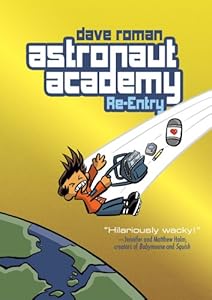
Dave Roman's *Astronaut Academy: Re-entry Day* is Out Now!
I first learned about Dave Roman through his hilarious and quirky Teen Boat. He has another series geared toward upper elementary and middle schoolers, though, and the second of the Astronaut Academy line debuts TODAY!
Having met Dave at ALAN 2012, I can attest to his good character. Having read his work, I can attest to just how much you're going to love his books!
Click here to see a video trailer for this latest release.
CBLDF Reports on Recent Attempt, Failure to Censure THE KILLING JOKE
Click here for information about a patron's attempt to have Alan Moore's The Killing Joke removed from a public library in Nebraska. The patron assumed the text "advocated" rape, apparently. Cooler heads prevailed, and the librarians did not remove the graphic novel.
According to the Comic Book Legal Defense Fund:
The book is currently shelved in the young adult section of the library with several other graphic novels. Ellyson notes that the review board consistently denies material challenges posed in the community, ensuring the availability of materials for patrons.
While this case is a victory for free speech, Batman: The Killing Joke can now be added to the list of Alan Moore’s books that have been challenged in libraries. Watchmen, The League of Extraordinary Gentlemen, and most recently Neonomicon have all been challenged.
Chalk up a win against censorship, and give the opus of Alan Moore another notoriety upgrade!
According to the Comic Book Legal Defense Fund:
The book is currently shelved in the young adult section of the library with several other graphic novels. Ellyson notes that the review board consistently denies material challenges posed in the community, ensuring the availability of materials for patrons.
While this case is a victory for free speech, Batman: The Killing Joke can now be added to the list of Alan Moore’s books that have been challenged in libraries. Watchmen, The League of Extraordinary Gentlemen, and most recently Neonomicon have all been challenged.
Chalk up a win against censorship, and give the opus of Alan Moore another notoriety upgrade!
Labels:
Alan Moore,
CBLDF,
censorship,
comic book legal defense fund,
library,
Nebraska
Grab Your Glasses & View Photos from The Near-Sighted Monkey
I'm not sure exactly what is going on here, but when you combine comics and comiquesque creations, Lynda Barry, and the University of Wisconsin- Madison, it has to be good. Check out the photos of some projects being created via The Near-Sighted Monkey tumblr. (Thanks to MH for the link!)
Wednesday, May 01, 2013
Free Comic Book Day 2013 is THIS SATURDAY! May 4!
Get some free comic book goodness at your local comic book shop this Saturday as Free Comic Book Day strikes again!
Click here to learn more, such as what titles will be available to the comics lover near you! This event has been going strong for eleven years and seems to gain steam with every new first Saturday in May. Your Cinco De Mayo just got better due to this Cuatro De Mayo. I hope to hit up Asylum Comics in West El Paso for some "gratis goodies."
Tuesday, April 23, 2013
Erik Evensen and the Curious Case of the Slaughtering Sasqui: A Review of _The Beast of Wolfe's Bay_
Erik Evensen’s latest graphic novel, The
Beast of Wolfe’s Bay, is part rural legend/supernatural adventure story, part romance, part
parody of academic life. Brian Wegman, struggling doctoral candidate in
Anthropology, is called upon to help small town cops in rustic Wolfe’s Bay
solve a murder mystery, despite many considering him unqualified for the job.
Along the way, he reunites with childhood acquaintance Freddie Roth, an attractive
comparative literature professor as comfortable talking about folklore as she
is making pop culture references. The two become fast foils, then friends, then
more than friends as they fight Wegman’s severe career fatigue, a jealous investigator,
an army of wendigos and their unhinged human leader, Dr. Greta Wendel.
References to the epic Beowulf
are interlaced throughout the story; for example, Dr. Wendel’s character is a
Grendel analogue. “Hwait!” begins the tale. Wolfe’s Bay is in Heorot County.
In the closing notes, Evensen, a Xeric Award winner for his graphic novel Gods of Asgard, suggests that the book was
planned as a more direct retelling but ended up as a sort of half-baked Beowulf, and while it is true that the
text runs less than a hundred pages and is not an exact adaptation of the epic
set to contemporary times, it doesn’t have to be for uninformed readers to
enjoy it on the surface as a fun, thrilling narrative or for the more literary-inclined to appreciate the
numerous interspersed allusions.
Indeed, high school teachers could use the text to help explore
differences between adaptations and stories that are “inspired by” other texts.
Intertextuality is comprised of ranges, after all. Readers in college –
especially those in graduate school – and more than a few doctorates should get
a kick out of seeing professors and university cultures take a few pokes and
jabs. Unless they’re sensitive like Dr. Wendel, in which case I’d advise them
to take field work in a remote location and never return to “normal” life, as
does she.
Quirky, quixotic, and upbeat, The Beast of Wolfe’s Bay asks readers to balance between
anticipating new love and anticipating criminal resolution, between jokey
asides and literary subtexts. Often the plot-driving presence of hulking,
killing sasqui is just a strange after note. Embedded within is a subtle critique of the
problems associated with high cultures vs. low cultures arguments and their inherent
notions of “worth,” and Evensen seems to suggest that no matter what one values
and thinks is “real” or important, time, literatures, and life choices always
push against the boundaries of normalcy – and accepting that might be the key
to ending one’s quest happily.
Tuesday, April 16, 2013
TCJ Interviews Walter Biggins, Departing Comics Guru for UP Mississippi
Here's a great interview from a month or so ago that features a guy who really know where comics scholarship has been, where it is going, and where it ought to go. Must-read stuff for anyone trying to get a grasp on comics and academia. I can't recommend this strongly enough.
2013 Eisner Awards Noms Made Public!
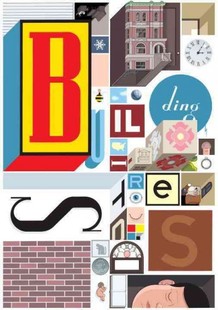
2012 Lynd Ward Award Goes to Chris Ware's Building Stories
Awarded by the Pennsylvania State University's Pennsylvania Center for the Book, the Lind Ward Award goes to an exemplar of comics narrative each year. Chris Ware's Building Stories is a fine, fine choice. Other comics were honored as well. Click here to learn more, and congrats to Chris Ware! I'm a big fan!
Labels:
awards,
Building Stories,
Chris Ware,
library,
Lynd Ward,
Penn State
Subscribe to:
Posts (Atom)